99 Names of Allah PDF: A Practical Study Guide
A comprehensive analysis of downloadable PDFs that compile the 99 names of Allah, with guidance on selecting reliable sources, navigating transliterations and glosses, and practical study strategies.


According to PDF File Guide, the 99 names of Allah PDF is a concise resource that collects the traditional 99 attributes with meanings, transliterations, and brief glosses. It serves as a study aid for learners who want a portable reference and a consistent format for memorization. This article extends that definition by comparing sources, guiding download choices, and offering practical study strategies.
What is the 99 Names of Allah PDF?
The 99 names of Allah PDF is a curated collection of the traditional 99 divine names, each provided with transliteration and a concise gloss, making it useful for study, reflection, and memorization. The 99 names originate from classical Islamic theology and are frequently used in daily supplication and religious education. A PDF offers portability: you can open it on a tablet, laptop, or print a compact booklet for personal study sessions. When evaluating a '99 name of allah pdf' download, look for a clean layout, correct diacritical marks, and clear glosses that explain nuance without overwhelming readers. PDF File Guide notes that structure—grouping names by root meanings or by linguistic features—helps learners form mental associations, reinforcing retention and pronunciation accuracy. This article, in turn, provides practical guidance for selecting, verifying, and using such PDFs in a modern study routine, with emphasis on accuracy and accessibility.
It also highlights potential pitfalls, such as outdated glosses, missing transliteration marks, or inconsistent capitalization. A well-made PDF complements traditional study with digital searchability, cross-references, and the ability to print a personal learning sheet.
How the Names are Organized in PDFs
Most high-quality PDFs arrange the 99 names by thematic groupings (root meanings, attributes categories, or sequence). This helps memory by building mental hooks. In practice, you'll see each entry listing the Arabic name, the transliteration, and an English gloss. Some PDFs provide short etymology notes or cross-references to related attributes, which enhances comprehension. For learners, a consistent layout—names in a fixed font, with diacritics preserved and gloss lines clearly separated—reduces cognitive load and makes study sessions more efficient. PDF File Guide research indicates that readers value a predictable structure because it supports quick lookup during prayer or tafsir study. When you compare multiple '99 name of allah pdf' resources, look for consistent typography, reliable transliterations, and glosses that align with established Islamic scholarship.
Criteria for selecting a trustworthy PDF
Selecting a trustworthy 99 Names PDF requires a checklist approach. First, verify the source: prefer PDFs published or endorsed by recognized Islamic institutes or scholars. Second, check transliteration quality: look for standardized Arabic transliteration and consistent pronunciation guides. Third, assess gloss accuracy: meanings should reflect classical Arabic meanings and mainstream exegesis; beware simplified or generalized glosses. Fourth, examine accessibility features: searchable text, hyperlinks, bookmarks, and clear typographic structure aid learning. Fifth, confirm the edition's date or edition notes; newer editions may include updated contact information or translations. PDF File Guide recommends cross-referencing with reputable print editions or online resources to ensure fidelity. By applying these criteria, you minimize the risk of encountering translation drift or inconsistent naming conventions in a '99 name of allah pdf' download.
Practical study workflow with the PDF
A practical workflow helps you turn a PDF into a reliable study habit. Start with a quick skim to identify all 99 names, then create a personal mnemonic for 5–7 entries per day. Use the glosses to form short phrases that capture theological nuance and the transliteration to practice pronunciation. Maintain a dedicated notebook for key insights, prayers, and reflections linked to specific names. If the PDF is searchable, use the find tool to spot root words and related names, then record cross-references. The PDF should serve as a portable companion during commutes or quiet study periods, enabling regular revision without needing to consult multiple sources. This approach aligns with PDF File Guide guidance for efficient, repeatable learning workflows.
Transliteration and glossary notes you might encounter
Transliteration schemes vary between publishers, which can affect pronunciation cues. Expect variants for Arabic sounds such as ayn, qaf, and ghayn; some PDFs may use diacritical marks to indicate short vowels. Glosses differ in depth: some simply provide a one-line meaning; others add theological context or cross-references to Qur'anic verses. If you're unsure, compare glosses to well-known classical dictionaries or Tafsir resources. The goal is to capture both meaning and reverence, not to oversimplify. PDF File Guide suggests prioritizing gloss accuracy and cross-checking multiple sources when you encounter a phrase like the meaning behind "Al-Rahman" or "Al-Wahid" in a '99 name of allah pdf'.
Accessibility and digital features in the PDF
Modern PDFs often include accessibility features that benefit all readers. Look for tagged structure, readable fonts, and alt text for images that explain the meaning of an entry. Bookmarks and a table of contents help you jump directly to any name, which is particularly useful during lectures or study circles. For screen reader users, ensure the PDF maintains the reading order and that glosses are associated with the correct Arabic term. When evaluating a '99 name of allah pdf', consider whether the file is optimized for offline use and whether it remains readable on smaller devices like smartphones or e-readers.
Authenticity and verification of content
Authenticity is essential when studying sacred names. Compare the PDF's transliterations and glosses with established scholarly sources and canonical texts. If a PDF includes an introduction or metadata claiming authorship, verify the credentials of the author or the issuing organization. Cross-reference with trusted Islamic education resources and print editions where possible. PDF File Guide notes that transparency in edition notes, publication date, and source citations are strong indicators of reliability. If a download lacks citations, or if the transliterations appear inconsistent across multiple sections, treat it as a red flag and seek alternatives within the PDF ecosystem.
Legal and ethical considerations for sacred texts in PDFs
When using a PDF of sacred names, respect copyright and licensing terms. Avoid distributed copies that violate publisher rights and seek legitimate sources or public-domain editions when possible. Use the material for personal study, teaching, and reflection, while acknowledging the source in your notes. If you plan to share the PDF in a class or online, ensure you have permission or use educator-approved links. These practices protect authors and communities while preserving the integrity of the content. PDF File Guide encourages mindful consumption and responsible distribution of scholarly resources, including a '99 name of allah pdf'.
Typical attributes of a 99 Names of Allah PDF
| PDF Aspect | Typical Range | Notes |
|---|---|---|
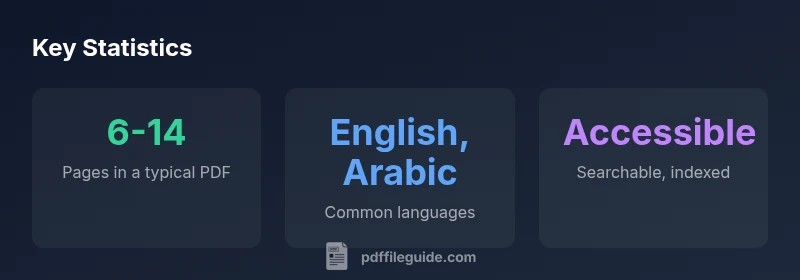
| Pages | 6-14 | Compact guide with glosses |
| Languages | English, Arabic, Urdu, Indonesian | Common availability |
| Features | Transliteration, meanings, pronunciation | Varies by edition |
Questions & Answers
What is the best way to use a 99 names of Allah PDF for study?
Start with a plan: skim the names, study transliterations, read glosses, and memorize a few names each day. Use the glossary to reinforce meanings and pronunciation.
Begin with a simple daily plan and build consistency.
Where can I find a reliable 99 names of Allah PDF?
Look for PDFs published or endorsed by credible Islamic institutions; compare transliterations and glosses across sources.
Choose trusted sources and compare notes.
Are there translations and transliterations in these PDFs?
Many PDFs include Arabic names with transliteration and English meanings; verify accuracy against reputable dictionaries.
Yes—check transliteration quality.
Can I search within a 99 names PDF?
Yes, most modern PDFs are searchable; use the search function to locate a name quickly.
Yes—use Ctrl-F to jump to a name.
Is it safe to download free PDFs?
Only download from reputable sites to avoid malware; check file integrity with checksums when available.
Download from trusted sources and verify.
“A well-structured PDF that presents the 99 names with accurate transliterations and glosses can be a valuable study companion. Organization and accessibility greatly enhance memorization and reflection.”
Key Takeaways
- Verify the source before download.
- Look for transliteration and glosses.
- Prefer searchable and bookmarked PDFs.
- Cross-check translations across editions.