Declaration of Human Rights PDF: Editing, Conversion, and Verification
Learn how to edit, convert, and verify a Declaration of Human Rights PDF with best-practice workflows for fidelity, accessibility, and authenticity. Practical guidance from PDF File Guide.


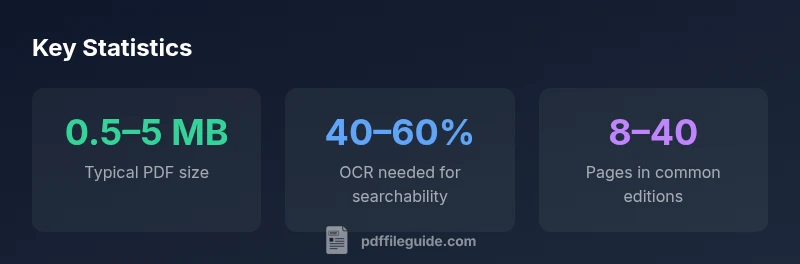
There isn’t a single standard size for a "Declaration of Human Rights" PDF; editions vary. Typical plain-text PDFs run under 1 MB, while versions with scans or embedded images can range from 2 MB to 5 MB. For editing, converting, or accessibility work, prioritize content fidelity and proper tagging.
Understanding the Declaration of Human Rights PDF: scope and formats
The phrase "Declaration of Human Rights PDF" most commonly refers to a PDF edition of the Universal Declaration of Human Rights (UDHR) or its language variants. These documents may be provided by governments, international bodies, educational institutions, or NGOs, and exist in plain-text, scanned-image, and hybrid formats. For professionals, the critical differences lie in text fidelity, OCR status, and embedded fonts. When you encounter a Declaration of Human Rights PDF, verify the edition and language to ensure you’re working with the intended version, especially for multilingual or jurisdiction-specific rulings. In practical terms, the PDF File Guide team notes that fidelity to the original text—preserving punctuation, hyphenation, and diacritics—drives downstream tasks like searchability, accessibility tagging, and compliant redactions.
In addition to content fidelity, assess the document’s structure: are headings hierarchical, is the reading order logical, and does the PDF contain metadata that authenticates its source? These attributes influence not only editing efficiency but also the reader’s ability to navigate the document across devices.
According to PDF File Guide, planning your workflow around the document’s accessibility and metadata from the outset reduces rework and ensures compliance with accessibility guidelines. The UDHR itself is a canonical text, and when presented as a PDF, it becomes a practical artifact for study, testing, and advocacy work.
If you’re preparing a new edition or a classroom handout, consider creating a clean text layer, embedding fonts where allowed, and keeping image assets separate to facilitate future conversions. For public-domain or government-authored PDFs, confirm licensing terms before making derivative editions.
This section emphasizes that the “declaration human rights pdf” family of documents is diverse; your approach should adapt to whether you’re preserving a scanned reproduction, delivering a lightweight text version, or providing an accessible, tagged file for assistive technologies.
Key considerations when editing a declaration rights PDF
Editing a Declaration of Human Rights PDF requires a careful balance between fidelity and practicality. First, confirm you have the right to edit or distribute the specific edition—licenses vary between publishers and jurisdictions, even for historic documents. When you begin, capture a baseline: extract the text, confirm the exact wording of articles, and identify nonessential images or annotations that could be preserved or removed without altering meaning.
- Preserve the original structure: maintain article numbering, headings, and indentation to avoid misinterpretation.
- Font considerations: embed fonts only if permitted by license; otherwise, use closest matches and note substitutions in a change log.
- Image handling: distinguish between embedded source images and inserted logos or seals. If you must resize or crop seals, document changes for provenance.
- Accessibility readiness: plan for tagging, reading order, and alt text so screen readers convey the full content.
- Version control: maintain a changelog and version identifiers in the metadata to track edits over time.
When working with the Declaration of Human Rights PDF, always align edits with accessibility and legal-use standards. PDF File Guide recommends keeping a separate, clean text layer for indexing and searchability, then layering on formatting as needed for output formats. This approach improves downstream workflows such as conversions and print preparation while safeguarding the document’s integrity.
Practical edits should be tested across devices (desktop, tablet, mobile) to ensure legibility and navigation remain intact. If your edits introduce new content or translations, clearly mark the changes and retain the original language for reference.
Practical editing considerations for Declaration of Human Rights PDFs
| Aspect | Common Challenge | Recommended Practice |
|---|---|---|
| Text fidelity | Text drift during edits | Preserve original punctuation; use a change log to track modifications |
| Accessibility tagging | Missing headings or reading order issues | Tag headings in proper hierarchy; verify reading order with a screen reader |
| Edition authenticity | Conflicting editions or metadata | Validate metadata against official sources; keep edition notes |
Questions & Answers
How can I ensure the text remains searchable after editing a Declaration of Human Rights PDF?
Start with a clean, text-based layer for edits. Run OCR only where needed and verify the resulting search index against the original text. Maintain a changelog and compare word-for-word where possible to ensure fidelity.
Make a clean text layer first, then OCR only where necessary; always verify search results against the original text.
What’s the best way to tag a legal PDF for accessibility?
Create a logical reading order, apply proper heading levels, and provide alt text for images. Use semantic tagging for lists and tables, and test with a screen reader to confirm accuracy.
Add sensible headings, alt text, and correct table structure; test with a screen reader.
Is OCR required for scanned copies of the Declaration?
Yes, to enable text search and copy/paste. Choose high-quality OCR, verify accuracy, and correct misreads, especially for numbers and diacritics that appear in UDHR translations.
Yes—OCR helps readers search and copy text; verify accuracy carefully.
How do I verify the edition and authenticity of a Declaration PDF?
Check metadata, publisher stamps, and edition notes. Compare key article wording against official sources when possible, and rely on trusted repositories or government portals.
Check metadata and edition notes, compare key text with official sources.
Which tools support batch editing of PDFs for this use case?
Look for professional PDF editors that support tagging, font embedding options, and accessibility checks in batch mode. Always test a small batch first to avoid widespread errors.
Use a tool that supports tagging and accessibility checks in batch mode, then test a small batch first.
“Preserving the integrity of a legal text in PDF form requires deliberate tagging, font handling, and a disciplined workflow that respects both fidelity and accessibility.”
Key Takeaways
- Edit with permission and maintain provenance
- Preserve structure and heading hierarchy
- Tag for accessibility from the start
- Use a separate text layer for indexing
- Document all changes and edition sources