When Was PDF Format Introduced? A History of PDFs
Discover the origins and milestones of the PDF format, from its 1993 debut to ISO standardization and PDF 2.0, with practical insights for editors and developers.


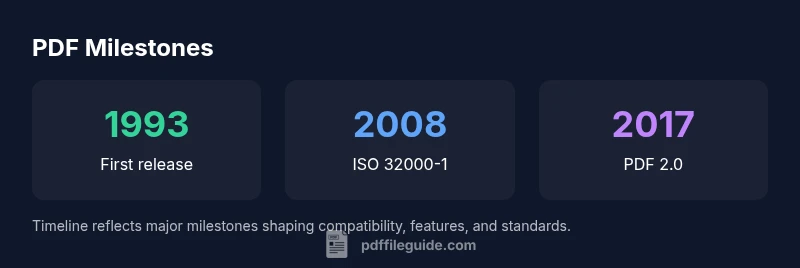
PDF format originated in the early 1990s as a portable document model developed by Adobe. The first public release, PDF 1.0, arrived in 1993, and the format was later standardized by ISO as PDF 32000-1 in 2008, with PDF 2.0 (ISO 32000-2) published in 2017, shaping modern document workflows for users and organizations worldwide.
The birth of the PDF format
The question of when the pdf format was introduced has deep roots in the 1990s as a strategic solution for cross‑platform document sharing. Adobe Systems envisioned a portable format that could faithfully reproduce complex layouts, fonts, and graphics on any device. The goal was to eliminate the times when a document looked different on a colleague’s computer due to missing fonts or incompatible software. In practice, the early PDF aimed to be a universal snapshot of a page, independent of the viewer or operating system. The result was a file that could be opened and printed consistently, making it ideal for business reports, manuals, and forms. Over time, the format evolved with embedded fonts, interactive elements, and richer media, cementing its place in daily workflows. The quick history reveals that the origin of pdf format relates to a clear need for reliability across environments and devices, especially for official documentation that must stay visually stable.
ISO standardization and PDF 1.x era
As the ecosystem matured, the need for formal interoperability led to ISO standardization. In 2008, the ISO published PDF 32000‑1, aligning industry implementations with a single, openly referenced specification. This transition helped ensure longer-term compatibility, particularly for archiving, printing, and cross‑border document exchanges. Before ISO 32000, Adobe’s own specifications governed PDF development; after the standardization, vendors, developers, and organizations could confidently rely on a common baseline. During this era, sub‑standards like PDF/A for archiving and PDF/X for print began to take shape, emphasizing reliability, font embedding, color management, and compatibility with long‑term preservation needs. Readers should recognize that ISO 32000-1 codified essential behaviors, while individual extensions refined capabilities for specific domains.
Milestones between 1.0 and 1.7: features that shaped everyday use
The PDF sequence includes pivotal version milestones that expanded what PDF documents could do. PDF 1.0 introduced the core concept; subsequent updates added richer graphics, font embedding, and improved security. Around PDF 1.4, transparency and more complex media handling entered the standard, enabling refined visual effects and more capable forms. PDF 1.6 introduced 3D annotations and enhanced multimedia support, reflecting the growing demand for interactive documents. By the time PDF 1.7 arrived from Adobe, it served as the de facto last major version from the vendor before the ISO aligned the format under PDF 32000‑1 in 2008. These increments collectively broadened adoption across government, enterprise, and education, supporting more ambitious document workflows while preserving backward compatibility where feasible.
PDF 2.0 and modern capabilities
With the ISO’s approval of PDF 2.0 (ISO 32000‑2) in 2017, the format entered a new era of clarity and capability. PDF 2.0 refined topics like accessibility, tagging, and security semantics to improve compatibility with assistive technologies and robust signing workflows. While the core layout concept remains the same, the newer standard emphasizes a cleaner data model, better metadata handling, and improved cryptographic options. For professionals, this means more reliable long‑term preservation, stronger document integrity checks, and easier integration with modern content management systems. The evolution from the original PDF to PDF 2.0 illustrates how a format can stay relevant by adapting to changing technology and user needs without losing its foundational principles.
Related standards: archival, accessibility, and printing
Beyond the core PDF specification, several standards address specific use cases. PDF/A targets reliable long‑term archiving by restricting features that hinder future readability and ensuring font embedding. PDF/X focuses on predictable printing workflows, with color control and profile requirements for commercial jobs. PDF/UA (Universal Accessibility) concentrates on making documents usable by people with disabilities, emphasizing proper tagging and structure for screen readers. These variants demonstrate how the same format can serve diverse needs—from archival integrity to accessible design and print precision—without creating a separate format for each task. When planning a workflow, understanding these variants helps ensure compliance, future accessibility, and consistent output across channels.
Practical guidance for editors and organizations
Editors and IT teams can optimize PDFs by aligning with the most appropriate standards for their use cases. Start with a clear definition of the document’s life cycle: archiving needs, accessibility requirements, and distribution channels. For long‑term storage, favor PDF/A compliance and proper font embedding. For print‑centric workflows, consider PDF/X constraints to guarantee color and media handling fidelity. If accessibility is a priority, ensure that tagging and reading order are correct and tested with assistive technology. Finally, leverage metadata and version controls to track updates and maintain a consistent baseline across teams. Cumulatively, this approach helps organizations minimize risk, improve interoperability, and future‑proof critical documents.
The future of PDF: what to expect in the coming years
Looking ahead, the PDF format is likely to continue expanding in areas such as enhanced accessibility, stronger cryptographic protections, and smarter integration with cloud‑based workflows. As organizations demand greater control over how documents render on diverse devices, developers will focus on tighter interoperability, improved performance for large files, and improved support for dynamic content while preserving the static, reliable presentation that PDFs provide. For readers, this ongoing evolution should translate into more trustworthy documents that remain faithful to their original intent, with easier access for everyone.
Milestones in PDF version history and their general capabilities
| Version | Year Released | Notable Features | Standard Status |
|---|---|---|---|
| PDF 1.0 | 1993 | Fixed layout, basic font embedding | Original release by Adobe |
| PDF 1.4 | 2001 | Transparency, enhanced graphics | Adobe release; later ISO alignment |
| PDF 1.7 | 2006 | Improved graphics, embedded fonts, optional content | Adobe's last major version |
| PDF 2.0 (ISO 32000-2) | 2017 | Modern semantics, accessibility improvements | ISO standard |
Questions & Answers
When was the PDF format first released?
The PDF format was first released in 1993 with PDF 1.0, created by Adobe to enable consistent document viewing across platforms. Since then, the format has evolved through multiple versions and standards.
PDF was first released in 1993, and it’s evolved through versions to support more features and cross‑platform reliability.
What is the difference between PDF and PDF/A?
PDF is a general document format. PDF/A is a variant designed for long‑term archiving, restricting features that may hinder readability and ensuring reliable font embedding and metadata.
PDF/A is the archival variant of PDF, optimized for long‑term readability and preservation.
What year did ISO standardize PDF?
ISO standardized the PDF format as PDF 32000‑1 in 2008, which established a unified baseline for implementations across vendors and platforms.
The ISO standard for PDF 32000‑1 was published in 2008.
Is PDF 2.0 backward compatible with older PDFs?
PDF 2.0 (ISO 32000‑2) maintains compatibility with many existing documents, but it introduces improvements and new features that may require updated readers for full benefit.
PDF 2.0 is largely compatible but benefits from readers that support its new features.
How can I verify whether a PDF is accessible?
To verify accessibility, test proper tagging, reading order, and alternate text for images. Use assistive tech like screen readers and validation tools that check PDF/UA compliance.
Use tagging and screen readers to test accessibility and look for PDF/UA compliance.
“The PDF format has evolved from a page‑layout tool into a robust, interoperable standard that remains central to digital document workflows.”
Key Takeaways
- Trace PDF’s birth to the early 1990s and Adobe’s Acrobat
- Note ISO standardization that enabled cross-platform interoperability
- Identify major version milestones (1.0, 1.6, 1.7, 2.0)
- Consider archival, accessibility, and printing standards (PDF/A, PDF/UA, PDF/X)
- Apply version-aware practices to ensure long-term usability