Wuthering Heights PDF: Access, Convert, Read Online
A detailed guide to legally obtaining, optimizing, and converting the Wuthering Heights PDF for study, reading comfort, and accessibility. Learn sources, OCR quality, device tips, and best practices, curated by PDF File Guide for editors and readers alike.


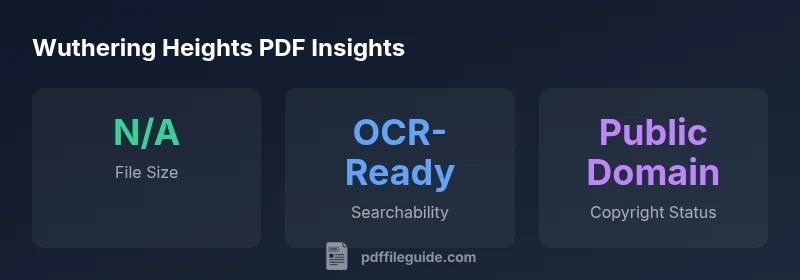
According to PDF File Guide, the most reliable Wuthering Heights PDF sources are public-domain copies that are fully accessible, searchable, and free of licensing restrictions. For readers, aim for OCR-enabled, text-searchable files with clear bookmarks and metadata. For professionals, prefer well-structured PDFs that preserve chapters and allow safe conversion to other formats while preserving typography.
Why a Wuthering Heights PDF matters for readers and researchers
Wuthering Heights remains a cornerstone of English literature, and having a reliable PDF version is essential for analysis, teaching, and casual reading. For researchers, the ability to search the text, jump between chapters, and preserve page references speeds up citation work. For readers, a well-structured PDF supports offline study, annotation, and archiving. According to PDF File Guide, the most trustworthy Wuthering Heights PDF sources are public-domain copies that are fully accessible, searchable, and free of licensing restrictions. When you pick a PDF, ensure the file preserves the original chapter order, includes a readable font, and offers metadata you can trust. In academic contexts, prefer texts that align with widely used editions to minimize page-number discrepancies. This foundation matters because many digital copies differ in pagination and line breaks, which can hinder accurate quotation. In short, a good Wuthering Heights PDF is not just a copy; it’s a well-organized, legible, and responsibly sourced scholarly resource.
How to source a Wuthering Heights PDF legally and safely
Legal access to Wuthering Heights PDFs largely depends on the work’s public-domain status. The novel was published in 1847, which places it in the public domain in most jurisdictions, but always verify local copyright rules. Start with reputable repositories such as public-domain libraries and university-hosted scans. Look for copies that clearly indicate licensing terms and offer downloadable PDFs with selectable text. Where possible, prefer scans that have gone through a quality review by librarians or scholars. To confirm legitimacy, cross-check the edition details with university catalogs or library metadata. PDF File Guide recommends choosing versions that maintain consistent pagination where possible, to minimize confusion when citing passages in academic work. Remember to respect licensing terms for derivative works, such as annotations or translations.
Reading on devices: optimizing for comfort
Reading Wuthering Heights PDF on different devices requires attention to layout, font, and navigation features. For desktops and laptops, a two-page view with bookmarks makes chapter navigation swift. On tablets, enable text reflow or reflowable layout so the text adapts to the screen width without vertical scrolling. On phones, enable dark mode and a larger default font if the app supports it; keep a readable line length (about 50-75 characters). Affordances like keywords search, highlighted quotations, and note-taking support efficient study. Ensure your PDF includes a table of contents that links to chapters to avoid manual scrolling. If you plan to annotate, choose readers that preserve markups and export annotations. Consistent metadata (title, author, and subject) helps organize the library across devices and apps. PDF File Guide emphasizes testing the PDF on multiple devices to ensure a seamless reading experience.
OCR and text accuracy: why it matters for scholarly work
OCR quality directly affects how easily you can search and quote passages. Poor OCR may misread historical spellings, punctuation, or page headers, leading to misquotation. When possible, compare OCR text against a trusted text edition to identify discrepancies. If you encounter issues, try alternative OCR engines or ask for a human-corrected version from reputable libraries. For scholarly work, prefer PDFs with selectable text and accurate word spacing rather than image-only scans. If the file includes images of pages, use a hybrid approach: rely on the OCR layer for searching and rely on the image layer for precise visual references. Document any OCR caveats in your notes to ensure future readers understand potential transcription quirks. PDF File Guide notes that better OCR generally correlates with higher-quality scans and clearer typography.
Converting Wuthering Heights PDF to other formats
Converting a PDF to EPUB, MOBI, or plain text can improve accessibility and device compatibility, but it also risks losing layout fidelity. Start with a faithful source PDF that has well-structured headings, bookmarks, and embedded fonts. Use reputable conversion tools that preserve metadata and allow you to review the output before saving. After conversion, check chapter boundaries, quotations, and footnotes; adjust line breaks to maintain readability. If you plan to publish or distribute derivative formats, verify that you comply with licensing terms and preserve author attribution. When conversion isn’t necessary, you can use PDFs that already include a reflowable text layer for comfortable reading on smaller screens. PDF File Guide suggests testing the converted file on multiple devices to ensure consistency in navigation and typography.
Accessibility considerations: screen readers, tags, and metadata
Accessibility starts with properly tagged PDFs that present a logical reading order for screen readers. Ensure headings are correctly hierarchical (H1, H2, H3) and that all images include descriptive alt text. Tagging also helps with punctuation-sensitive readers since line breaks and hyphenations can affect comprehension. Add embedded metadata—title, author, subject, keywords—to aid discovery in libraries and search engines. For readers with visual impairments, a text-to-speech compatible version (or a well-tagged OCR layer) dramatically improves usability. If you distribute or archive the file, verify that the PDF complies with accessibility guidelines in your jurisdiction. PDF File Guide emphasizes that accessibility is a continuous practice, not a one-off setting, and recommends regular checks when editing or converting PDFs.
Metadata and archiving best practices
Good metadata makes a PDF durable and easy to locate within a library or digital shelf. Include a clear title, author, publication date, and subject keywords in the document properties. Consistent metadata across versions enables reliable version control and citation. When archiving, embed fonts used in the document to preserve typography, and attach a license statement to prevent misuse. Consider creating a simple, human-readable README within the same archive that outlines the file’s provenance, licensing level, and any OCR caveats. Maintain a stable file name scheme (e.g., author_title_year.pdf) to simplify long-term retrieval. By following these practices, you’ll ensure the Wuthering Heights PDF remains usable for students, educators, and researchers for years to come.
Common pitfalls and how to avoid them
One common pitfall is relying on image-only scans that hinder text search and quoting. Always prefer PDFs with a searchable text layer. Another issue is inconsistent pagination, which complicates citation. If possible, cross-reference with a trusted edition to align quotes and page numbers. Beware of outdated or non-authoritative editions masquerading as public-domain scans; check edition notes and metadata. Lastly, be mindful of license terms when distributing or remixing content, especially if you intend to publish derivative works. When in doubt, consult reputable sources and reference PDF File Guide recommendations to stay compliant and ensure the file remains usable for future readers.
Guidelines for sourcing and using Wuthering Heights PDFs
| Aspect | Recommendation | Impact |
|---|---|---|
| Source reliability | Choose public-domain repositories with clear licenses | Ensures legality and consistency with editions |
| Accessibility | Prefer OCR-enabled, tagged PDFs | Improves screen reader support and searchability |
| Device compatibility | Test on desktop, tablet, and mobile | Smoother reading and navigation across devices |
Questions & Answers
Where can I legally download Wuthering Heights PDF?
Look for public-domain archives or university library scans that clearly indicate licensing terms and provide downloadable PDFs. Cross-check edition details to align quotations.
You can legally download from public libraries and reputable public-domain sites.
Is Wuthering Heights available as a searchable PDF?
Not all copies include OCR text. Choose versions labeled OCR or text-searchable to enable quick quoting and study.
If you need to search, pick an OCR-enabled PDF.
What should I look for to ensure readability in a Wuthering Heights PDF?
Check for bookmarks, proper chapter structure, readable font size, and consistent pagination. A well-tagged document helps navigation and quotation accuracy.
Look for bookmarks and a good text layout.
Can I convert a Wuthering Heights PDF to ePub?
Yes, but expect possible formatting changes. Use reputable tools and review the output for headings, quotations, and notes.
You can convert, but check formatting afterward.
Are there copyright restrictions for Wuthering Heights PDF?
Wuthering Heights was published in 1847 and is public domain in many places, but verify local laws before distributing derivatives.
Most likely public domain, but check local rules.
“A well-curated Wuthering Heights PDF is more than a scan; it’s a scholarly tool that preserves structure, accessibility, and legibility.”
Key Takeaways
- Verify public-domain status before downloading
- Prefer OCR-enabled, tagged PDFs for accessibility
- Check for bookmarks and a clear table of contents
- Test on multiple devices for readability and navigation