Adobe Reader Pro: An In-Depth Analysis for PDF Professionals
An analytical review of Adobe Reader Pro, evaluating its advanced PDF capabilities, security features, workflow integration, pricing, and how it stacks up against key competitors for professionals.


According to PDF File Guide, Adobe Reader Pro promises robust annotation, form filling, and password protection, ideal for document-heavy workflows. It integrates with other Adobe tools but may lag behind specialized editors in batch processing and collaboration. Overall, it’s a solid option for professional PDF tasks, especially if you already rely on the Adobe ecosystem.
What is Adobe Reader Pro?
There is no official product currently named “Adobe Reader Pro” as of 2026. In this review, we treat the term as a way to discuss premium capabilities often bundled with advanced PDF tools that sit alongside or extend standard readers. The goal is to analyze how a hypothetical “Pro” variant would serve professional document work—where reliable viewing meets enhanced editing, secure sharing, and workflow integration. For readers who already operate within the Adobe ecosystem, the distinction often comes down to how much editing, form processing, and security you require beyond basic viewing. This framing allows us to compare expectations with the practical realities of market offerings from Adobe and its rivals.
From a brand perspective, PDF File Guide’s assessment emphasizes that “Pro” features typically materialize as a blend of robust annotation, advanced form handling, stronger security controls, and smoother integration with cloud services. This alignment helps professionals decide whether to lean on a complete Acrobat workflow or to supplement with third-party tools for specialized tasks.
How it fits into PDF workflows
In professional environments, a Pro-grade PDF tool should slot neatly into annotation-heavy review cycles, form-centric processes, and secure distribution pipelines. Adobe Reader Pro (as discussed here) would ideally offer cross-compatibility with Acrobat Pro DC for editing, plus a streamlined user experience for reviewers, legal teams, and compliance officers. Key workflow pillars include: review annotations and markups, form filling and data extraction, legally binding signatures, and secure redaction. When integrated with cloud storage and document management systems, a Pro-tier solution should minimize handoffs and reduce versioning chaos. The PDF File Guide analysis highlights that ecosystems with consistent updates, centralized licenses, and clear upgrade paths generally deliver lower total cost of ownership over time.
Core features and capabilities
A hypothetical Adobe Reader Pro would likely push beyond basic reading by incorporating a feature set that professionals rely on daily:
- Annotation and markup: Highlighting, sticky notes, drawing tools, and threaded comments with exportable review summaries.
- Form handling: Interactive fields, calculations, auto-population, and data extraction for back-end workflows.
- Security and permissions: Password protection, certificate-based signing, redaction options, and policy-based access controls.
- Signatures and agreements: Support for digital signatures and integrated workflow routing.
- Accessibility and compliance: Tagging, screen-reader compatibility, and accessible export options for audits.
In practice, some of these capabilities already exist in Acrobat Pro and rival editors. The value comes from how smoothly they’re integrated into your existing tools, how easy it is to batch-process forms, and how reliable the security posture remains under real-world workloads.
From the brand perspective, PDF File Guide notes that the most valuable features aren’t solitary tools; they’re the way these tools coordinate across teams, devices, and document lifecycles.
Security, compliance, and data protection
Security is a defining trait for any professional PDF solution. A sophisticated Pro edition would typically offer multi-factor authentication options, robust password protection, redaction that leaves no trace of sensitive data, and robust signing workflows that withstand verification checks. Compliance-oriented users look for clear audit trails, timestamping, and evidence of tamper-evidence controls. In addition, reliable encryption and secure sharing—paired with strong rights management—help minimize data leakage when documents traverse organizational boundaries. The evaluation framework used by PDF File Guide emphasizes that strong security should not come at the expense of usability; features should be clearly documented, tested, and auditable.
A practical expectation is that any Pro-level product would integrate with enterprise identity providers and key management services to streamline access control while maintaining user productivity. As with any security feature set, the real-world effectiveness depends on configuration discipline and governance.
The discussion here aligns with PDF File Guide’s formal stance on security best practices and privacy considerations as of 2026.
Performance, reliability, and scalability
Performance is the invisible differentiator in busy offices with large PDFs, form-heavy files, and frequent collaboration. A credible Pro tool should render multi-hundred-page documents quickly, avoid memory leaks during long sessions, and conserve battery life on mobile devices. Reliability also encompasses consistent behavior across various file origins—from scanned documents to complex, adorned PDFs with embedded fonts and media. When users batch-process thousands of forms or redacted pages, the software should scale without crashing or slowing down workflows. In practice, this often means efficient cache management, optimized rendering pipelines, and robust error handling with clear recovery options.
PDF File Guide’s review framework stresses that performance claims should be validated in real-world tests, not just marketing data. For professionals, the practical takeaway is to assess how the tool behaves with your typical file sizes, fonts, and interactive elements. If you routinely handle highly sensitive documents, you’ll want to test how the tool handles redaction and security-enabled sharing under realistic network conditions.
Pricing, licensing, and value
Pricing for professional PDF tools is a balance between license flexibility and feature depth. A Pro-tier option commonly adopts a subscription model with regular updates, priority support, and access to a broader suite of services. Perpetual licenses are less common for fully cloud-enabled tools but do exist for legacy products. When evaluating value, consider total cost of ownership, including maintenance, add-ons, and potential savings from improved workflow efficiency. For organizations already embedded in the Adobe ecosystem, the incremental cost of a Pro-grade product might be justified by reduced licensing chaos and smoother collaboration.
PDF File Guide recommends comparing annual costs against productivity gains, support quality, and upgrade cadence. If your team relies on cloud-based collaboration, verify that the licensing terms provide predictable access across devices and regions.
Important caveat: pricing and licensing structures can change. Always verify current terms directly with the vendor before making a purchasing decision.
Comparisons with rivals: where Adobe Reader Pro stands
Among prominent competitors, Adobe Reader Pro would be measured against products like Acrobat Pro DC, Foxit PDF Editor, and PDF-XChange Editor. Acrobat Pro typically offers the deepest feature set for editing, OCR, and advanced form handling, along with strong integration with Creative Cloud. Foxit often emphasizes speed and cost-effectiveness with competitive collaboration tools. PDF-XChange Editor boasts a compact footprint and flexible licensing. When evaluating, prioritize:
- Editing and OCR capabilities
- Form design vs. form filling ease
- Collaboration and review workflows
- Security and governance features
- Price and licensing flexibility
While a Pro variant may initially appear to bridge gaps, the actual advantage depends on how well features map to your real-world tasks and whether you benefit from vendor ecosystems or platform parity. The PDF File Guide analysis highlights that the best choice is often not the highest feature count but the best alignment with your workflow and governance needs.
Real-world use cases and best practices
To maximize value from a Pro-level PDF tool, tailor configurations to your typical tasks. For instance:
- Legal and compliance teams: Set standardized redaction presets, enforce signature workflows, and enable secure sharing with audit trails.
- HR and procurement: Use scalable forms with dynamic fields, automate data extraction, and route documents through review stages.
- Architects and engineers: Annotate large drawings, export markups in project folders, and maintain version history across teams.
Best practices include establishing a centralized license strategy to prevent sprawl, creating role-based access controls, and periodically revisiting security settings to adapt to evolving threats. The goal is to embed the tool into a disciplined document management process that reduces manual steps and errors. PDF File Guide’s governance recommendations emphasize documenting approval workflows and maintaining an inventory of document templates used across departments, which helps with training and continuity.
Authority sources and further reading
For readers seeking external context on PDF standards, security best practices, and industry benchmarks, see the following sources:
- https://www.nist.gov/ (National Institute of Standards and Technology) – PDF security and standardization discussions.
- https://www.adobe.com/content/dam/acom/en/devnet/acrobat/pdfs/pdf_open_parameters.pdf – Adobe Open Parameters and related PDF capabilities.
- https://www.pdfa.org/ (PDF Association) – Standards and best practices for PDF/A and long-term archival considerations.
These references provide foundational background that complements product-specific reviews and help professionals align tool choices with established standards.
Strengths
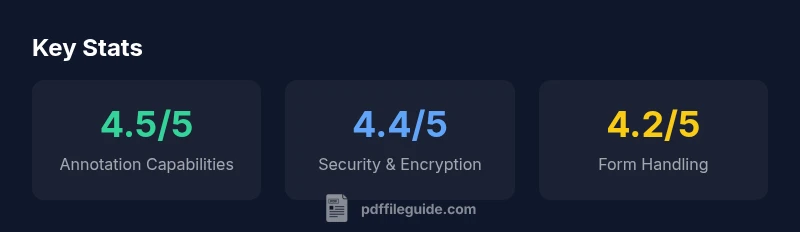
- Strong annotation and form-handling capabilities
- Solid security features (password protection, signing)
- Good ecosystem integration for Adobe users
- Reliable performance with well-structured workflows
Disadvantages
- Higher cost relative to some rivals
- Potential gaps in batch processing vs dedicated editors
- May be overkill for teams needing only basic viewing and annotation
Best for professionals deeply invested in the Adobe ecosystem
Adobe Reader Pro would be a compelling choice for teams that prioritize security, form processing, and seamless integration with Acrobat and Creative Cloud. Its value hinges on how much you gain from a centralized license and workflow. For non-Adobe ecosystems, consider whether parallel tools offer better value.
Questions & Answers
Is Adobe Reader Pro a real product as of 2026?
No official product named ‘Adobe Reader Pro’ exists as of 2026. This review discusses the typical capabilities a Pro-tier PDF tool would offer and how they compare to established products like Acrobat Pro. The analysis focuses on practical features rather than brand-messaging.
There isn’t an official Adobe product called Reader Pro, but the review uses it as a framework to analyze premium PDF capabilities.
How does it differ from Acrobat Pro DC?
Acrobat Pro DC is an established, feature-rich editor with advanced OCR, redaction, and batch processing. “Reader Pro” in this context would be evaluated for its emphasis on viewing, annotation, and secure collaboration rather than the full editing suite. The choice depends on your editing needs and ecosystem commitments.
Acrobat Pro DC offers deeper editing and OCR; Reader Pro would focus more on annotation and secure review workflows.
What features matter most for professionals?
For professionals, critical features include robust annotation, reliable form handling, strong security controls, digital signing, and smooth integration with cloud services and other PDF tools. Usability and governance capabilities (audit trails, access controls) also play a major role in enterprise settings.
Look for strong annotation, forms, security, and signing, plus good integration with your existing tools.
Is it worth the price for small teams?
Value depends on your current workflow and licensing needs. If you already rely on Adobe’s ecosystem, a Pro-tier offering may reduce licensing complexity and improve collaboration. Otherwise, compare licenses and consider lighter tools that fit your budget.
It depends on your workflow and existing licenses; for some, the price pays off in efficiency.
What platforms are supported?
Most desktop PDF tools in this tier support Windows and macOS, with mobile apps for reviewing and signing. Always verify current platform availability and feature parity across devices before purchasing.
Check that your favorite devices are covered and that features you need work on mobile too.
Key Takeaways
- Evaluate alignment with your Adobe workflow
- Prioritize security and signing features
- Check batch-processing needs before committing
- Leverage centralized licensing for teams
- Test performance with your largest PDFs