Frankenstein Mary Shelley PDF: Find, Edit, and Use
Learn how to safely locate, download, annotate, and convert the Frankenstein Mary Shelley PDF. This step-by-step guide from PDF File Guide helps readers manage public-domain texts for study, teaching, and accessible reading across devices.


In this guide you will learn how to locate, safely download, and work with a frankenstein book mary shelley pdf. The steps cover legal sources, how to verify authenticity, annotating for study, and converting formats for different devices. This approach helps readers and students access a public-domain classic while preserving quality and accessibility.
Understanding the Frankenstein book mary shelley pdf
For students, researchers, and casual readers, the Frankenstein book mary shelley pdf represents a convenient way to study Mary Shelley’s classic without physical copies. In 1818, Frankenstein was first published, and today the text is widely available in digital formats because the work is in the public domain. This means you can legally download and share a high-quality PDF edition, provided you respect the edition’s copyright notices when applicable. The reason many readers look for a frankenstein book mary shelley pdf is simplicity: you can search, annotate, and hyperlink passages, and you can adjust font size for comfortable studying. According to PDF File Guide, choosing a reliable PDF source reduces the risk of corrupted files or malicious downloads, especially when dealing with scans or OCR text. In this guide we’ll outline safe sources, best practices for reading, and practical steps to edit or convert the document for different devices.
The historical context of Frankenstein, written during the Romantic era, informs its themes of knowledge, responsibility, and the boundaries between creator and creation. When you open a frankenstein book mary shelley pdf, you’ll notice phrasing and annotations differ across editions due to OCR quality and editorial notes. Your goal is to pick a clean, legible edition and use tools that preserve the original text while enabling thoughtful study. This balance supports both academic rigor and accessible reading across devices and screen sizes.
Public domain status and licensing
Frankenstein, published in 1818, is widely regarded as public-domain text in many jurisdictions, including the United States. That public-domain status applies to the core story, but some modern editions or translations may include new introductions, annotations, or formatting that carry separate rights. When you search for a frankenstein book mary shelley pdf, pay attention to edition dates and copyright notices to avoid inadvertently using a restricted edition. PDF File Guide emphasizes that public-domain availability does not automatically guarantee quality; look for scans with clear typography and no invasive watermarks. If you intend to reuse the text for teaching or redistribution, confirm the specific licensing terms of the edition you download and stick to sources that clearly label public-domain status.
Public-domain handling also varies by country, so readers abroad should verify regional licensing if they plan to reuse the PDF in courses or online publications. In practice, a reliable frankenstein book mary shelley pdf will come from reputable archives or libraries rather than personal blogs. This reduces the risk of incomplete pages, mis-scanned passages, or missing chapters. The key is to maintain the integrity of the original narrative while enabling a smooth reading experience across devices and formats.
Safe, legitimate sources for frankenstein book mary shelley pdf
Finding a trustworthy frankenstein book mary shelley pdf is essential to avoid corrupted files or misleading editions. Start with established digital libraries and archives that host public-domain works. For example, the Internet Archive often preserves multiple historical editions of Frankenstein, allowing you to compare page layouts and typography. The Library of Congress offers scanned copies of early editions in its digital collection, which can be accessed for scholarly study. University repositories and reputable project archives also host public-domain texts with clean OCR or better-quality scans. When you search for frankenstein book mary shelley pdf, prefer sources that provide clear licensing statements and a provenance note describing the edition and scanning process. PDF File Guide notes that using verified sources improves search results and reduces the risk of malware or questionable OCR quality. In practice, a reliable frankenstein book mary shelley pdf will clearly indicate public-domain status and provide a straightforward download option. Always check the file size and page count to ensure you have a complete text.
To start, look for: a) a direct public-domain edition with notes removed or clearly labeled, b) a scan that preserves page numbers for cross-referencing, and c) an index or table of contents to orient your reading. If you cannot locate a clean copy from a major archive, consider a scanned edition hosted by a university library that includes a brief licensing note and a citation. These sources offer a dependable base for study and annotation.
Verifying authenticity and quality
After locating a frankenstein book mary shelley pdf from a trusted source, verify its authenticity and quality before investing time in annotation or conversion. Start by checking the file’s metadata and the publisher or archive host. A high-quality Frankenstein PDF should have legible typography, accurate line breaks, and a complete page sequence without missing sections. If you see obvious OCR errors (e.g., misread letters, broken hyphenations), use post-processing tools to clean the text or choose a different edition. Compare a few sample pages with a known edition to confirm alignment and pagination. When possible, download a small representative sample before grabbing the entire book mary shelley pdf. PDF File Guide recommends testing the file on multiple devices—desktop, tablet, and smartphone—to ensure the layout remains readable across screen sizes. Be mindful of file size; very large scans may indicate heavy image-based pages that can hinder searchability. If you encounter suspicious prompts or unusual file hosting, stop the download and revert to a verified archive.
In addition to authenticity, assess accessibility: does the PDF support search, text selection, and screen-reader compatibility? If a PDF is image-based, you may need OCR (optical character recognition) to enable text search. Some archives provide OCR’d versions; prefer those for study and annotation workflows. By focusing on these checks, you’ll save time and avoid working from a flawed or incomplete copy. The aim is a frankenstein book mary shelley pdf that yields reliable citations and smooth annotation.
Reading, annotation, and study workflows
A well-organized workflow for the frankenstein book mary shelley pdf can dramatically improve comprehension and retention. Begin by establishing a consistent reading view—adjust font size, margins, and background color to minimize eye strain. Use highlights to mark major themes (ambition, responsibility, creation) and create notes in a dedicated panel or margin. Many readers support color-coded annotation schemes; for example, yellow for motifs, blue for characters, and green for historical context. If you plan to quote passages in essays, enable precise page references or PDF bookmarks to cross-reference with published editions. For longer study sessions, create a study map that links chapters to themes, characters, and notable quotes. PDF File Guide reminds readers to maintain a clean, well-organized library of notes and highlights, so you can export your annotations when needed. Finally, consider exporting or printing a study packet that includes a chapter-by-chapter outline, key passages, and discussion questions. This approach keeps your analysis structured and ready for classroom discussion or publication.
If you use a dual-device setup, keep a synced copy in cloud storage so your annotations and highlights remain accessible across devices. A well-managed frankenstein book mary shelley pdf workflow saves time when preparing lectures, seminars, or papers, and supports deeper literary analysis.
Converting frankenstein book mary shelley pdf to other formats
Converting a frankenstein book mary shelley pdf to other formats, such as ePub or plain text, can improve reading on e-readers and mobile devices. Start by exporting to a reflowable format only if your PDF contains clean text (not just scanned images). If OCR has already produced searchable text, you can convert to ePub or MOBI without losing most chapter headings or index references. Be mindful of layout changes: poetry, long quotes, and italicized passages may require manual adjustment after conversion. For classroom use, consider exporting to text for easier quoting and indexing, or create a light-weight HTML version for web-based reading. When choosing a converter, select tools that preserve hyperlinks and footnotes, which are crucial for scholarly work. PDF File Guide recommends testing the resulting file on multiple devices (desktop, tablet, e-reader) to ensure readability and correct navigation. Keep a backup of the original PDF in case you need to revert to the unaltered text for citation checks or peer review.
In practice, a careful frankenstein book mary shelley pdf conversion preserves scholarly value while enabling easy distribution across devices and formats. If you encounter layout quirks, revisit the original PDF to adjust fonts, margins, or image scaling before finalizing the converted file.
Accessibility and device considerations
Reading a frankenstein book mary shelley pdf on different devices requires attention to accessibility features. On desktop and laptop screens, use screen-reader-friendly text with properly tagged headings and accessible annotations. On tablets and e-readers, consider font choices and line spacing to maximize readability. For visually impaired readers, ensure the PDF has OCR text that screen readers can navigate; avoid image-only pages unless they are accompanied by alternative text. When distributing to a class, provide a tagged PDF with proper heading structure and a simple table of contents. PDFs with embedded bookmarks are particularly helpful for quick navigation. If you plan to publish excerpts or quotes, confirm the excerpt length and licensing to avoid copyright issues. The end goal is a frankenstein book mary shelley pdf that remains readable and navigable across devices, while preserving the integrity of the original text and editorial notes.
Accessibility isn’t a one-size-fits-all feature; test on multiple devices and gather feedback from readers with different needs. A well-prepared PDF supports diverse readers and fosters inclusive study.
Best practices and common mistakes
To maximize the value of a frankenstein book mary shelley pdf, adopt best practices that promote accuracy, readability, and longevity. Always use reputable sources to prevent malware and ensure edition provenance. Maintain a consistent annotation strategy, and backup annotated copies in multiple locations. If you plan to distribute the PDF, respect license terms and provide proper citations. Common mistakes include downloading from questionable sites, assuming OCR is perfect, and neglecting to verify the edition against a trusted text. These can lead to misquotations or broken references. Another pitfall is attempting to convert a scanned image PDF without verifying text accuracy—OCR errors can undermine scholarly work. By sticking to quality sources, validating text, and using a structured workflow for annotation and conversion, you’ll protect the integrity of your study while making Frankenstein accessible to a broader audience. The goal is to empower readers to engage deeply with the text using a reliable frankenstein book mary shelley pdf workflow.
Authority sources
For deeper context on Frankenstein, Mary Shelley, and public-domain texts, consult authoritative references. The Library of Congress provides historical context and digitized editions (loc.gov). Britannica offers scholarly summaries of Mary Shelley’s life and the novel’s themes (britannica.com). The Internet Archive hosts multiple public-domain editions for comparison and study (archive.org). These sources help verify edition details, licensing, and historical significance, supporting rigorous research and safe downloading practices.
Tools & Materials
- Computer or tablet with internet access(For downloading, annotating, and converting PDFs)
- PDF reader/editor software(Examples: Adobe Acrobat Pro, Foxit, or open-source editors)
- Annotation tools (keyboard/mouse or stylus)(For highlighting, notes, and comments)
- Reliable browser with security features(Keep updated; avoid insecure extensions)
- Cloud storage or external drive(Backup edited files and originals)
- A source list for public-domain texts(Archive.org, LOC, or university repositories)
- Optional: e-reader device or app(For comfortable long-form reading on the go)
Steps
Estimated time: 45-60 minutes
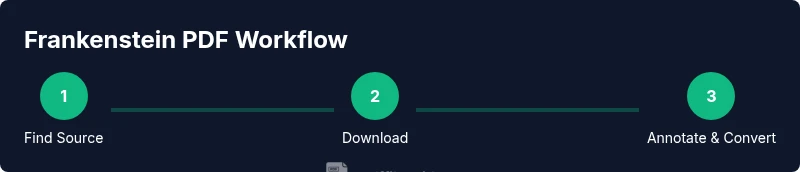
- 1
Find a legitimate frankenstein book mary shelley pdf
Search trusted archives or library catalogs for a public-domain edition. Check licensing notes and edition details before downloading to ensure you’re using a legal copy suitable for study.
Tip: Prefer sources that show publication year and edition notes to confirm public-domain status. - 2
Download the PDF from a verified source
Choose a direct download link from a reputable archive. Save a local copy and note the source URL for future reference. Verify the file size and page count against the catalog entry.
Tip: Avoid clicking random links; always verify the host domain. - 3
Open with a capable PDF reader/editor
Open the file in a reader that supports highlighting, note-taking, and text search. If the PDF is scanned, enable OCR-aware features or import it into an editor that can apply OCR.
Tip: Test searchability on 2-3 pages to confirm text is selectable. - 4
Annotate and organize your notes
Highlight key passages, add margin notes, and create a theme map linking chapters to motifs like responsibility and ambition. Use a consistent color scheme for quick reference.
Tip: Export annotations regularly in a readable format (PDF + notes). - 5
Convert to another format if needed
If you plan to read on an e-reader, export to a reflowable format (ePub or MOBI) and verify navigation. Ensure hyperlinks and notes transfer correctly.
Tip: Keep the original PDF intact; only save conversions as separate files. - 6
Back up and organize your files
Store copies of the original PDF, your annotated version, and any converted formats in a clearly named folder. Maintain a log of edits for scholarly use.
Tip: Use a standardized naming convention: Frankenstein_Mary_Shelley_2026_Annotated.pdf
Questions & Answers
Is Frankenstein in the public domain in 2026?
Frankenstein was first published in 1818 and is generally in the public domain in many jurisdictions, including the US. However, some modern edition notes or introductions may have separate rights. Always verify the licensing terms of the edition you download.
Frankenstein is generally public domain, but check edition notes for any added content that may have rights.
Where can I legally download a frankenstein book mary shelley pdf?
Look for public-domain copies on established archives like Internet Archive or national libraries. Library of Congress often hosts digitized editions. Avoid sketchy sites that bundle malware with downloads.
Use trusted archives like Internet Archive or the Library of Congress for safe, legal downloads.
What software can I use to annotate a Frankenstein PDF?
Many tools work well, including Adobe Acrobat, Foxit, and open-source readers. Choose one that supports highlights, note-taking, and exportable annotations.
Adobe Acrobat, Foxit, or open-source editors all can annotate PDFs.
Can I convert Frankenstein PDF to ePub for an e-reader?
Yes, if the PDF has selectable text. Use reputable conversion tools and verify that navigation remains intact after the conversion.
Converting to ePub works if the text is selectable; check navigation afterward.
What should I watch out for when downloading public-domain PDFs?
Be wary of non-authoritative sources, malware, and incomplete scans. Prefer well-known archives that provide licensing notes and full-page scans.
Avoid unknown sites; use trusted archives with licensing notes.
Watch Video
Key Takeaways
- Choose reputable sources for public-domain texts
- Annotate with a consistent scheme for clarity
- Back up both original and edited copies
- Test conversions across devices to ensure accessibility