PDF Conversion for Free: A Complete Guide
Learn how to convert documents to and from PDF for free using trusted online and offline tools. Practical steps, privacy tips, and best practices for safe, high-quality results.


You can convert documents to and from PDF without paying by using free online tools, desktop apps, and built-in features in your word processor. This guide shows legitimate, privacy-conscious options, plus steps to preserve formatting. You’ll learn which tools fit your needs and how to avoid hidden costs.
Why free PDF conversion matters
For many individuals and teams, pdf conversion for free is a practical way to share and archive documents without licensing costs. It opens opportunities for students, small businesses, and freelancers who need quick results. According to PDF File Guide, free conversion options can substantially cut project expenses while keeping formatting consistent across devices. The team also notes that privacy and data handling are common concerns when using online tools, so your choice should balance convenience with security. In 2026, a growing ecosystem of offline and online options makes free conversion accessible to most users, provided you select reputable services and understand the trade-offs between speed, quality, and safety.
This approach aligns with common workflows in offices that require quick turnarounds and easy distribution. By exploring both online and offline options, you can tailor a process that protects sensitive data while still delivering professional results. The PDF File Guide team emphasizes that starting with a clear file plan—knowing formats, fonts, and expected outputs—reduces surprises later in the workflow.
Top free tools for PDF conversion
There are several categories of free tools to choose from. Online converters are convenient for small, non-sensitive jobs, while offline desktop software and office-suite export features help protect privacy for confidential materials. Public-domain or open-source options can be useful for education and hobby projects. PDF File Guide analysis shows that offline tools are typically preferred for sensitive documents, but reputable online services can be suitable for non-confidential work. Always review terms, data handling policies, and upload limits before converting.
When selecting a tool, consider the input formats you deal with (Word, Excel, images, or webpages), the desired output (PDF or convert from PDF to another format), and any accessibility needs like embedding fonts for consistent viewing across devices.
How to convert from common formats (Word, Excel, images, and webpages)
Word to PDF: Use the built-in Export or Save as PDF option in your word processor to preserve layout and fonts. This is usually the quickest, most reliable route for text-heavy documents. Excel to PDF: Export each worksheet or the entire workbook as PDF, then organize pages for printing. Images to PDF: Batch images to a single PDF by arranging the order and setting image quality. Web pages to PDF: Use the browser’s Print dialog to “Save as PDF,” adjusting margins and header/footer options for clean results. Each method has its quirks, so test with a sample file first.
The key is to choose a path that balances convenience with privacy, and to verify that the output maintains critical elements like fonts, tables, and images.
Privacy, security, and permissions when using free tools
Free tools, especially online converters, can raise security concerns if you’re handling confidential data. Always start by understanding where your data is stored, whether files are retained on servers, and if you need to log in. Where possible, prefer offline or desktop-based tools for sensitive documents. Use private browsing modes if you must use an online service, and delete uploads as soon as you’ve verified the output. If you must upload, choose services with transparent privacy policies and a clear data retention schedule. For extra security, avoid converting documents containing personal identifiers or client data on public networks.
A practical 5-step workflow for a typical conversion
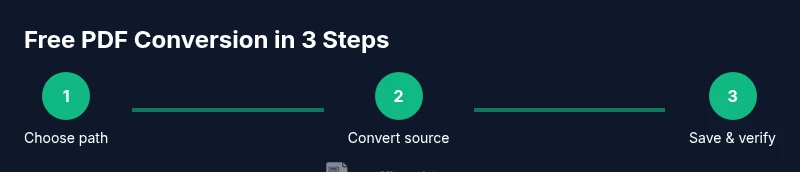
- Decide path: Choose offline (privacy-first) or online (speed-first) based on your document sensitivity. 2) Prepare file: Clean metadata, check fonts, and ensure images are optimized. 3) Pick tool: Select a trusted offline tool or reputable online converter. 4) Convert and review: Export or print to PDF, then verify layout, fonts, and links. 5) Save and back up: Name files clearly, store in a known folder, and create a backup. Waiting time is usually minutes for online services depending on file size.
Tip: Start with a small sample file to calibrate settings before converting large batches.
Troubleshooting common issues when using free tools
If fonts shift or layouts break after conversion, try embedding fonts or adjusting page size and margins before exporting. Image quality can degrade if compression is high; lower compression or increase resolution for important images. If color accuracy is critical, verify that color profiles are preserved. Large documents may fail on online services due to size limits; split into parts or use offline tools for heavy tasks. Always compare the final PDF against the source to catch missed elements.
Best practices for quality and accessibility when converting for free
Embed fonts when possible to preserve typography across devices. Use descriptive document structure (headings, lists) to aid screen readers in the PDF. If you plan to share with others, enable simple search and navigation via bookmarks. Keep document metadata clean to avoid exposing unnecessary information. Regularly update your tools to stay compatible with newer PDF standards and accessibility guidelines.
Quick pre-conversion checklist for smooth results
- Confirm input formats supported by your chosen tool. - Check available output options: page size, margins, and orientation. - Verify font embedding and image compression settings. - Review privacy policies if using online converters. - Run a test file to verify results before processing sensitive documents.
Keeping your PDF library organized and future-proof
Create a naming convention that includes version numbers and dates. Store source files and PDFs in clearly labeled folders with consistent hierarchy. Consider adding bookmarks and metadata to improve searchability. For long-term access, export key PDFs to final archival formats and keep backups in multiple locations.
Tools & Materials
- Web browser (Chrome, Edge, Firefox)(For online converters and accessing cloud storage.)
- Free online PDF converter service(Choose reputable providers; avoid uploading sensitive documents.)
- Office suite with Export/Save as PDF(Useful for Word/Excel/PowerPoint to PDF conversions.)
- PDF reader/viewer(Check output and accessibility after conversion.)
- Optional offline PDF printer or editor(Helps with offline workflows and batch tasks.)
Steps
Estimated time: 30-45 minutes
- 1
Choose conversion path
Decide whether you will convert online for speed or offline for privacy. This choice affects which tools you’ll use and how you handle sensitive data. Consider the document’s content and the need for sharing.
Tip: When handling confidential material, default to offline methods. - 2
Prepare your source file
Clean up the document: remove unnecessary metadata, ensure fonts are installed, and check that images are correctly arranged. A clean source reduces surprises after export.
Tip: Test a small sample file first to fine-tune settings. - 3
Select the appropriate tool
Open the target tool and choose the relevant export/print-to-PDF option. If using online tools, ensure you’re on a reputable site. If offline, adjust your export settings.
Tip: Embed fonts when you want consistent typography. - 4
Convert and review the result
Export or print to PDF and then review the output for font consistency, layout, links, and image quality. Check all pages, especially tables and figures.
Tip: Keep original files until you confirm the PDF matches expectations. - 5
Refine and retry if needed
If something looks off, re-export with adjusted margins, page size, or compression. A second pass often resolves most formatting issues.
Tip: Document changes and re-run until satisfied. - 6
Save, name, and back up
Save the final PDF with a clear, versioned name. Back up to a trusted location and consider adding metadata for future searchability.
Tip: Create a lightweight index of your PDFs for easy retrieval.
Questions & Answers
What is the best free method to convert a Word document to PDF?
For Word documents, using the built-in Export or Save as PDF feature is usually the most reliable and quickest method. It preserves layout and fonts without needing third-party tools. If you need additional formatting control, a reputable offline PDF tool can provide more options.
Use Word's built-in Export to PDF for a quick and reliable conversion.
Can I convert PDFs to Word or Excel for free?
Yes, you can convert PDFs back to Word or Excel using free desktop tools or reputable online services. Expect occasional formatting adjustments, especially with complex tables. Always review and correct layout after conversion.
Yes, free tools can convert PDFs back to Word or Excel, but check formatting afterward.
Are free online converters safe for sensitive documents?
Online converters can be convenient but pose privacy risks for sensitive documents. If you must use them, choose services with transparent privacy policies and avoid uploading personal data. Prefer offline tools for confidential material.
Online converters can be convenient, but be cautious with sensitive files.
How can I preserve fonts and layout during conversion?
Embedding fonts and selecting appropriate page size, margins, and orientation helps preserve fonts and layout. When possible, use export options designed for high fidelity rather than relying on print-to-PDF alone.
Embed fonts and set proper page options to keep layout intact.
What are common issues with free converters and how can I fix them?
Common issues include font substitution, image quality loss, and misaligned tables. Resolve by using embedded fonts, adjusting compression settings, and testing with multiple document sections before processing large batches.
Font and image issues are common; test and adjust settings to fix them.
Do I need to pay for higher-volume conversions?
Many free tools have limits on file size or conversion counts. For frequent, high-volume work, consider a paid plan or a desktop solution with no cloud dependencies to avoid throttling.
Free tools may limit usage; paid options exist for more volume.
Watch Video
Key Takeaways
- Master free PDF conversion by balancing online convenience with offline privacy
- Choose reliable tools and verify output quality
- Embed fonts and maintain document structure for accuracy
- Always protect sensitive documents and review privacy policies
- Organize PDFs with clear naming and metadata