Compare Documents PDFs: A Practical, Data-Driven Guide
A rigorous, data-driven comparison of desktop and online PDF tools for editing, converting, and annotating PDFs, featuring a detailed table and practical recommendations.


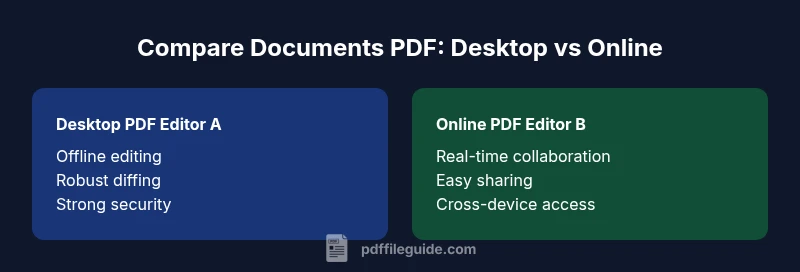
When you need to compare documents in PDF, Desktop PDF Editor A offers robust offline editing, precise diffing, and batch processing; Online Editor B prioritizes speed, ease of sharing, and collaboration. For heavy editing and security, choose Desktop; for rapid review and annotations on the fly, choose Online. This article explains why.
Why Accurate Document Comparison Matters
For professionals who work with PDFs daily, the ability to compare documents pdf matters for preserving edits, tracking changes, and maintaining formatting across versions. This is a core capability in editing and review workflows. According to PDF File Guide, understanding how different tools approach document comparison helps you avoid rework and ensure consistency across teams. The PDF File Guide Editorial Team highlights that choosing the right tool depends on your workflow, data sensitivity, and collaboration needs. This section lays the groundwork by defining what 'compare documents pdf' means in practice, and how to evaluate two mainstream approaches: desktop software and cloud-based services. The goal is to outline practical criteria you can apply immediately.
Core Criteria for Assessment
Effective comparison of PDFs hinges on several core criteria: accuracy of diffs, handling of graphics and typography, support for annotations, security and privacy controls, and the ability to export results in useful formats. You will want to examine how each tool preserves layout, whether it highlights differences clearly, and how it integrates with other workflows (version control, cloud storage, and collaboration). Consider your typical file sizes, whether you need batch processing, and if you require compliance features like PDF/A. In short, a robust comparison should map features to your daily tasks and risk profile.
Desktop vs Online PDF Editors: The Big Difference
Desktop editors tend to offer more powerful editing engines, offline reliability, and stronger batch-processing capabilities. Online editors excel in quick reviews, real-time collaboration, and cross-device access. When you run a compare document pdf task, the desktop option often provides granular controls—zoom-level fidelity, font-embedding checks, and precise page-layout diffs—while the online option emphasizes intuitive diff visuals, comments, and shareable links. The choice depends on whether your priority is deep, repeatable edits or rapid, collaborative feedback.
Feature-by-Feature Breakdown
To understand practical implications, here's a feature-by-feature comparison tailored to compare documents pdf workflows:
- Editing capabilities: Desktop tends to offer more robust text and image editing within the PDF canvas, while online editors focus on lightweight adjustments and markups.
- Diffing quality: Desktop products may render diffs with higher fidelity in complex layouts; online tools often prioritize text diffs for speed.
- Annotations and collaboration: Online editors shine with threaded comments, real-time co-authoring, and cloud sharing; desktop tools offer sophisticated annotation sets that can be exported.
- Security and compliance: Desktop solutions provide stronger data control on local machines; online solutions rely on cloud security models and data residency options.
- Conversion and export: Desktop apps usually support PDF/A exports and batch conversions; online tools offer instant exports with cross-platform compatibility.
- Performance: Desktop tools avoid network latency and can handle large files locally; online editors' performance depends on bandwidth and server loads.
Desktop vs Online PDF Editors: The Diff and Editing Reality
In practice, when you compare documents pdf, the desktop editor's diff mode will typically overlay edits with precise bounding boxes, allowing you to verify changes at the pixel level. The online editor's diff mode often highlights textual changes and offers comment threads to capture reviewer intent. If your team needs to document every modification for auditing or legal purposes, you may prefer a desktop workflow with exportable diff reports; for fast turnarounds, an online workflow with collaborative annotations can save minutes per file.
Security, Privacy, and Compliance Considerations
Security concerns are central to PDF collaboration. Desktop editors keep sensitive documents on local devices, reducing exposure to cloud-based data threats. Online tools can offer encryption in transit and at rest, but you should assess data residency policies, access controls, and audit logs. For regulated industries, confirm whether the tool supports PDF/A archiving, digital signatures, and immutable records. Always review the vendor's privacy policy and, when possible, conduct a risk assessment before enabling shared links or cloud storage.
Workflow Scenarios: When to Use Desktop vs Online
Consider these common scenarios:
- You are preparing a final version with extensive edits and need offline access: Desktop PDF Editor A is your best bet.
- You must gather rapid input from multiple stakeholders and share a link: Online PDF Editor B shines for collaboration.
- You need to combine edits from different contributors while preserving version history: A hybrid approach—edit offline, then review online—often yields the best results.
- You work with sensitive client data and must minimize cloud exposure: Favor desktop workflows with encrypted storage and controlled distribution.
Performance and Reliability Across Environments
Performance varies with file size and system specs. Desktop solutions typically maintain responsiveness for very large PDFs on powerful machines, whereas online editors may show latency on large files or slow connections. Reliability depends on service uptime for online tools and on customer hardware for desktop tools. In both cases, ensure you have local backups and tested restore processes, so a single failed comparison does not derail a project.
Integration and Ecosystem Compatibility
Your PDF comparison workflow benefits from integration with your existing toolset. Desktop editors often integrate with local file managers, print services, and enterprise content management systems. Online editors connect seamlessly with cloud storage, issue-tracking platforms, and collaboration suites. When evaluating 'compare documents pdf' capabilities, consider how well each option fits into your existing ecosystem, including version control, authentication methods, and automation pipelines.
Practical Tips for a Smooth Comparison
- Define success criteria before starting the comparison (what constitutes an acceptable diff).
- Prepare a baseline version and multiple revision variants to expedite diffs.
- Test across representative documents with varied layouts, fonts, and images.
- Use exportable reports to document review outcomes for audits or sign-offs.
- Run periodic reviews of your toolset to ensure it remains aligned with changing workflows.
Common Pitfalls and How to Avoid Them
Be mindful of the following risks when you set up a compare documents pdf workflow: relying on poor-quality diffs due to rendering issues, over-reliance on comments without resolving tracked changes, and assuming all cloud-based tools meet your security requirements. Always verify how diffs are computed, maintain version history, and keep a local, offline backup strategy for confidential materials. A thoughtful approach helps prevent costly rework.
Comparison
| Feature | Desktop PDF Editor A | Online PDF Editor B |
|---|---|---|
| Editing Capabilities | Robust offline editing with precise control | Web-based edits with quick adjustments |
| Diff/Compare Tools | Pixel-accurate diffs, layout-aware | Text-focused diffs with quick highlights |
| Annotations | Comprehensive annotation toolkit, export-ready | Collaborative comments, shareable reviews |
| Security & Compliance | Local data control, offline storage | Cloud-based with encryption and access logs |
| File Handling & Size | Handles large files offline | Web-based with browser limits and size caps |
| Pricing/Access | Subscription or perpetual license (offline features) | Freemium tier with paid upgrades |
| Platform Compatibility | Windows/macOS, offline availability | Cross-platform via browser |
| Batch Operations | Advanced batch processing and automation | Manual batch handling, limited automation |
| Export & Integration | PDF/A, images, server exports; APIs available | Instant exports; cloud integrations |
Strengths
- Desktop option provides offline reliability and stronger editing power
- Online option enables rapid collaboration and cross-device access
- Hybrid workflows can leverage the strengths of both tools
- Both offer reasonable price ranges with scalable plans
Disadvantages
- Desktop requires installation and can be resource-intensive
- Online depends on internet quality and raises data-privacy considerations
- Feature parity is not always complete across platforms
- Export formats or APIs may vary by plan
Desktop PDF Editor A generally offers best balance for offline editing; Online PDF Editor B excels for fast reviews.
For heavy, offline editing and strict control, Desktop wins. For rapid collaboration and cloud access, Online wins. The PDF File Guide team recommends evaluating both Desktop and Online options and adopting a hybrid approach when appropriate.
Questions & Answers
What is the main difference between desktop and online PDF editors when comparing documents?
Desktop editors offer stronger offline editing, deeper control over diffs, and robust batch processing. Online editors emphasize speed, collaboration, and cross-device access. The right choice depends on your priorities for editing power vs. teamwork.
Desktop editors give you powerful offline editing; online editors make collaboration easier. Your choice should match whether you prioritize control or speed.
Can I reliably diff two PDFs with both options?
Diff accuracy varies by tool and document complexity. Desktop options often provide layout-aware diffs, while online tools favor text-based diffs. Always verify with representative samples.
Yes, but compare results with real documents to ensure accuracy across layouts.
Are web-based editors secure for sensitive documents?
Security depends on the provider’s policies. Look for encryption, access controls, and audit logs. For regulated industries, prefer a desktop workflow with local storage and controlled distribution.
Web editors can be secure if you follow best practices and rely on trusted providers; for sensitive data, offline is safer.
Do I need to pay to access advanced compare features?
Many tools offer a free tier with core features, while advanced diff and export options typically require paid plans. Assess which features you truly need before upgrading.
Basic diffing is often free, but advanced features usually require a paid plan.
How do I determine which tool is best for my team?
Map your workflow to the tool’s strengths: offline editing and security for controlled environments vs. cloud-based collaboration for fast feedback. Pilot both options with a small team.
Test both tools with a small group to see which matches your workflow.
Key Takeaways
- Evaluate your primary workflow needs before choosing tools
- Choose Desktop for offline editing and security considerations
- Choose Online for collaboration and fast access
- Consider a hybrid workflow to maximize benefits
- Test both tools with representative PDFs to confirm fit