Difference Between PDF and Adobe: A Practical Guide
Explore the difference between PDF as a file format and Adobe's toolkit. This analytical guide clarifies when to view, edit, or convert PDFs using leading software in 2026.


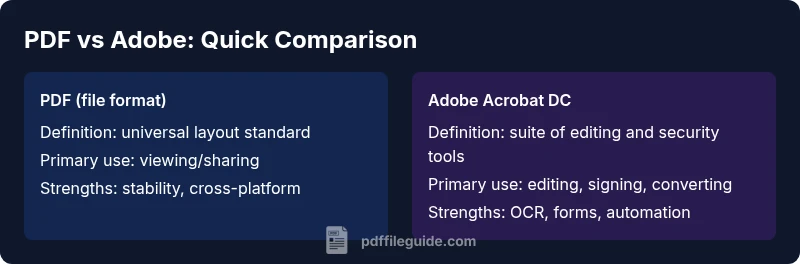
Difference between pdf and adobe? PDF is a universal file format that preserves layout across devices, while Adobe refers to the software suite that creates, views, and edits PDFs—most notably Adobe Acrobat. In practice, use PDFs for portable documents and Adobe tools when you need editing, secure signing, or advanced conversion. PDF File Guide notes this distinction helps streamline workflows.
The core question: what is the difference between pdf and adobe? Understanding this distinction is essential for modern document workflows. In short, the difference between pdf and adobe centers on a file format versus a software ecosystem. PDF is a standardized file format designed to preserve typography, layout, and vector graphics across devices. Adobe, by contrast, refers to the company behind widely used tools such as Acrobat and Creative Cloud apps, which create, view, edit, annotate, convert, and secure PDFs. From the perspective of a professional editor, the key distinction is not about one thing doing everything; it is about the roles each part plays in a workflow. According to PDF File Guide, the right pairing of format and tool boosts reliability, collaboration, and compliance. If you routinely share documents with external partners, a pure PDF file ensures universal rendering. If your work involves editing, signing, or automating conversions, you’ll rely on Adobe’s editors. The difference between pdf and adobe thus maps to: portability and stability (PDF) vs. production capabilities (Adobe).
Historical context of PDF and Adobe
PDF and Adobe emerged on different paths that intersect today. PDF evolved in the early days of digital documents as a way to freeze content and layout so it could be shared consistently, regardless of software or hardware. Adobe, the company behind that format, commercialized tools to view, edit, and annotate PDFs, culminating in a broad family of products under the Acrobat umbrella and the broader Creative Cloud ecosystem. Over time, the industry adopted PDF as a universal standard, while Adobe expanded its software offerings to cover creation, security, accessibility, and automation. PDF File Guide highlights this history to help professionals distinguish between a stable format and a suite of capabilities that enable active document workflows.
Core definitions: what is a PDF vs what is Adobe
A PDF (Portable Document Format) is a file format designed to preserve the visual integrity of a document. It is meant for reliable viewing and printing across platforms. Adobe refers to a company and a set of software tools that handle PDFs, including creation, editing, signing, and conversion. In daily practice, you save to PDF to share, and you use Adobe tools to modify, secure, or annotate those PDFs. PDF File Guide emphasizes this separation to avoid conflating a format with a toolset. Understanding this distinction helps teams choose the right app for a given task and prevents unnecessary licensing complications.
The role of Adobe in the PDF ecosystem
Adobe’s Acrobat family anchors the PDF ecosystem for many professionals. Acrobat Reader provides secure viewing, while Acrobat Pro adds features for editing, form creation, OCR, and file security. Adobe’s tools also integrate with cloud workflows, enabling document signing, conversion to other formats, and batch processing. For organizations, licensing models and feature tiers shape how teams approach PDFs—whether as a simple exchange format or as an editable production asset. The PDF File Guide perspective is that the ecosystem around PDF should serve the task, not the other way around; tool choice should align with the required editing, signing, or automation capabilities.
Common misconceptions clarified
A common misconception is that PDFs can only be edited with Adobe. In reality, PDFs can be edited with a range of third-party tools, and even some built-in viewers offer basic annotation. Another misunderstanding is that Adobe makes PDFs themselves; in fact, PDF is an open, ISO-standard format, while Adobe provides powerful editors and services to work with that format. Finally, some assume that more features always equate to better results; in practice, choosing the right tool depends on the task, the team, and the desired output. PDF File Guide reinforces that clarity between format and tool helps avoid overcomplication.
How software tools from Adobe relate to PDF operations
Adobe tools address key PDFs operations: editing text and images, rearranging pages, applying digital signatures, and performing secure conversions. Acrobat Pro supports form production, OCR for scanned documents, and accessibility tagging for assistive technologies. Beyond Acrobat, Adobe’s cloud services enable automated workflows, batch processing, and integration with other enterprise systems. For many workflows, you’ll first generate a clean PDF, then switch to an Adobe tool to modify content, apply security settings, or ensure accessibility. This sequencing — PDF for creation and distribution, Adobe for editing and automation — is central to efficient workflows.
Use-case scenarios: when you should rely on PDF alone vs Adobe tools
If your priority is sharing and preserving layout across multiple devices, PDFs alone may suffice, especially with reliable viewers and basic annotations. When collaboration requires edits, form filling, or secure signing, Adobe tools shine. For archival projects where long-term stability matters, the PDF format supports reliability, while Adobe adds the ability to enforce policies and track signatures. For automated workflows, you might generate PDFs with one tool, then use Adobe services for batch signing and conversion. In short, use PDF for portability and records; use Adobe for active editing, signing, and workflow automation.
Security and accessibility considerations
Security and accessibility are central to professional PDF use. PDFs can embed passwords, permissions, and encryption, but proper configuration is essential to avoid weak protections. Accessibility tagging and structure improve screen reader support, ensuring content is usable by a wider audience. Adobe tools provide granular control over security settings and accessibility checks, but correct setup remains crucial. PDF File Guide notes that combining robust PDF structure with clear accessibility tagging yields the best outcomes for compliance, collaboration, and long-term usability.
Performance, compatibility, and cross-platform behavior
Performance and compatibility depend on the device, the PDF complexity, and the editor used. PDFs render consistently across modern readers, but very large or feature-rich PDFs can require more processing power. Adobe’s ecosystem usually offers broad cross-platform support, including desktop and mobile apps, yet some light viewers may struggle with complex forms or high-resolution media. For teams, adopting a standard PDF workflow with vetted Adobe tools often yields predictable behavior and fewer rendering surprises across platforms.
Practical tips for professionals editing, converting, and optimizing PDFs
Begin with a clean PDF structure: organize pages, tag content, and ensure fonts are embedded. When editing, prefer non-destructive workflows: edit in a copy rather than the original, preserve metadata, and verify accessibility. For conversion, test outputs across common readers and devices, and validate that interactive elements such as forms and signatures work as intended. Finally, optimize PDFs for performance by managing image resolution, compressing embedded fonts, and enabling linearized delivery for faster web viewing.
Getting started: choosing the right tools for your workflow
Start by mapping tasks to tools: viewing and sharing require reliable PDFs; editing, signing, and conversions require powerful editors. Consider licensing, team size, and security needs when selecting software. A practical approach is to use PDFs for distribution and Adobe Acrobat Pro for production editing and workflow automation, while relying on free readers for basic review. This disciplined pairing helps minimize friction and maximize output quality.
Comparison
| Feature | PDF (file format) | Adobe Acrobat DC |
|---|---|---|
| Definition | A standardized file format preserving layout across platforms | A commercial PDF editor suite handling creation, editing, signing, and conversion |
| Primary use | Document distribution with reliable rendering | Editing, form creation, signing, and secure sharing |
| Key strengths | Universally supported; stable, non-editable by default | Powerful editing, OCR, and advanced features |
| Typical users | Anyone needing portable documents | Professionals who edit, annotate, or produce PDFs |
| Cost model | Free viewers common; paid options for editing | Subscription-based with feature tiers |
| Cross-platform support | Broad compatibility across OS and devices | Desktop and mobile apps across platforms |
| Best for | Viewing, sharing, archiving | Active editing, forms, and secure workflows |
Strengths
- PDFs enable universal sharing with stable layouts
- Adobe tools unlock advanced editing and security features
- Having a clear format/tool split reduces licensing confusion
- Strong ecosystem support and learning resources
Disadvantages
- Editing PDFs without a dedicated editor can be limiting
- Some Adobe features require subscriptions
- Creating accessible PDFs can be challenging without proper tooling
- Adobe tools may introduce vendor lock-in for specific workflows
PDFs are the standard for portability; Adobe tools are best for editing and production workflows
Use PDFs when you need reliable viewing and long-term accessibility. Choose Adobe tools when your tasks include editing, signing, and batch conversions to production-ready documents. The two work best when paired strategically.
Questions & Answers
What is the practical difference between PDF and Adobe?
The practical difference is that PDF is a file format designed for consistent viewing, while Adobe is a set of tools that create, edit, sign, and convert PDFs. PDFs ensure portability; Adobe tools enable active production workflows.
PDF is the format, Adobe is the toolkit you use to work with those PDFs.
Do I need Adobe to view PDFs?
No. Most devices include a built-in PDF viewer, and many third-party apps can open PDFs. Adobe tools are not required just to view or share PDFs, but they’re useful for editing or signing.
You can view PDFs with free readers; you don’t need Adobe to open them.
Can PDFs be edited without Adobe software?
Yes. Several third-party editors and online services can modify PDFs. The best-fit option depends on your editing needs, such as text changes, image replacement, or form updates.
You don’t have to use Adobe to edit PDFs, but check compatibility with your editing needs.
Which is better for professional workflows: PDFs or Adobe tools?
For professional workflows, PDFs handle distribution and archiving well, while Adobe tools support editing, forms, and automation. The best solution often combines both: use PDFs to share, use Adobe for edits and signatures when needed.
It depends on whether you need to edit or just share and sign.
How should I convert documents to PDF?
Conversion can be done from many sources using printers to PDF or export features in word processors. For secure or accessible PDFs, use tools that preserve tagging, fonts, and metadata.
You can convert from many apps, but verify fonts and accessibility afterward.
Key Takeaways
- Pair PDFs for distribution and Adobe for editing
- Clarify format vs. tool to avoid licensing confusion
- Test outputs across readers to ensure compatibility
- Use accessibility tagging for inclusive documents
- Balance security settings with usability in professional workflows