The PDF Bible: A Complete How-To for PDFs
Learn to edit, convert, and optimize PDFs with a complete, practical framework—the PDF Bible. This guide covers tools, workflows, accessibility, and best practices for professionals.


The PDF Bible helps you master editing, converting, and optimizing PDFs through a structured, repeatable workflow. In 2-3 short sentences, you’ll learn the essential tools, steps, and strategies to turn complex PDF tasks into reliable outcomes.
What is the PDF Bible and why it matters
According to PDF File Guide, the PDF Bible is a living, practical reference that combines editing, conversion, and optimization into a repeatable workflow. The PDF File Guide team found that professionals rely on a unified resource to maintain consistency across projects. This article introduces the concept and explains how to build a robust PDF Bible that supports precise edits, reliable conversions, and efficient optimization. By treating PDFs as data-rich documents with structure, you gain repeatable results, reduced errors, and a clearer path from raw files to polished outputs. The term pdf bible signals a comprehensive guide you can consult on-demand for any editing or formatting task.
Throughout this guide, you’ll see how to document best practices, choose the right tools, and apply proven methods to real-world scenarios.
Core Principles of a Reliable PDF Bible
A credible PDF Bible rests on a handful of core principles that apply across industries and roles. First, accuracy matters: every edit, tag, or font change should preserve the document’s meaning and readability. Second, structure guides success: consistent headings, metadata, and color usage help readers and machines parse content. Third, accessibility cannot be an afterthought: adding semantic tags, alt text, and logical reading order makes PDFs usable for assistive technologies. Fourth, security and privacy should be built in from the start: enable appropriate protections and redact sensitive information when needed. Fifth, reproducibility is essential: document steps, settings, and conventions so teammates can reproduce results without guesswork. In practice, this means keeping a living style guide, a checklist, and a change log that tracks decisions and outcomes.
The pdf bible concept also emphasizes a lifecycle approach: plan, edit, review, convert, optimize, and audit. When you adopt a lifecycle mindset, you can reuse templates and workflows across projects, reducing time and errors.
Tools and Formats You Should Master
To build a serious PDF Bible, you need tools that cover editing, conversion, and optimization. A capable PDF editor forms the core of your toolkit, complemented by reliable font packs, color profiles, and image editors. OCR capabilities help with scanned documents, while accessibility and tagging utilities ensure compliance with assistive technologies. In addition, you’ll want to understand common formats and outputs: PDF/A for long-term archiving, PDF/X for print workflows, and multi-format export options (Word, HTML, SVG) for downstream editing. Mastery also includes metadata handling, watermarking and security settings, and batch-processing features to scale across large workloads. The goal is to choose tools that stay consistent with your pdf bible principles rather than chasing every new feature.
As you accumulate techniques, organize them in a modular library: reusable templates for cover pages, chapter headings, and figure captions; a set of tag and metadata presets; and standardized compression profiles tailored to document type.
Building a Consistent Workflow: Planning, Editing, and Auditing
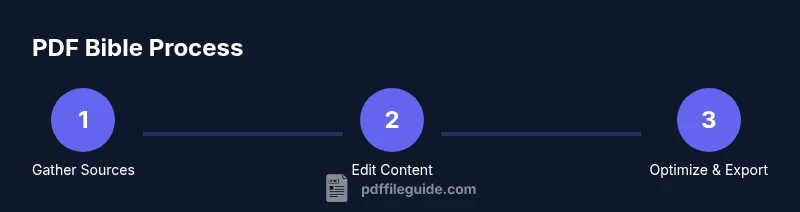
A well-defined workflow is the backbone of any PDF Bible. Start with a planning phase where you outline the document’s purpose, audience, and required outputs. Establish a typography and layout system, including font families, line spacing, margins, and color usage. During editing, apply changes in a staged environment: use version control for major edits, keep backups, and annotate changes so teammates understand why decisions were made. Once edits are complete, run a structured audit: verify metadata accuracy, ensure links work, confirm image rendering quality, and test accessibility tags. Finally, when exporting, choose the appropriate format and settings for the target audience (print, screen, or archival). This structured approach minimizes regressions and makes future updates efficient.
Incorporate a checklist that covers content accuracy, accessibility, and performance. The pdf bible mindset is to document each decision, so future editors can reproduce the same outcomes with confidence.
Practical Editing Techniques: Text, Images, and Layout
Editing a PDF is about precision and predictability. For text, use the editor’s find-and-replace features to maintain consistency in terminology and spelling. When updating images, verify resolution, color profiles, and compression quality to maintain legibility. Layout adjustments should respect margins, grid systems, and alignment guides to ensure a clean, professional appearance. Annotations and comments can help you collaborate without altering the original content, while stamps and approvals create a clear audit trail. For complex documents, consider creating variants or modular sections that can be swapped in without affecting the overall structure. Document all font embedding choices and why you selected specific families to avoid font conflicts in downstream workflows.
Converting PDFs: From Documents to Editable Formats and Back
Converting PDFs to editable formats (such as Word or InDesign) is a common requirement in the pdf bible workflow. Prioritize preserving layout integrity and reading order during conversion. After export, review the resulting file to correct any misaligned elements, updated fonts, or missing images. Conversely, when exporting from editable sources back to PDF, choose the most appropriate preset (screen, print, or archival) and ensure compatibility with downstream systems. Keep an eye on metadata, document properties, and accessibility tags during every conversion. If your workflow involves multiple formats, maintain a consistent naming convention and a centralized repository of conversion presets to speed up future projects.
Optimizing PDFs for Size and Performance
Optimization is a balance between visual quality and file size. Start with image compression settings that optimize readability without introducing artifacts. Embed only the fonts you need, and consider font subsetting for large documents to reduce bloat. Remove unnecessary metadata and streamline the document structure to improve loading times and searchability. When possible, test different compression levels on representative pages to gauge impact. Finally, verify that interactive features (forms, scripts) remain functional after optimization. Documentation of the chosen compression profile helps maintain consistency across future edits.
Accessibility and Compliance: Tagging, Reading Order, and Semantics
A PDF Bible must address accessibility and compliance. Begin by tagging the document with a logical reading order that aligns with the visual layout. Add descriptive alt text to images and figures, and ensure that form fields have accessible labels. Use semantic tagging (headings, lists, landmarks) to aid screen readers. Verify document structure with accessibility audit tools and manual checks. Maintain an accessibility checklist as part of your pdf bible to ensure ongoing compliance across projects. This focus on accessibility not only broadens reach but also improves searchability and usability for all readers.
Case Studies: Real-World Scenarios with the PDF Bible
Consider a corporate report that requires weekly edits, cross-team collaboration, and archival delivery. A robust pdf bible approach would establish a shared style guide, templates for metadata, and a standard export path to PDF/A for archival. In education, researchers can maintain a live repository of chapter templates, figure captions, and referencing formats, making it easier to update bibliographies and citations. In publishing, you’ll want precise color management, print-ready presets, and careful font handling to ensure faithful reproduction across devices. While each scenario differs, the underlying principle remains the same: plan, document, and iterate with a consistent framework so every project follows the same dependable path.
Tools & Materials
- Computer with reliable internet(Windows/macOS/Linux; modern browser and hardware)
- PDF editor software(Full editing capabilities, not just viewing)
- Font package(Common professional fonts; licensing checked)
- OCR tool(Useful for scanned PDFs and image-based content)
- Source PDFs and references(Keep originals safe; obtain proper rights)
- Backup storage(External drive or cloud backups)
- Color calibration tools(Ensure accurate image reproduction)
Steps
Estimated time: 6-9 hours
- 1
Collect sources
Assemble all source PDFs and reference materials. Verify access rights and note any licensing constraints before editing.
Tip: Create a master folder with subfolders for sources, edits, and outputs. - 2
Choose your primary PDF editor
Select a tool that supports tagging, forms, and batch processing. Ensure it’s updated and licensed.
Tip: Prefer an editor with templates and automation features for consistency. - 3
Define typography and layout
Set up a typography and layout style guide, including fonts, sizes, margins, and color schemes.
Tip: Lock these settings in a reusable template. - 4
Import, tag, and restructure content
Import content into a structured layout, apply semantic tags, and establish reading order.
Tip: Document tag decisions for future edits. - 5
Check accessibility and metadata
Verify alt text, tags, reading order, and metadata accuracy; fix any gaps.
Tip: Run automated checks and supplement with manual review. - 6
Compress and optimize assets
Balance image quality and file size; embed only necessary fonts and remove unused elements.
Tip: Test multiple compression levels on sample pages. - 7
Export, audit, and publish
Export to the target formats, perform final checks, and archive with a versioned name.
Tip: Maintain a changelog for each export.
Questions & Answers
What exactly is the PDF Bible?
The PDF Bible is a comprehensive, practical guide for editing, converting, and optimizing PDFs, designed to be reused across projects.
The PDF Bible is a complete guide to editing, converting, and optimizing PDFs.
Which tools do I need to start?
A capable PDF editor, your source PDFs, fonts (as needed), and a backup strategy.
You’ll need a reliable PDF editor, your source PDFs, and a solid backup plan.
How can I improve accessibility in PDFs?
Tag structure, provide alt text for images, and ensure correct reading order.
Make sure the PDF is tagged with proper reading order and alt text.
Is it safe to compress PDFs?
Compression saves space but can affect image quality; choose a balanced profile.
Compression helps, but watch for quality loss.
What are common mistakes when editing PDFs?
Over-embedding fonts, neglecting metadata, and skipping backups.
Common mistakes include over-embedding fonts and not backing up.
How do I verify the final PDF?
Run accessibility checks, verify links, and proof on print or display.
Check accessibility, hyperlinks, and print/readability before final release.
Watch Video
Key Takeaways
- Plan edits with a clear scope and audience.
- Use a consistent typography and layout system.
- Prioritize accessibility in every stage.
- Balance compression with readability for optimal PDFs.
- Document decisions and maintain versioned exports.