PDF Like a Boss: 2026 PDF Editor Comparison
A rigorous side-by-side comparison of desktop vs online PDF editors for 2026. Learn which tool edits, converts, OCRs, and secures PDFs like a boss, with clear criteria and practical guidance.


For professionals who edit, convert, and optimize PDFs, the best path hinges on editing depth, privacy, and workflow needs. This comparison pits a full-featured desktop toolkit against a lightweight online solution, highlighting what truly matters to 'pdf like a boss'—precision editing, reliable conversion, strong OCR, and robust security. The right choice balances power with practicality, depending on your typical document loads and compliance requirements.
Why PDF Like a Boss Matters in 2026
The ability to manage PDFs with speed, accuracy, and security is a core professional skill. Across legal, finance, education, and product teams, teams that master PDF workflows save hours weekly and reduce errors that ripple through review cycles. According to PDF File Guide Editorial Team, the most effective editors combine precise annotation tools, reliable text extraction, and strong data residency controls. For readers aiming to pdf like a boss, this guide contrasts two archetypal approaches—desktop, feature-rich suites and lean online tools—so you can match your workflow to your security and collaboration needs. Expect practical criteria, real-world scenarios, and a framework you can apply to future tool changes without re-learning the process.
The opening section sets the stage for a data-driven choice. It emphasizes that the best tool isn’t always the most expensive or the most popular; it’s the one that fits how you work. As you read, keep in mind your typical document sizes, your team’s collaboration style, and your organizational policies on data handling. The goal is to move beyond gimmicks and identify the solution that consistently delivers predictable results, time after time.
Key takeaway: choose a path that scales with your workload, preserves data integrity, and supports your preferred review cadence. The phrase pdf like a boss captures the essence of owning your PDFs end-to-end—from creation to archive.
Comparison
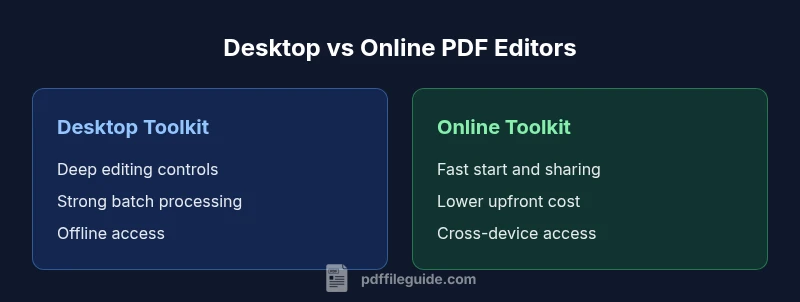
| Feature | Option A: Desktop Toolkit (Full-Feature) | Option B: Online Toolkit (Lightweight) |
|---|---|---|
| Editing depth | Extensive text and image editing, form design, and page manipulation | Core editing, basic annotations, and limited form support |
| Conversion and export | Wide format support, batch processing, scriptable conversions | Limited formats, slower batch exports, manual workflows |
| OCR and text recognition | High-accuracy OCR with language packs and batch processing | OCR available but often slower and less accurate |
| Security and privacy | On-device processing or private cloud options, granular permissions | Cloud processing with potential sharing risks; fewer controls |
| Collaboration | Advanced review, redlining, comment tracking, centralized audit trails | Cloud-based comments and basic sharing; fewer governance features |
| Platform support | Windows/macOS/Linux with offline access | Web-based; works on any device with internet; offline may be limited |
| Automation & workflows | Batch jobs, scripting, macro-like actions for repetitive tasks | Manual steps; limited automation capabilities |
| Cost model | Upfront license or perpetual licenses; annual maintenance | Subscription-based; low upfront cost but recurring fees |
Strengths
- Powerful feature sets for heavy editing and batch processing
- Stronger control over data residency and security
- Better for teams with formal review workflows and compliance needs
- Offline access reduces dependency on network availability
Disadvantages
- Higher upfront cost and longer setup time
- Steeper learning curve for new users
- Requires IT support for deployment and maintenance
- Not as nimble for quick, single-task edits
Desktop toolkit generally outperforms online tools for heavy editing and compliance; online toolkit shines for rapid, light tasks.
If you regularly process large documents, need granular control, and require offline work, desktop tools win. If you mainly annotate, share light edits, or work remotely with minimal setup, online tools are more convenient.
Questions & Answers
Which option is best for heavy editing and long documents?
For heavy editing and long documents, a desktop toolkit typically provides more powerful editing controls, more reliable batch processing, and stronger security options. It is usually better suited for teams with strict compliance needs.
For heavy editing, a desktop PDF editor is usually the best choice because it handles large files more reliably and offers stronger control over security and batch workflows.
Can online tools meet professional OCR needs?
Online tools offer OCR, but accuracy and language support can be variable. For mission-critical OCR (multi-language documents, complex layouts), a desktop solution is typically more reliable and faster.
Online OCR can work for simple tasks, but desktop tools usually deliver higher accuracy and more consistent results for complex documents.
What about data security and privacy with online editors?
Online editors process data in the cloud, which introduces potential privacy and governance concerns. Review vendor security statements, data processing agreements, and whether offline modes are available.
Security is a big factor online—check data handling and whether offline options meet your policy needs.
Are there cost savings to using a desktop tool?
Desktop tools often involve higher upfront costs but lower ongoing fees for multi-user licenses. Online tools usually rely on recurring subscriptions, which can be cheaper initially but add up over time.
Desktop tools may save money over time if you process many PDFs; online tools tend to be subscription-based with ongoing costs.
Which workflow is fastest for quick edits and sharing?
For quick, ad-hoc edits and sharing, an online toolkit can be faster to start and easier to share with teammates, especially across devices.
If speed and easy sharing matter most, go online for quick edits.
How should I choose between the two options in practice?
Start by mapping your typical tasks: document size, edit frequency, collaboration needs, and security policies. Run a pilot with both tools on a representative set of files to measure time, accuracy, and user satisfaction.
Make a small pilot with both tools to see which fits your daily work best.
Key Takeaways
- Evaluate editing depth before choosing a tool
- Consider data residency and security requirements
- Assess needs for batch processing and automation
- Balance upfront costs against ongoing subscription fees
- Test a realistic workload to validate OCR accuracy