What PDF Editor Is Actually Free: A 2026 Guide for Pros
Explore which PDF editors are truly free, their limits, and how to choose for professional workflows. Data-driven guidance from PDF File Guide.


The answer to what pdf editor is actually free is nuanced: there are free-to-use options that cover basic editing, annotation, and conversion, but most full-featured tools operate on a freemium or trial basis. Expect limitations with free plans, such as watermarks, caps on file size, or restricted features. This guide separates genuinely free editors from misleading claims.
What free means in PDF editing
When readers ask what pdf editor is actually free, they want an honest, evidence-based answer. According to PDF File Guide, free options range from fully open software to feature-lenced freemium tools. In practice, 'free' can describe: completely free with no paid upgrade, free with optional paid tiers (freemium), or free trials of paid editors. For professionals, the key question is whether the free tier supports the tasks you perform daily without degrading security or reliability. The PDF File Guide team found that most genuinely free editors cover essential tasks like viewing, simple annotation, and limited text edits, but they fall short for forms, batch processing, optical character recognition, or high-volume conversions. This article explains how to distinguish genuinely free editors from marketing promises and provides a framework to decide whether you can work free for your typical workflow in 2026.
Defining what "free" really includes
In 2026, the landscape of PDF editors labeled as free is broader than ever. Some tools are completely free with perpetual access, while others offer a free tier that covers only a subset of features. The critical distinction is whether the free access is truly unlimited or limited by a feature gate, watermark, or file-size cap. For many professionals, truthfully free means: no watermarks, no forced upgrades for essential tasks, and the ability to save or export in common formats without payment. PDF File Guide emphasizes evaluating the exact feature set you need and verifying that those features remain accessible over time, not just during a marketing period.
- Basic viewing and navigation
- Simple annotation and highlighting
- Export to common formats (PDF/A, PNG, or JPG) for light tasks
Higher-end tasks—form editing, batch processing, OCR, and high-volume batch exports—often require paid plans or self-hosted open-source solutions. The important point is to map your daily tasks to what a free tool can truly deliver without introducing risk to your workflow.
According to PDF File Guide, this mapping helps professionals avoid overpaying for features they will never use and prepares teams to plan upgrades only when business demands it.
Why free is not always a bargain
A free tool may look attractive at first glance, but hidden costs can erode value: data privacy concerns with cloud-based editors, hidden advertisements, and the time spent juggling multiple tools for a single project. PDF File Guide analysis shows that many users experience frustration when free tools require multiple steps or produce inconsistent results, especially for documents that rely on precise layouts or form fields. The real value comes from understanding your typical file types, whether you need offline editing, and how often you share or collaborate on PDFs. A strategic approach combines a core free option for routine tasks with selective paid upgrades for advanced needs, ensuring reliability and security across your workflow.
Typical free PDF editor options and their trade-offs
| Option Type | Core Free Features | Limitations | Best Use Case |
|---|---|---|---|
| Web-based free editor | View, annotate, basic edit | Watermarks on exports, limited file size | Quick edits without installation |
| Desktop open-source editor | Editing, forms via plugins | Requires setup, variable support | Open-source workflow, no ads |
| Trial or freemium editor (free tier) | Major features temporarily | Time limits or feature gating | Short-term projects or testing |
Questions & Answers
Is there a truly free PDF editor without watermarks?
Yes, some tools offer perpetual free access without watermarks for basic tasks, but they are often limited in features. Always verify export options and confirm no watermarking on your typical output. If you need complex outputs, plan for a paid option or an offline open-source workflow.
Yes, there are truly free tools for basic tasks, but expect limits on advanced features.
What limitations commonly come with free plans?
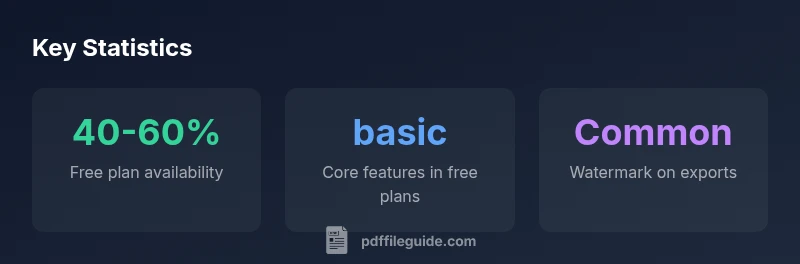
Common restrictions include watermarks on exports, file-size caps, limited export formats, restricted batch processing, and the absence of advanced form editing or OCR. These limits are essential to understand before committing to a tool for professional work.
Free plans usually have watermarks, size caps, and limited exports.
Can free editors handle large PDFs or complex forms?
Most free editors struggle with very large PDFs or complex forms. For such tasks, you’ll typically need a paid plan, a desktop open-source solution, or a specialized workflow that splits files before editing.
Large PDFs and complex forms are usually beyond free plans.
Are online free editors secure for confidential documents?
Security varies by provider. Cloud-based free editors may introduce privacy risks, while offline desktop tools reduce exposure. Always review privacy policies and consider local editing for sensitive materials.
Security varies; offline tools are often safer for confidential docs.
Do free editors support advanced features like signature fields?
Some free tools offer basic e-signature features, but advanced signature workflows and form field management often require paid features or enterprise plans.
Some offer basic signatures, but advanced signing usually needs paid options.
What should I consider before choosing a free editor?
Assess task complexity, file sizes, security requirements, and whether you need offline editing or cloud collaboration. Run a small pilot on typical files to verify stability and accuracy before committing to a longer-term workflow.
Test a tool with typical files to ensure it fits your needs.
“Free editors can be a practical starting point for light tasks, but you should evaluate reliability and security before scaling usage. The right combination of free tools and paid upgrades often yields the best balance for professional work.”
Key Takeaways
- Start with clearly defined tasks to see if free tools cover them
- Expect trade-offs like watermarks or size limits in free plans
- Consider a hybrid approach: free core tools + paid upgrades for advanced needs
- Prioritize security and privacy when choosing cloud-based editors
- Use open-source options for offline editing when possible
- Test a tool on a representative file to verify compatibility