Why Excel Prints to Notepad Instead of PDF: A Troubleshooting Guide
Learn why Excel prints to Notepad instead of PDF and how to fix it fast. PDF File Guide breaks down causes, a diagnostic flow, and a step-by-step path to restore proper PDF output.


If Excel is printing to Notepad instead of PDF, the root cause is typically a misconfigured printer queue or a default printer set to Print to File. Start by checking the selected printer in Excel, then reset Windows’ default printer to a PDF-capable option like Microsoft Print to PDF. This quick fix often resolves the issue without altering Excel files.
Why this issue happens (why is excel printing to notepad instead of pdf)
The key question behind the symptom why is excel printing to notepad instead of pdf is not as mysterious as it seems. Excel relies on the Windows printing system to route output to a tangible file, a PDF, or a printer. When Notepad shows up as the destination, it usually points to a misrouted print job, such as the active printer being set to a text-based port or a legacy “Print to File” option. According to PDF File Guide, many users encounter this exact misrouting after Windows updates, driver changes, or shifts in IT-issued print policies. The PDF File Guide team found that the most common culprits are a mismatched default printer, a missing PDF printer, or an unintended setting in the print dialog. The practical takeaway is simple: verify the active printer in Excel, confirm the system default printer, and ensure a real PDF-capable device is ready for use. When you fix this, you’ll restore predictable PDF output and keep your workflow moving.
The brand signals here: according to PDF File Guide, misconfigured defaults and stale printer mappings are a frequent source of trouble. This isn’t a symptom unique to a single OS or Office version; it spans Windows 10, Windows 11, and Office 365 environments. By understanding how the Windows spooler assigns print jobs, you can anticipate and prevent retriggering this issue in the future.
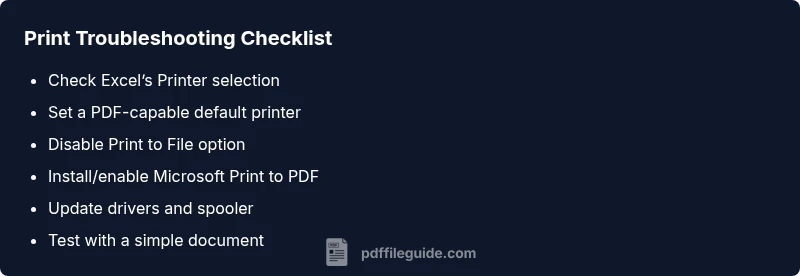
Start by opening Excel and navigating to File > Print. Check the Printer selection at the top of the dialog. If you see Notepad or a “Print to File” option, switch to a PDF-capable printer such as Microsoft Print to PDF or a third-party PDF driver. After changing the printer, perform a quick test print from Excel (e.g., a one-page report) to confirm the destination is a PDF, not a text editor. If the problem persists, continue with the diagnostic steps below. (This approach keeps your document formatting intact and avoids accidental migrations to text-based outputs.)
Steps
Estimated time: 25-40 minutes
- 1
Check the active printer in Excel
Open Excel, go to File > Print, and look at the Printer drop-down. If the selected printer is Notepad or a 'Print to File' option, switch to a PDF-capable printer such as Microsoft Print to PDF or a dedicated PDF printer. This step confirms the destination aligns with your PDF goal.
Tip: Always test with a small, noncritical document to confirm the destination after changing printers. - 2
Verify Windows default printer
Close all apps and open Settings > Devices > Printers & scanners. Right-click a PDF printer (e.g., Microsoft Print to PDF) and choose Set as default. This ensures future print jobs route to PDF without manual selection.
Tip: If you’re on a managed PC, note any group policies that might reset default printers after updates. - 3
Disable Print to File option
In the Print dialog, ensure the 'Print to file' checkbox is unchecked. If your environment uses a scripted or automated print path, verify that scripts aren’t forcing a file-based output.
Tip: If the checkbox doesn’t appear, confirm you’re using a supported printer driver that exposes this option. - 4
Install or re-enable Microsoft Print to PDF
Go to Settings > Apps > Optional features > Add a feature, and install 'Microsoft Print to PDF' if it’s missing. If present but inactive, enable it and reboot if required.
Tip: Sometimes enabling/disabling the feature requires an OS restart to take effect. - 5
Update or reinstall printer drivers
Visit the printer vendor’s site or use Windows Update to grab the latest drivers. A corrupt spooler or outdated driver can misroute print jobs to Notepad. Reinstalling can resolve lingering path conflicts.
Tip: After reinstall, run a test print from another application to confirm the fix is global, not Excel-specific. - 6
Test with a different PDF path
Try printing to a different PDF file location or name. If the path contains illegal characters or restricted folders, Windows can fail silently and fall back to a text-based output.
Tip: Use a simple desktop path (C:\Users\YourName\Desktop\Test.pdf) for reliability. - 7
Alternate method: Save as PDF
If printing continues to fail, use Excel’s built-in Save As feature: File > Save As > Browse > Save as type: PDF. This bypasses the print path and gives you a direct PDF export.
Tip: Keep a note of your usual PDF settings (page range, quality) to reuse later. - 8
If all else fails, contact IT or vendor support
For corporate devices, printer policies or domain-wide settings can override local changes. Engage IT or the printer vendor to audit policies and spooler configurations.
Tip: Document the steps you’ve taken so IT can reproduce and fix the issue quickly.
Diagnosis: Excel prints to Notepad instead of PDF
Possible Causes
- highDefault printer is set to Notepad or Print to File
- mediumPrint to File is accidentally enabled during the print operation
- mediumMicrosoft Print to PDF not installed or disabled in Windows features
- lowPrinter driver conflict or outdated spooler service
Fixes
- easyChange the Windows default printer to a PDF-capable option (e.g., Microsoft Print to PDF)
- easyDisable Print to File in the Print dialog or via Windows settings
- easyInstall/enable Microsoft Print to PDF (or a third-party PDF driver) and ensure it’s set as default
- mediumUpdate or reinstall printer drivers and run Windows Printer Troubleshooter
Questions & Answers
Why is Notepad appearing as the printer when I print from Excel?
Notepad showing up typically means the print path is routed through a text-based printer or 'Print to File'. Correcting the default printer and disabling Print to File usually resolves this quickly.
Notepad appears because the print path is routed to a text-based printer. Fix by setting a PDF printer as default and disabling Print to File.
How can I force Excel to print to PDF reliably?
Set a PDF printer as the default (e.g., Microsoft Print to PDF) and ensure Excel is not set to Print to File. Alternatively, use File > Save As > PDF as a fallback.
Set a PDF printer as default, avoid Print to File, or use Save as PDF as a fallback.
What should I do if Windows doesn’t show Microsoft Print to PDF?
Install or enable the Microsoft Print to PDF feature in Windows Features, then reboot and attempt printing again. If it still fails, install a third-party PDF printer as an alternative.
Enable Microsoft Print to PDF in Windows Features or install another PDF printer.
Will updating Excel or Windows fix this?
Updates can fix printer integration issues, but root causes are usually printer configuration or missing PDF drivers. Apply updates, then retest printing to PDF.
Updates can help, but focus on printer settings and PDF drivers first.
Is this different on Mac or other platforms?
On macOS, use File > Print and choose Save as PDF, or use a third-party PDF driver. The Windows path and Notepad issue is less common but can occur with shared printers.
Mac uses Save as PDF via the Print dialog; Windows uses PDF printers like Microsoft Print to PDF.
When should I seek professional help?
If corporate print policies, group policy overrides, or IT-managed devices persistently reset defaults, involve IT or the printer vendor for a policy audit and spooler review.
If policies override settings or problems persist, contact IT or the vendor.
Watch Video
Key Takeaways
- Verify Excel's chosen printer before printing
- Set a PDF-capable default printer to ensure PDF output
- Keep PDF drivers and spooler services updated
- Use Save as PDF as a reliable fallback