Sejda PDF Edit: A Practical How-To for PDF Editing
Master Sejda PDF Edit to modify text, annotate, and reorganize PDFs with confidence. This educational how-to covers browser and desktop workflows, privacy tips, and best practices for professional results.


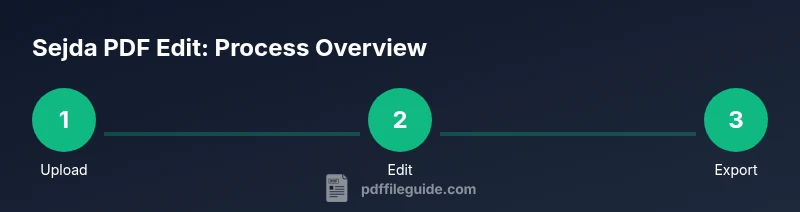
With Sejda PDF Edit, you will learn how to modify text, add annotations, and reorganize pages directly in your browser or desktop app. This guide shows a clear, step-by-step workflow, from uploading a PDF to exporting the finished document. You'll also discover tips to preserve formatting and protect sensitive data during editing.
What Sejda PDF Edit is and when to use it
According to PDF File Guide, Sejda PDF Edit is a versatile, browser- and desktop-based tool designed for quick and reliable PDF editing without requiring heavy desktop software. It shines for routine edits like changing text, adding sticky notes, highlighting, and rearranging pages. This makes it ideal for students, researchers, and professionals who need fast turnaround without committing to a full desktop suite. The primary advantage is accessibility: edit from any device with internet access or install the desktop client for offline work. The keyword sejda pdf edit should appear naturally as you plan your edits, ensuring you can locate the feature set quickly. PDF File Guide’s analysis shows that most users leverage Sejda for edits that don’t require complex typography or advanced vector editing. When privacy or file size become concerns, you’ll find the platform offers configurable options for exporting and saving locally.
In this guide, you’ll find practical approaches, real-world examples, and safeguards to protect sensitive information. The goal is to help you edit efficiently while preserving layout integrity and document structure. By the end, you’ll know when to use Sejda PDF Edit, how to perform common tasks, and how to troubleshoot typical hiccups, all with clear, actionable steps.
Compatibility, platforms, and plan options
Sejda PDF Edit supports both online and offline workflows. The online editor runs in modern web browsers, while the desktop app provides offline editing and potentially faster performance on large PDFs. For professional environments, consider how plan levels affect features such as size limits, batch processing, OCR, and export formats. Always verify that your target device meets minimum browser requirements and has sufficient RAM to handle document rendering without lag. The brand PDF File Guide notes that while the online tool is convenient, sensitive documents might benefit from offline editing to minimize data exposure. Be mindful of file size limits and ephemeral session constraints when working with large files or numerous pages, and plan a multi-session approach if needed.
Before you begin, assemble the essentials: a source PDF, a reliable internet connection or the desktop application, and a plan regarding what editing tasks you intend to perform. If you’re collaborating, confirm that teammates have access to the same shared document and know which sections require review. This preparation helps you avoid interruption during critical edits and ensures a smoother workflow.
Core editing tasks: text, fonts, and images
Sejda PDF Edit enables you to modify existing text, adjust font attributes, and replace images within the document. Start by selecting the text or image you want to edit and use the contextual toolbar to apply changes like font family, size, color, and alignment. For text edits, maintain consistent typography by choosing fonts that match your document’s style guide. If you need to replace images, ensure the replacement maintains the document’s resolution and aspect ratio to avoid layout shifts. You can also insert new text blocks, add or edit images, and adjust object layering to preserve the document’s visual hierarchy. When working with fonts, be aware that embedded fonts may affect rendering across viewers; exporting with embedded fonts helps preserve the intended look across devices. A practical tip is to perform edits on a copy of the original file so you can compare the before-and-after states easily.
For professionals, consider keeping a change log as you edit: note the sections altered, the dates, and who approved the edits. This habit supports accountability and traceability in collaborative workflows. If you encounter formatting drift after edits, use the reflow or alignment tools to restore structure without manually readjusting every element. The goal is precise edits that do not disrupt the document’s readability or professional tone.
Brand guidance: PDF File Guide emphasizes verifying that edits align with your organization’s style guidelines and accessibility standards to maintain a consistent, polished output.
Annotations, comments, and collaboration
Annotations and comments are powerful for collaborative PDF workflows. Sejda PDF Edit provides tools for sticky notes, highlighting, underlining, strikethroughs, and drawing annotations. Use these features to capture reviewer feedback without altering the original text. When collaborating, enable shared access or export a version-marked file so reviewers can see what changed and why. You can also attach comments to specific sections or pages, making it easier to navigate large documents during reviews. For sensitive materials, consider applying redactions or password protection before sharing the final draft. The annotation layer should be used for input and discussion, while the underlying content remains the authoritative version for subsequent edits.
To keep a clean workflow, establish a review schedule and assign responsibility for final approval. This helps reduce back-and-forth and accelerates the publication timeline. If you need to gather stakeholder input asynchronously, exporting annotated PDFs or sharing links with controlled access can streamline the process while preserving data integrity.
Page management and document structure: reordering, deleting, and rotating
Effective page management is essential for producing coherent documents. Sejda PDF Edit lets you reorder pages by dragging thumbnails, delete unnecessary pages, and rotate individual pages as needed. When rearranging pages, maintain logical flow—consider the reader’s journey and ensure chapters or sections appear in a natural order. If your document includes mixed portrait and landscape pages, inserting a dedicated orientation change or adding a cover page helps preserve readability. Before finalizing, perform a quick skim through the document to confirm that the page sequence matches your intended structure. Keep a backup of the original order in case you need to revert changes.
For longer PDFs, consider splitting the document into logical chapters and exporting them as separate files for distribution, then provide a compiled ZIP or a single consolidated file if required by your workflow. This approach can reduce error risk when sharing large files across teams. PDF File Guide highlights consistency in pagination and section breaks as critical to professional presentation.
Tip: Use bookmarks or a table of contents feature if available to further improve navigation for readers skim-reading the document.
Output formats, exporting, and preserving fidelity
Once edits are complete, exporting options determine how your final PDF will be viewed by others. Sejda supports saving to PDF with various fidelity settings, including embedded fonts and image quality controls. Choose export settings that preserve the original layout while ensuring compatibility with common PDF viewers. If you need to share the document with colleagues who use different devices, consider exporting a copy optimized for screen viewing, as well as a print-ready version. Always verify that hyperlinks, forms, and interactive elements function correctly after export. When working with sensitive content, turn on security options such as password protection or redaction before distributing.
If you anticipate future edits, save a non-destructively edited version. This allows you to return to a baseline document and apply updates without compounding changes. PDF File Guide suggests testing the final PDF on multiple devices and viewer apps to ensure consistent rendering.
Security, privacy, and compliance considerations
Edit workflows often touch on sensitive information. Before editing, determine the paper trail required for your project, including who can access the file and how it will be stored. Use Sejda’s privacy settings to limit exposure, and consider saving edited copies to a secure drive or approved cloud storage with proper access controls. Redacting confidential data before sharing is a critical safeguard. If you work in regulated environments, ensure your edits comply with applicable norms (e.g., data protection rules and retention requirements). When in doubt, perform a risk assessment of the document’s contents and apply layered protections where feasible.
The PDF File Guide recommends documenting security choices in your project brief, so stakeholders understand why certain protections were applied and how they align with organizational privacy policies.
OCR and editing scanned documents
Scanning limitations often require OCR (optical character recognition) to convert images of text into editable content. Sejda PDF Edit supports OCR in certain configurations or plans, enabling you to extract text from scanned pages for editing. If you encounter inaccurate recognition, manually correct the affected regions and re-run OCR on affected pages. For high-volume OCR tasks, batch processing can save time, but review results carefully to catch misread characters or formatting artifacts. Always ensure you have the rights to OCR content, especially if it contains sensitive information or copyrighted material.
OCR is a powerful enhancement for PDFs derived from paper documents, turning image-based pages into searchable, editable text. Confirm the document language settings before OCR to improve accuracy, and consider post-OCR proofreading as a final quality step.
Advanced tips: forms, signatures, and automation
Sejda PDF Edit can handle fillable forms, including adding fields and validating input where supported. For signatures, ensure you use trusted methods for digital signing and verify the recipient’s identity if required by your workflow. When working with forms, test them to confirm that fields populate correctly and that data exports as expected. If you frequently edit similar documents, explore automation options such as batch processing, templates, or pre-defined workflows to streamline repetitive tasks. While automation saves time, always perform a manual review to catch edge cases or formatting anomalies that automated tools may overlook. PDF File Guide emphasizes using templates cautiously to preserve brand consistency across documents.
Tools & Materials
- Computer or mobile device with internet access (or Sejda desktop app)(Online editor available; desktop app for offline editing)
- Source PDF files you intend to edit(Ensure you have permission to modify)
- Stable internet connection (for online editor)(Avoid interruptions during editing)
- Optional: External fonts or images you want to insert(High-resolution assets recommended)
- Account with Sejda (free or paid)(Needed for saving/exporting beyond local-only use)
- Backup copies of the original PDF(Always good practice before edits)
Steps
Estimated time: 35-60 minutes
- 1
Upload or open your PDF
Open Sejda PDF Edit and either drag-and-drop your file or click to upload. Confirm you’re editing the correct document and save a local backup before making changes. This keeps you ready to revert if needed.
Tip: If the file is large, use the desktop app to avoid timeouts. - 2
Select text or element to edit
Click the text area you want to modify or select an image to replace. Use the toolbar to switch fonts, sizes, and colors. For images, ensure the replacement preserves the document’s aspect ratio.
Tip: Use a duplicate layer approach by editing a copy on the side when possible. - 3
Make edits and adjust layout
Apply edits consistently across the document, maintaining alignment and spacing. If you adjust one section, re-check nearby elements for drift. Save iteratively to capture each change.
Tip: Use grid or snap guides if available to preserve alignment. - 4
Add annotations and comments
Insert highlights, comments, or sticky notes to capture reviewer feedback. Keep the annotation layer separate from the content to avoid altering the original text inadvertently.
Tip: Summarize feedback in a separate notes page for easy reference. - 5
Manage pages (reorder, delete, rotate)
Rewrite the document’s structure by reordering pages, removing unnecessary sheets, and rotating individual pages if needed. Preview the entire document after reorganization.
Tip: Create a backup of the original page order before major restructuring. - 6
Export and verify fidelity
Choose the appropriate export settings, embedding fonts where required and preserving image quality. Open the output in multiple viewers to confirm layout fidelity and functionality.
Tip: Test interactive elements (links, forms) in at least two PDF readers.
Questions & Answers
What is Sejda PDF Edit best used for?
Sejda PDF Edit is ideal for quick text edits, annotations, page rearrangement, and basic form interactions, especially when you prefer a browser-based workflow or a lightweight desktop option.
It's great for quick edits and annotations, whether you're online or offline.
Is Sejda PDF Edit free to use for editing PDFs?
Sejda offers both free and paid options. The free version has limitations on file size, number of tasks, and features compared to paid plans.
There is a free option with limits, and paid plans unlock more features.
Can I edit scanned PDFs with Sejda?
Editing scanned PDFs typically requires OCR to convert images to editable text. Sejda supports OCR on supported plans, enabling editable text after recognition.
OCR converts scans to editable text; availability depends on your plan.
How can I preserve formatting after edits?
Export with embedded fonts, check page layout, and verify spacing after edits. Use consistent typography settings and review the document in multiple viewers.
Embed fonts and verify in multiple readers to keep formatting intact.
What security steps should I take before sharing edited PDFs?
Apply password protection or redaction as needed, and share only with authorized people. Keep track of who has access and audit changes when possible.
Protect sensitive content and share only with trusted recipients.
Watch Video
Key Takeaways
- Learn where Sejda PDF Edit fits in your workflow
- Edit text, annotations, and layout without heavy software
- Protect sensitive data with proper sharing and security steps
- Export with fidelity and verify across viewers
- Leverage forms, signatures, and OCR where appropriate