How to check if pdf is accessible
A practical, research-based guide for professionals to verify PDF accessibility using manual checks and automated tools, covering tagging, reading order, alt text, language, forms, and reporting.


This guide shows you how to check if pdf is accessible by combining manual checks and automated tests. You'll learn essential steps, when to use each tool, and how to interpret results to meet accessibility standards. The quick answer outlines the core actions you should perform and the criteria you should verify to ensure a compliant, usable PDF.
Why PDF accessibility matters
For professionals who edit, convert, or optimize PDFs, accessibility is not a luxury—it's a responsibility and a baseline for usability. How to check if pdf is accessible isn't only about compliance; it's about ensuring people who rely on assistive technologies can access information. According to PDF File Guide, accessible PDFs improve readability, reduce user frustration, and broaden audience reach. When a document is properly tagged, with a logical reading order, descriptive alt text, and navigable structure, assistive technologies can interpret content correctly. This isn't merely about ticking boxes; it's about delivering information in a way that respects diverse needs, including people with visual impairments or cognitive differences. Accessibility is also a legal and organizational risk management issue; many industries require accessible documents for public distribution or regulated processes. In practice, the most reliable PDFs deliver logical reading order, clear headings, descriptive alt text for images, and properly tagged lists. In this section, we'll outline what accessibility means for PDFs, the standards that govern them, and the practical steps to verify compliance. The goal isn't perfunctory checklists; it's a repeatable process that you can incorporate into your workflow. The PDF File Guide team found that teams who integrate accessibility checks early in the document lifecycle save time downstream and avoid costly rework. By the end, you'll know how to check if pdf is accessible using a combination of checks and fixes.
What accessibility means for PDF
Accessibility for PDFs means that the document's content is exposed in a way that assistive technologies can interpret. This includes tagging the structure (paragraphs, headings, lists), maintaining a logical reading order, providing descriptive alt text for images, ensuring navigational landmarks (bookmarks), and indicating the document language. Two widely referenced standards guide these practices: PDF/UA (the international standard for tagged PDFs) and WCAG (Web Content Accessibility Guidelines) for digital content. In practice, accessibility for pdf is about ensuring screen readers can announce headings in order, forms can be filled with keyboard, and color alone doesn't convey meaning. The PDF/UA standard focuses on the tagging and reading order inside the PDF, while WCAG provides guidance on perceivable, operable, and understandable content. When you perform checks, you're validating both the structure and the user experience. PDF accessibility isn't a one-and-done test; it's a continuous process that evolves as content changes. For professionals tasked with accessibility, the goal is to produce PDFs that function well with screen readers, magnification, and keyboard navigation, while remaining faithful to the original content. The PDF File Guide emphasizes embedding semantic structure and avoiding reliance on visual cues alone. This alignment with standards helps ensure inclusivity and reduces the risk of barriers for readers with disabilities.
Quick, practical checks you can perform
To start, open the document in a PDF reader and enable a keyboard-only navigation mode. Verify that headings appear in the correct order and that a logical reading flow exists. Look for hidden tagging or structural information by checking the Tag View (where available). Ensure all images have alt text or descriptive captions that convey their meaning. Check that lists, tables, and form fields are properly tagged and navigable. Confirm the document language is set correctly so screen readers pronounce words properly. Finally, confirm that links are descriptive rather than generic like 'click here'. Why this matters: screen readers rely on tagging and semantic structure to present content coherently. You can perform these checks manually, in parallel with automated scans, to spot issues the tool might miss. As you test, document any finding with the exact location (page number or tag path) to streamline fixes. The goal is to build a predictable, usable document from the start, not to chase problems after distribution.
Automated testing tools you can rely on
Automation accelerates the checking process by quickly identifying common issues such as missing tags, incorrect reading order, and alt text gaps. Use a combination of free and paid checkers to cover different angles. Start with a basic tag and reading order assessment, then run a more comprehensive validator that reports gaps in language tagging, figure descriptions, and accessibility of forms. Many tools offer guided remediation suggestions and exportable reports, which you can share with authors and developers. While automation is powerful, remember that it cannot judge usability or the accuracy of alt text; human review remains essential. If you test across platforms, you can catch issues that appear in certain viewers or on mobile devices. Document each tool’s findings and compare results to validate consistency. The aim is to create a reliable, repeatable testing process that you or your team can run at key milestones in the document lifecycle.
Interpreting results and reporting
When a tool flags issues, categorize them by severity: critical blockers (must fix before release), major improvements, and minor fixes. Keep a running log that records the issue, the action needed, and the person responsible. Include screenshots or tag paths to provide precise context. For stakeholders, translate technical terms into clear, measurable outcomes: for example, 'headings are tagged and announce in reading order' or 'alt text exists for principal figures.' Provide a remediation plan with expected timeframes and a recheck date. If you cannot fix a problem due to content ownership or layout constraints, document the rationale and propose alternatives (like paraphrasing content or providing accessible summaries). The goal is transparency and accountability, not blame. This section helps ensure that the results of your accessibility checks drive concrete improvements and that your PDFs move closer to WCAG and PDF/UA conformance. The PDF File Guide approach emphasizes actionable, traceable reporting so teams can act quickly and measure progress.
Common fixes for accessible PDFs
Fixing accessibility often requires structural changes rather than cosmetic edits. Begin by tagging content correctly: ensure headings are hierarchical (H1-H6), lists are marked as lists, and tables have headers. Add descriptive alt text for images and ensure all form fields are labeled. Correct the reading order so content appears in a logical sequence when navigated with a screen reader. Set the document language and ensure that the tab order matches the visual layout. For scanned documents, apply OCR with careful verification and re-tag the resulting text. Avoid relying on color alone to convey information; provide text labels and descriptions. Use meaningful link text like 'Annual Report 2025' rather than 'click here'. After applying fixes, re-run automated checks and test with at least one screen reader to confirm improvements. This process often reveals edge cases in complex layouts, such as multi-column bodies or nested tables, which require reordering or additional tagging. The aim is to deliver a stable, accessible PDF that remains faithful to the original content while accommodating diverse readers.
A practical workflow you can adopt
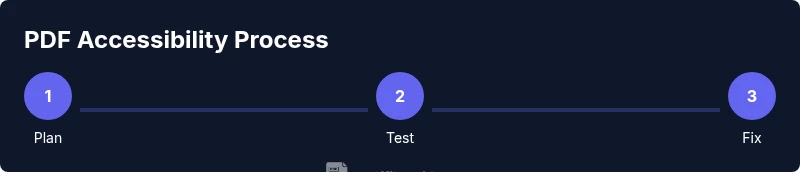
- Plan and scope: define accessibility goals, select test materials, and align with project timelines. 2) Run automated checks: gather baseline results and identify glaring problems. 3) Manual verification: inspect reading order, alt text, and tags in the Tag View. 4) Test with assistive tech: use a screen reader to navigate and interact with forms. 5) Document issues: capture tag paths, page numbers, and remediation steps. 6) Implement fixes: update tagging, alt text, language, and reading order in the source file or authoring tool. 7) Re-check: re-run automated checks and perform a quick manual pass. 8) Sign off and report: share results with stakeholders and log decisions. This workflow helps ensure consistency and repeatability, turning a once-off check into a repeatable practice within standard workflows. The process may vary by document type (forms, long reports, or multi-language PDFs), but the core steps remain the same.
Authoritative sources
- WCAG 2.1/2.2 standards: https://www.w3.org/TR/WCAG21/
- PDF/UA standard overview: https://www.pdfa.org/standards/pdfua/
- U.S. Section 508 guidelines: https://www.section508.gov/ These sources provide the foundational guidance for creating and evaluating accessible PDFs and other digital content. Use them to anchor your checks and remediation plan, and to justify decisions to stakeholders.
Tools & Materials
- Target PDF file to test(The document you will evaluate for accessibility)
- Computer with current software(Requires a modern OS and PDF reader with tagging/view support)
- Automated accessibility checker(Any tool that reports tagging, reading order, and alt text issues)
- Screen reader software(NVDA, VoiceOver, or TalkBack for live testing)
- Accessibility testing log/template(Template to record issues and fixes)
Steps
Estimated time: 45-75 minutes
- 1
Plan and prepare
Define what you will test, confirm the document’s purpose, and set success criteria before you begin. Identify which pages or sections are high risk (forms, long text, or tables).
Tip: Clear objectives prevent scope creep and speed up remediation. - 2
Run automated checks
Use your chosen automated tool to scan for missing tagging, incorrect reading order, missing alt text, and language issues. Export the report for reference.
Tip: Treat automated results as a baseline, not a final verdict. - 3
Inspect reading order and tagging manually
Open the Tag View or equivalent and verify the logical order of content. Check that headings are hierarchical and that lists and tables have proper tags.
Tip: If the order is off, adjust the tagging structure before content edits. - 4
Check images and form elements
Ensure all images have meaningful alt text and that form fields are labeled and navigable. Verify that hyperlinks have descriptive text.
Tip: Alt text should convey function, not decoration. - 5
Test language and accessibility features
Confirm the document language is set and that accessibility features (like bookmarks) work as expected during navigation.
Tip: Language metadata improves pronunciation in screen readers. - 6
Test with assistive technology
If possible, use a screen reader to navigate the document and test forms. Note any gaps in navigation or content interpretation.
Tip: Keyboard-only testing reveals issues that mouse users may miss. - 7
Document issues and plan fixes
Record exact locations of problems, propose remedies, assign owners, and set deadlines.
Tip: Include tag paths or page numbers to speed remediation. - 8
Re-check and finalize
Apply fixes, re-run automated checks, and re-test with assistive tech to confirm improvements.
Tip: If issues persist, escalate or re-author as needed.
Questions & Answers
What makes a PDF accessible?
An accessible PDF has proper tagging, a logical reading order, descriptive alt text for images, a defined document language, and navigable forms. These elements allow assistive technologies to interpret and present content correctly.
Accessible PDFs have tags, alt text, and a logical reading order, plus language and form support.
How do I test PDF accessibility for screen readers?
Use a screen reader to navigate the document with keyboard controls, listening for correct headings, link descriptions, and form labels.
Test with a screen reader and keyboard to ensure navigation and labeling work.
Which tools should I use to check PDF accessibility?
Combine automated checkers with manual review to cover tagging, reading order, alt text, and language settings.
Use both automation and manual checks for the most reliable results.
Can scanned PDFs be made accessible?
OCR can convert scans to text, but you must re-tag content and add alt text and structure for true accessibility.
Yes, with OCR and proper tagging, though some content may require manual adjustment.
How long does it take to fix accessibility in a PDF?
It varies by document complexity; plan for a structured remediation phase and re-check.
It depends on the document, but expect an iterative process with testing.
What if I can't modify the source file?
Provide an accessible summary or alternative formats if the source cannot be updated, and note constraints.
If edits aren't possible, offer summaries or alternate formats and document constraints.
Watch Video
Key Takeaways
- Check structure and reading order
- Verify alt text for images
- Validate language and navigation
- Use a combined automated/manual approach
- Document results for accountability