When to Test PDF: Practical Guide for Professionals
Discover when to test PDF files for reliability, accessibility, and security. A practical, step-by-step guide with tools and best practices for professionals editing and converting PDFs.


Test PDFs at key milestones in their lifecycle to ensure reliability, accessibility, and security. This quick guide highlights the main testing checkpoints—structure, tagging, forms, rendering across readers, and security settings—and outlines a practical routine to implement tests consistently. You’ll see where to test, what to look for, and how to document results for audits.
Why Testing PDFs Matters
Testing PDF files is essential for ensuring that documents render correctly, remain accessible to all users, and uphold security and integrity across devices and workflows. When to test pdf matters at every stage—from authoring to distribution—to catch issues early and save time in audits or reviews. The PDF File Guide team emphasizes that consistent testing reduces surprises in shared workflows and helps teams meet accessibility standards, especially for documents that will be read by people using assistive technologies. By validating layout, fonts, and reading order, you protect the document’s message and credibility across platforms.
Key Testing Areas for PDFs
A robust testing regime examines several core areas: (1) structure and tagging to guarantee logical reading order for assistive technologies; (2) font rendering and image quality to ensure legibility; (3) form fields and JavaScript behavior if enabled; (4) metadata and permissions to prevent information leakage or unauthorized edits; (5) encryption and password protection settings; and (6) cross-reader rendering and printing consistency. Each area contributes to the overall quality and accessibility of the PDF, and skipping any could lead to user frustration or compliance gaps. A practical approach is to map each area to a concrete test case and record the results for future reference.
When to Test PDF in Your Workflow
You should test PDFs at several predictable points to maximize efficiency and minimize risk. First, test during creation or after initial assembly to catch layout or tagging issues early. Second, test after any automated processing (conversion, OCR, or batch editing) to confirm changes didn’t degrade accessibility or structure. Third, test before sharing externally or archiving to ensure security settings and metadata are appropriate. Finally, test after significant revisions or updates to verify that new content remains accessible and readable. In short: when to test pdf is driven by change events, user needs, and governance requirements.
Tools and Methods for PDF Testing
Effective PDF testing combines manual checks with lightweight automation. Manual checks include opening the document in multiple readers to verify rendering, reading order, and form functionality. Automated methods include accessibility checkers that verify tagging, reading order, alt text, and structure; validation tools for conformance with PDF/UA or PDF/A standards; and simple tests for searchability, copy-paste, and metadata integrity. Use a diverse toolkit: computer with a modern browser or PDF viewer, a screen reader for accessibility validation, an accessibility checker, and a log sheet to document results. The goal is a repeatable process you can audit later.
Step-by-Step: How to Test a PDF (Preview)
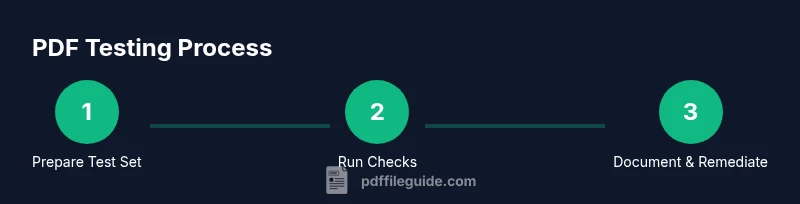
Below is an overview of the steps you’ll implement in the dedicated STEP-BY-STEP block. They outline actions you can perform to systematically verify a PDF’s usability, accessibility, and security. This preview helps you prepare for hands-on testing and aligns expectations across team members who will run the checks.
Accessibility Testing Deep Dive
Accessibility testing ensures the PDF is usable by all readers, including people who rely on screen readers or keyboard navigation. Key checks include proper tagging, logical reading order, alternative text for images, and accessible tables. Ensure that form fields are labeled, that tab navigation follows a logical sequence, and that color contrast is sufficient. Testing should also consider language tagging, metadata clarity, and the ability to extract meaningful content without loss of meaning. These checks help your PDFs meet accessibility standards and provide an inclusive experience.
Security and Integrity Checks
Security testing focuses on permissions, password protection, encryption, and content integrity. Verify that sensitive sections are properly restricted, that passwords or permissions are not easily bypassed, and that digital signatures validate the document’s authenticity. Integrity checks include confirming that file content is preserved during conversions or processing, and that there are no unexpected metadata leaks. Always document the security posture of PDFs before distribution and ensure compliance with relevant policies.
Tools & Materials
- A computer with internet access(Needed to run readers, checkers, and validators)
- Multiple PDF readers and viewers(Test rendering across different environments (browser, desktop app))
- Screen reader software(For accessibility validation; include options for at least one Windows and one macOS solution)
- Accessibility checker/tool(Automates verification of tagging, reading order, alt text, and structure)
- Validation tool for PDFs (PDF/A, PDF/UA)(Ensures compliance with standard conformance)
- Test PDFs set (diverse content)(Include scanned, text-based, forms, and image-heavy PDFs)
- Logbook or spreadsheet(Record test results, steps, and findings for audits)
- Printer or print emulator(Optional for verifying print fidelity)
Steps
Estimated time: 30-45 minutes
- 1
Prepare a diverse test set
Assemble PDFs representing typical content: text-heavy documents, scanned images, forms, and image-rich files. Include at least one tagged and one untagged PDF to compare results. This ensures you cover common real-world scenarios.
Tip: Include a mix of accessibility-compliant and non-compliant samples to spot gaps quickly. - 2
Open in multiple readers
Open each PDF in at least two readers (e.g., browser viewer and a dedicated PDF app) to catch rendering differences. Check reading order, font rendering, and image scaling across platforms.
Tip: Pay attention to fonts that substitute unexpectedly; note any mismatches. - 3
Validate tagging and reading order
Use an accessibility checker to verify tag structure and reading order. Confirm that screen readers announce headings, landmarks, and list structures as expected.
Tip: If tags are missing or misordered, adjust the source document and re-test. - 4
Test form fields and interactivity
Interact with every form field: tab order, default values, field labels, and calculation scripts if present. Ensure data is captured correctly and that required fields are clear.
Tip: Check that fields remain accessible when exported or printed. - 5
Check metadata, search, and copy
Search within PDFs, copy-paste text, and review metadata for sensitive data. Ensure no unintended disclosures and that searchable text is accurate after OCR.
Tip: OCR results may vary; document the OCR version and accuracy notes. - 6
Document results and plan remediation
Record findings in a structured log: issue type, severity, steps to reproduce, and responsible owner. Prioritize remediation based on impact and accessibility requirements.
Tip: Create a remediation checklist to guide fixes and retries.
Questions & Answers
What does testing a PDF cover?
Testing a PDF covers rendering, structure and tagging, form fields, metadata, searchability, and security settings. It also checks accessibility compliance and cross-device compatibility to ensure a consistent user experience.
PDF testing covers rendering, tagging, forms, metadata, search, and security to ensure accessibility and compatibility.
When should you test PDFs during production?
Test during development after assembly, after automated conversions, before distribution, and after major edits. Regular testing at these milestones reduces surprises in reviews or audits.
Test at development, after conversions, before distribution, and after edits.
Which tools are best for PDF accessibility testing?
Use a combination of an accessibility checker, screen reader validation, and manual checks for tag structure. Validation against PDF/UA and related standards helps ensure compliance.
A mix of accessibility checkers, screen readers, and manual checks is best.
How do you test encrypted PDFs?
Verify that required permissions are enforced, that passwords protect only sensitive content, and that legitimate access remains uninterrupted for authorized users.
Check permissions and access controls; ensure authorized users can view content as intended.
Can testing be automated for PDFs?
Automation can cover repeatable checks like tag presence, reading order, and metadata verification. Combine automated results with manual review for best coverage.
Yes, automate repetitive checks and complement with manual reviews for depth.
Watch Video
Key Takeaways
- Define clear testing milestones for PDFs.
- Verify tagging and reading order for accessibility.
- Confirm form fields and interactivity work as intended.
- Test across readers and devices for reliability.
- Document results to support audits and governance.