How to Compress PDF File Size: A Practical Guide
Learn practical steps to reduce PDF file size without sacrificing essential quality. This guide covers techniques, tools, and best practices for professionals who edit, convert, and optimize PDFs.


If you’re wondering is it compress pdf file size, the answer is yes: you can shrink a PDF by optimizing images, removing metadata, and selecting smarter downsampling and compression settings. According to PDF File Guide, begin with a quick size check and apply focused optimizations to retain essential quality. Most changes stay invisible in appearance but drop file weight noticeably.
Why compressing PDF size matters
PDF files occupy storage and affect how you share them. For professionals who edit, convert, and optimize PDFs, shrinking file size can improve upload times, reduce bandwidth, and make email attachments feasible. The key is to balance quality with compression so the document remains readable on screens and prints accurately. According to PDF File Guide, a thoughtful approach combines content-aware optimizations with reliable tools. The question is practical for most workflows: is it compress pdf file size? The answer is yes, but the strategy must respect the document’s purpose. In this section, we’ll explore when compression pays off and how to set expectations for quality versus weight. You’ll learn how to frame your targets, estimate potential reductions, and avoid common pitfalls that create unreadable outputs.
What drives a PDF's size
A PDF’s size is driven by several interacting factors. Large or high-resolution images, embedded fonts, complex vector graphics, and transparency effects can dramatically increase file weight. Metadata, embedded thumbnails, annotations, and form fields add hidden data that often gets ignored during quick edits but contributes to size. Even color profiles and embedded color spaces can add bloat if not managed properly. Understanding these components helps you identify which optimizations will yield the biggest gains. PDF File Guide notes that the most impactful changes usually target image compression, font subsetting, and removal of unnecessary metadata. For is it compress pdf file size, this becomes a content-aware exercise: what elements must be preserved for the document’s purpose, and what can be trimmed without breaking readability or accessibility? As you assess your file, consider how the viewer will access it (screen, print, or mobile) and adjust your strategy accordingly.
Quick wins you can apply with minimal tools
If you want fast wins, focus on a handful of low-effort optimizations that almost always reduce size without obvious quality trade-offs. Remove unused metadata and thumbnails, flatten form fields if they don’t need to be interactive, and downsample large images to a practical resolution (e.g., 150–300 ppi for on-screen viewing). Convert color images to JPEG or WebP where appropriate, and ensure compatibility settings don’t force unnecessary high-bit-depth content. Use built-in optimization tools in your PDF editor to choose a suitable downsampling threshold and compression method. For many professionals, these quick wins form the backbone of an efficient compression workflow and are a practical starting point when facing a large, unwieldy file. PDF File Guide emphasizes testing after each change to confirm that essential details remain intact and readable.
Step-by-step: high-level plan before diving into tools
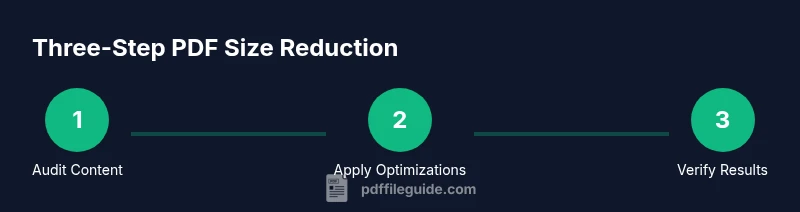
Before changing anything, set clear goals. Determine the target file size and acceptable quality loss based on the document’s use case (email distribution, archival, client delivery, or printing). Identify non-critical elements to trim first (e.g., metadata, embedded thumbnails, annotations). Decide whether you will compress images in-place or replace them with pre-processed versions. Choose a toolset that matches your workflow (GUI editors for quick tweaks, command-line tools for batch processing). Finally, plan a validation checklist to verify layout, searchability, and accessibility after optimization. This planning phase reduces repeated work and helps you justify compression decisions to stakeholders. PDF File Guide can assist in defining success criteria and ensuring consistency across files.
Advanced techniques for large PDFs
For very large or image-heavy PDFs, advanced optimization becomes necessary. This includes using scriptable tools like Ghostscript to apply targeted downsampling, color space reduction, and lossless versus lossy compression modes. Subsetting embedded fonts—keeping only the characters actually used in the document—can dramatically cut font payloads. Consider removing embedded multimedia and attachments unless absolutely required for the use case. If you distribute across the web, you may also enable linearization to improve streaming performance for incremental loading. When applying these techniques, keep a strict versioning approach: always keep the original file, document every change, and compare results against a baseline. PDF File Guide recommends testing across devices and viewers to ensure consistent appearance and functionality.
Measuring success: verification and quality checks
After compression, you must verify both size and readability. Compare the new file size to the original and calculate the percentage reduction. Open the PDF in multiple readers and devices to check layout, fonts, and image clarity. Run basic checks for text search, form functionality, and link accuracy. For print use, review color accuracy and printer output. Ensure accessibility attributes remain intact if the document needs assistive technology support. If issues arise, revert to the previous version or re-optimize with adjusted settings. The goal is an acceptable balance between file size and document integrity.
Safety and best practices for compression
Always back up the original before making changes. Use non-destructive workflows when possible and document each optimization pass. Don’t rely on a single tool or setting; test multiple configurations to find the best compromise for your content type. Be mindful of security considerations: compressing a PDF should not strip necessary permissions or encryption needed for sensitive documents unless you have alternative security measures in place. Finally, review your workflow periodically to align with evolving standards and best practices in PDF optimization.
Tools & Materials
- PDF editor software (e.g., Adobe Acrobat Pro, Foxit PDF Editor)(Use built-in Optimize/Reduce File Size features; adjust image downsampling and font embedding settings.)
- Ghostscript (gs) command-line utility(Ideal for scriptable, robust compression of multiple files.)
- qpdf (PDF transformation library)(Helpful for structural optimizations and linearization when applicable.)
- Original PDF backup(Always keep a non-modified copy in case you need to revisit changes.)
- Image editor or pre-processor (optional)(Use for re-optimizing images (resize, re-compress) before re-embedding.)
- Test devices (optional)(Screen and print tests help verify readability across scenarios.)
Steps
Estimated time: 45-90 minutes
- 1
Back up the original PDF
Create a secure, dated copy of the file in a separate folder. This protects you from accidental loss and lets you compare before/after results.
Tip: Use a descriptive naming convention like DocumentName_vOriginal_Date. - 2
Audit the document contents
Review the document to identify large images, embedded fonts, and sections with non-essential metadata. This helps target where to apply optimizations.
Tip: Note which pages contain heavy graphics that may require re-encoding. - 3
Remove metadata and unnecessary attachments
Delete metadata, thumbnails, and any non-essential attachments to shave weight without affecting content.
Tip: If metadata is needed for compliance, keep only the minimal fields. - 4
Downsample images to a practical resolution
Reduce image resolution to 150–300 ppi for on-screen viewing; print-critical graphics may require higher thresholds. Re-embed optimized images.
Tip: Avoid downsampling text images; preserve legibility for scanning. - 5
Subset embedded fonts
Include only the glyphs used in the document, rather than the full font.
Tip: Check that font subset does not impact non-Latin characters if used. - 6
Compress content streams and flatten layers
Apply lossless or lossy compression to streams and flatten transparency if the document won’t benefit from editing later.
Tip: Flattening may affect editability; plan accordingly. - 7
Save as optimized PDF with proper settings
Choose compatibility settings that balance features with size, and enable optimization options in your tool.
Tip: Prefer a modern standard unless you must support legacy viewers. - 8
Verify size, quality, and accessibility
Check file size, visual quality, and, if needed, accessibility tags and structure to ensure compliance.
Tip: Run a quick screen-check and a print test to confirm the result.
Questions & Answers
What is the most effective way to reduce PDF size without quality loss?
The most effective methods vary by content, but typically image downsampling, font subsetting, and metadata removal yield the biggest gains with minimal visible quality loss. Always test after changes to ensure readability and functionality.
Use image downsampling, font subsetting, and metadata removal, then test the result to ensure readability.
Can removing metadata impact accessibility or searchability?
Removing metadata can reduce file size, but essential accessibility and search features should remain intact if you preserve the document’s structure and tags. Carefully review what you remove.
If accessibility and search tags are needed, keep essential metadata and structure while removing non-essential data.
Is online compression safe for confidential documents?
Online tools can expose content to third parties. For confidential material, use offline, trusted software or in-house workflows to maintain security.
Prefer offline tools for sensitive PDFs to protect privacy.
Does font subsetting affect non-Latin characters?
Font subsetting reduces size by including only used glyphs. If your document includes multilingual text, verify all characters render correctly after subsetting.
Check multilingual content after subsetting to avoid missing glyphs.
When should I avoid compression altogether?
If the document contains critical print quality requirements or interactive forms that rely on embedded elements, you may need to limit compression or maintain higher quality settings.
If quality or interactivity is critical, limit compression and test thoroughly.
What tools are best for beginners?
Begin with built-in PDF editor optimization features. For batch work, Ghostscript and qpdf offer powerful command-line options with careful parameter tuning.
Start with GUI tools, then explore script-based options for batch tasks.
Watch Video
Key Takeaways
- Back up before compressing.
- Target the biggest size drivers first (images, fonts, metadata).
- Use appropriate tools for batch processing when possible.
- Verify readability and functionality after compression.