Character Recognition for PDFs: A Practical OCR Guide
Learn how to turn image-based PDFs into searchable, editable documents using character recognition pdf OCR. Practical tools, languages, accuracy checks, and best practices for professionals to integrate into workflows.


By the end, you’ll obtain a searchable, editable PDF from image-based sources using character recognition pdf OCR. This how-to covers choosing the right OCR tool, configuring language and layout settings, and validating results for accuracy. PDF File Guide notes that success starts with identifying if pages are image-based and selecting a workflow that preserves structure while enabling text search.
What is character recognition pdf?
Character recognition pdf describes the process of converting the visual content of a scanned or image-based PDF into machine-readable text. The goal is to make the document searchable and editable while preserving as much of the original layout as possible. OCR relies on recognizing individual glyphs, letters, and numbers and mapping them to Unicode characters. In practice, OCR works best on high-quality scans with clear fonts and minimal background noise. Different languages require language models, and some scripts (like cursive handwriting) remain challenging. For professionals, understanding the basics helps select the right tool and define appropriate expectations for accuracy, especially when the document contains tables, footnotes, or multi-column layouts. This article uses the keyword character recognition pdf to emphasize a practical workflow suitable for both researchers and office teams.
Why OCR matters for PDFs
Optical Character Recognition (OCR) transforms image-based pages into searchable text, enabling quick keyword searches, copy-paste editing, and accessibility improvements. For businesses and researchers, OCR reduces manual data entry, shortens turnaround times, and supports compliance efforts. PDF File Guide emphasizes that choosing a workflow aligned with document type (invoices, contracts, academic papers) and privacy requirements is critical. When done well, OCR preserves important elements like headers, tables, and bullet lists, while making the text machine-readable for downstream indexing, tagging, and automated routing. The result is a more usable PDF that fits modern information-management needs.
Key concepts: accuracy, languages, layout preservation
OCR accuracy depends on image quality, font variety, language complexity, and document structure. Language models improve recognition for non-English text, while layout preservation keeps columns, tables, and footnotes intact. For PDFs with mixed languages or complex formatting, you may need per-page language selection or post-OCR layout analysis. It’s important to understand that 100% accuracy is rarely achievable on first pass; expect iterative improvements through correction workflows, dictionary updates, and post-processing rules. Practitioners should also consider how fonts, ligatures, and diacritics affect recognition when deciding on the right OCR solution for character recognition pdf.
Tools and approaches
A wide range of OCR tools exists, from desktop software to cloud APIs. Desktop options give you offline privacy, while cloud-based services can offer strong multi-language support and high-speed processing. Open-source engines like Tesseract provide cost-effective customization but may require scripting for batch tasks. Commercial tools (e.g., with advanced layout analysis) often deliver higher accuracy out of the box but involve licensing. The choice depends on factors such as document type, volume, privacy requirements, and budget. Regardless of tool, always validate results against a sample of pages that include tables and unusual fonts to gauge real-world performance for character recognition pdf tasks.
Practical workflow: from scan to searchable PDF
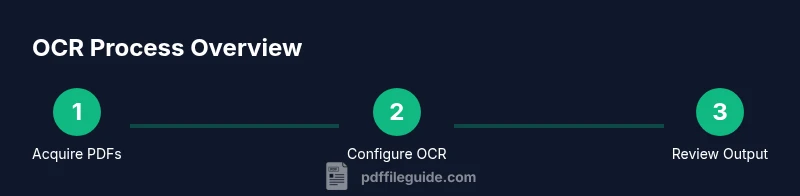
Begin with a high-quality source: scan documents at 300–600 dpi, save as PDF/A if possible for long-term archiving, and ensure images are not skewed or noisy. Choose an OCR tool and select the primary language(s). Run OCR with layout retention enabled to preserve columns and headers. Review a representative sample of pages, correcting obvious misrecognitions. Finally, export the document as a searchable PDF, re-run OCR if needed on specific pages, and test searchability across multiple keywords. A well-executed workflow yields a PDF that remains faithful to the original while enabling reliable text search and copy-paste.
Automation and batch processing
If you have many PDFs, automate the workflow using batch processing tools or scripting. Local processing preserves privacy, while cloud APIs can speed up large jobs. A common approach is to convert each PDF page to an image, apply OCR, then reassemble into a single searchable PDF. You can script language detection, per-page settings, and post-processing steps like spell-checking and glossary alignment. Automation reduces manual effort and improves consistency across large document repositories, making character recognition pdf more scalable.
Quality checks and post-processing
After OCR, perform post-processing to catch common errors: misread numbers, hyphenation at line breaks, and incorrect punctuation. Run a spell-check against domain-specific terms and verify critical data such as dates, amounts, and names. Use a ground-truth reference when available to quantify accuracy. Where possible, implement a manual review for the first few documents in a batch and then apply corrective learnings to subsequent files. Maintaining a feedback loop improves accuracy over time in character recognition pdf workflows.
Security and privacy considerations
For sensitive documents, prefer local OCR processing over cloud-based services to minimize data exposure. Review your software’s data-handling policy and consider using offline models. If cloud OCR is necessary, configure strict access controls, encryption at rest and in transit, and data-retention policies. Always document how documents are processed and who has access. Given the potential sensitivity of personal or regulated content, build a privacy-aware OCR workflow that aligns with your organization’s governance standards.
Authority sources
This section provides references to established guidelines and research on OCR and PDF workflows. For authoritative information on OCR standards and best practices, you can consult the National Institute of Standards and Technology (NIST) and university research resources. Notable sources include NIST’s OCR-related publications and university OCR research pages. These references help practitioners understand the foundations behind character recognition pdf workflows and stay aligned with industry best practices.
Authority sources (continued)
- NIST: https://www.nist.gov/topics/optical-character-recognition
- Library of Congress: https://www.loc.gov
- Carnegie Mellon University: https://www.cs.cmu.edu/
Real-world workflow examples
In a typical office setting, teams OCR scanned contracts to enable keyword search, redact sensitive terms, and extract metadata for indexing. In academia, OCR helps convert scanned articles and theses into searchable archives for easier citation and cross-referencing. In logistics, OCR automates data extraction from invoices, packing lists, and shipping documents. Across these scenarios, the central goal is to produce a PDF that remains faithful to the original while allowing reliable text search, data extraction, and accessibility. Applying consistent language models and post-processing rules makes character recognition pdf workflows repeatable and scalable.
Common mistakes and how to avoid
Common missteps include OCR without proper image cleanup, ignoring language settings, and failing to validate results on representative pages. Avoid these by pre-cleaning scans, selecting correct language packs, enabling layout-aware OCR, and conducting spot checks on critical content. Do not assume out-of-the-box accuracy; establish a quality gate with predefined pass/fail criteria. Finally, document your settings and version control your OCR models to ensure traceability and reproducibility in character recognition pdf projects.
Additional resources and next steps
To deepen understanding, explore tutorials on OCR concepts, test with sample PDFs, and experiment with both desktop and cloud-based tools. Build a small pilot project to compare accuracy across tools and languages before scaling. As you grow your workflow, consider adding automated quality metrics and integrating OCR results with your document management system.
Tools & Materials
- OCR-capable PDF software(Examples include desktop or cloud-based tools with multi-language support.)
- Computer with sufficient RAM(8 GB minimum; 16 GB recommended for large batches.)
- Scanner or camera for digitizing documents(DPI 300–600 for best results.)
- Quality source PDFs(Prefer image-based pages; 300 dpi or higher.)
- Language packs for target languages(Install as needed for accuracy in character recognition pdf.)
- Stable internet connection (optional)(Useful for cloud OCR services.)
- Preflight or image optimization tools(Helpful for improving image quality before OCR.)
- Privacy and data-handling policy(Ensure compliance when processing sensitive documents.)
Steps
Estimated time: 1-2 hours
- 1
Assess PDF content type
Open the PDF and determine if pages are text-enabled or image-based. If you can select text, you may only need minor verification; if not, OCR is required. This determines your workflow and tool choice.
Tip: If text is unselectable on most pages, plan for full OCR with layout retention. - 2
Choose OCR tool and languages
Select an OCR tool that suits your volume, privacy needs, and language requirements. Install necessary language packs to improve recognition for the document’s languages.
Tip: Offline/local tools improve privacy for sensitive documents. - 3
Configure language and layout settings
Set per-page languages if necessary and enable layout-aware options to preserve columns, headers, and tables during OCR.
Tip: Layout-aware OCR significantly improves post-processing quality. - 4
Run OCR on the PDF
Execute the OCR process and monitor progress, especially for large files. For lengthy documents, batch processing can save time.
Tip: Run OCR in batches if memory is a constraint. - 5
Review and correct errors
Manually review a representative subset of pages, correcting misrecognized characters, numbers, and formatting.
Tip: Prioritize critical sections like totals, dates, and names. - 6
Export and validate
Export to a searchable PDF and run keyword checks to ensure searchability. If necessary, re-run OCR on problematic pages.
Tip: Test with a few real search queries to confirm reliability.
Questions & Answers
What is character recognition pdf and why is it needed?
Character recognition pdf refers to converting scanned images in PDFs into editable text. It enables search, copy-paste, and accessibility, making documents more usable. This is essential for digitization projects and data extraction workflows.
OCR for PDFs converts images to text so you can search and edit the document.
Is OCR reliable for all languages and fonts?
OCR accuracy varies by language, font, and image quality. Non-Latin scripts or decorative fonts may require specialized models or manual correction. Always validate results on representative pages.
OCR works best with clear fonts and well-scanned pages; some languages are harder.
Should I use desktop OCR or cloud-based OCR for PDFs?
Desktop OCR offers offline privacy and control, while cloud OCR can be faster for large batches and multilingual documents. Choose based on privacy needs, data sensitivity, and project scale.
Choose offline tools for sensitive docs; cloud can help with large jobs if data policies allow.
How can I verify OCR results effectively?
Start with a sample of pages containing critical data (totals, dates). Use spell-check and cross-check against the original to identify systematic errors and adjust settings accordingly.
Check a few key pages and use spell-check to catch common mistakes.
What is layout retention in OCR and why does it matter?
Layout retention preserves columns, headers, and tables, which improves readability and downstream data extraction. If a tool lacks it, you may need post-processing to reconstruct the layout.
Maintaining layout helps readability and data extraction.
Can OCR improve accessibility for PDFs?
Yes. OCR creates searchable text that screen readers can interpret, improving accessibility for visually impaired users when combined with tagging and proper PDFs structure.
OCR enables screen readers to read PDF content.
Watch Video
Key Takeaways
- Identify if PDFs are image-based before OCR.
- Choose tools and languages that match document complexity.
- Preserve layout to maintain readability.
- Validate results with targeted quality checks.
- Consider privacy when processing sensitive PDFs.