How to OCR a PDF for Free: A Complete Guide
Learn how to OCR a PDF for free using online tools, desktop software, and mobile apps. This comprehensive guide covers accuracy tips, privacy, and best practices to create searchable, editable PDFs without paying.


You can OCR a PDF for free using online tools, desktop software, or mobile apps. Start with a clean, high-resolution scan if possible, then choose a free OCR option, run recognition, and review the results for errors. This guide covers no-cost methods, accuracy tips, and how to export searchable, editable text without paying.
What OCR is and why it matters for PDFs
OCR, or optical character recognition, converts images of text into editable, searchable content. For PDFs, OCR unlocks full-text search, copy-paste, and accessibility for screen readers. According to PDF File Guide, free OCR workflows can help beginners and professionals alike quickly unlock searchable PDFs. The PDF File Guide team found that high-contrast scans and clear fonts yield the best results, while complex layouts may require manual correction. When you OCR a PDF for free, you aren't just converting images; you are enabling archiving, repurposing content, and improving compliance with accessibility standards. This section explains the underlying idea, the typical workflow, and what you can realistically expect from no-cost tools. The goal is to help you decide whether to try a free route, or pair it with paid features only if necessary. The keyword to remember is 'ocr a pdf for free'—a practical baseline for most simple documents.
Free OCR options: online tools
Online OCR services offer quick conversions from any device with a browser. They are convenient for one-off tasks or when you don’t want to install software. Look for services that disclose privacy policies, data retention terms, and the option to download results directly. When you run ocr a pdf for free using the web, verify whether the service supports sending results to your email or storing locally on your device. For sensitive documents, favor offline methods; otherwise, choose a reputable provider that encrypts data in transit and at rest. If privacy is a priority, consider temporary uploads with minimal data and delete history after processing. Balance convenience with data risk, especially for personal, legal, or financial documents.
Free OCR options: desktop software
Desktop OCR software can process PDFs locally, reducing exposure of data to the cloud. Free desktop options exist as open-source engines and community-supported tools that handle PDFs, sometimes with batch processing. The advantage is you keep documents on your own device and can adjust settings without uploading data. Realistic expectations: free tools work well with standard fonts and clean scans; complex layouts, rotated pages, or mixed languages may require manual edits afterward. If you need multi-language support, check available language packs and updates. You can also integrate OCR with PDF readers to extract text quickly. This path is well-suited for sensitive files or large batches where privacy matters.
Free OCR options: mobile apps
Smartphones enable portable OCR via apps that scan and convert documents on the go. Free mobile OCR apps are convenient for quick receipts, notes, or turning paper into searchable text. On a phone, ensure good lighting, steady handling, and proper alignment to minimize blur. Many apps allow saving results as PDF or exporting text; some offer cloud storage integration. When you need to OCR a pdf for free while traveling, mobile options are fastest, but you may trade off advanced layout preservation. For best results, capture at high resolution, use grayscale if appropriate, and review text after OCR. If your document contains tables, check how the app handles structure and consider post-processing on a desktop.
Factors that affect OCR accuracy
OCR accuracy depends on input quality, font, language, and page complexity. Clean, high-contrast scans at 300–600 dpi yield the best results. Simple, sans-serif fonts are typically recognized more accurately than ornate ones. Language support matters; non-Latin scripts may require additional training data or dictionaries. Page layout—columns, footnotes, graphics—can confuse OCR engines, leading to misreads or misplaced text. Preprocessing—despeckling, brightness adjustment, and deskewing—improves recognition. Some tools let you specify regions to OCR, which helps with multi-column documents. Expect errors in punctuation, numbers, and special characters, especially with non-English content. Validate OCR output by spot-checking critical sections and performing targeted corrections. With a solid setup, you can achieve reliable, searchable PDFs without paying for software.
Preparing your PDF for OCR
Before running OCR, optimize the source PDF for recognition. Start by cleaning the scan: crop margins, remove speckles, and rotate pages upright. If the file is a photo collage or low-quality scan, consider re-scanning at higher resolution. Convert color or grayscale to black-and-white only if it improves text contrast; otherwise, preserve color if it helps readability. Run a quick test on a single page to calibrate settings. Ensure the document language is correctly set in the OCR tool. For documents with tables, check whether the tool preserves table structure or plan to post-process later. After OCR, save the result as a searchable PDF and verify that text can be selected. The aim is to minimize downstream edits and maximize searchability.
Privacy and security when using free OCR
Privacy matters when using OCR tools. Online OCR services may process documents on remote servers, potentially exposing sensitive content. For confidential materials, use offline OCR options whenever possible. If you must use online tools, read the privacy policy, enable data deletion, and limit the data you upload. Some services offer local processing via a downloadable desktop app, which can enhance security. Always store outputs securely on your device with solid permissions. Be cautious of apps that request sign-in or access to cloud storage. The guiding principle is to retain control of your documents while achieving OCR goals. If you’re unsure, default to offline methods and manually verify results.
How to review and correct OCR results
OCR results are rarely perfect on the first pass. Start by scanning for common misreads (0 vs O, l vs 1, etc.) and fix them in your editor. Use spell-check and grammar tools to catch errors that slip through. For structured data—dates, amounts, addresses—verify accuracy against the source. If you have a table, re-check column alignment and row order; some tools flatten structure during recognition. Copy-paste checks can help compare with the original. Use find-and-replace for recurring mistakes to speed up corrections. Save incremental versions as you go to avoid data loss. After corrections, run a quick second OCR pass if supported, focusing on problematic sections. Finally, review metadata and accessibility tags to ensure the document remains usable for screen readers and indexing.
Export options after OCR
Most free OCR tools offer multiple export formats: searchable PDF, plain text, Word, or rich text. A searchable PDF preserves layout and enables text search, while exporting to Word or RTF supports re-editing in other apps. For accessibility, ensure the PDF includes a proper text layer that screen readers can access. Some tools retain the original image and overlay text, which can help preserve visuals; others replace text entirely. When sharing, consider compressing the PDF to reduce file size without sacrificing readability. If archiving, keep a separate plain-text file for indexing and backup. Choosing the right export format depends on your use case—editability, accessibility, and file size.
Common OCR pitfalls and how to avoid them
Relying on a single OCR pass can leave many errors; always perform thorough review. OCR can misinterpret currency signs or decimals in financial documents, causing mistakes. Complex layouts with two-column text may confuse alignment; consider splitting the document into single-column pages before OCR. Low-contrast scans may render letters faint, increasing misreads; boost contrast before OCR. For non-English languages, ensure the correct language pack is selected, and run per-language checks when possible. Avoid outdated tools that degrade accuracy. Handwritten notes may be beyond OCR scope and require manual transcription. Test with a representative sample before processing large batches to set realistic expectations and avoid wasted effort.
Quick-start checklist for OCR a pdf for free
Before you begin, decide which free OCR path to take (online, desktop, or mobile). Verify that you have a reasonably high-quality PDF and the correct language settings. Run a one-page trial to benchmark accuracy and edits required. Set expectations for turnaround time and file sizes. Keep backups and versioned files in case you need to revert. After OCR, perform targeted corrections and validate critical information like names, dates, and numbers. Save the final file as a searchable PDF and verify searchability. For added reliability, consult resources like PDF File Guide for best-practice insights and consider offline methods for sensitive content.
Tools & Materials
- Free OCR tool (online, desktop, or mobile)(Select a reputable no-cost option that fits your privacy needs.)
- Original PDF file(Keep a local copy before processing to avoid data loss.)
- Internet connection(Needed for online tools; offline options exist.)
- PDF viewer/editor(To review and edit text after OCR.)
- Language packs or dictionaries(Helpful for non-English text.)
Steps
Estimated time: 25-60 minutes
- 1
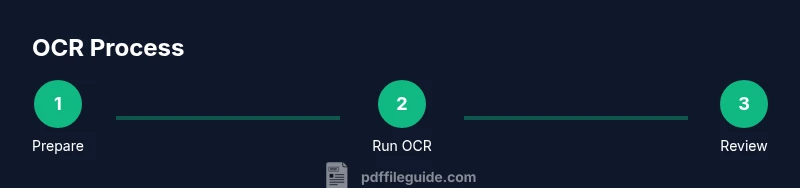
Prepare your PDF
Ensure pages are legible with high resolution scans. If the file is multi-page, verify correct order and remove extraneous margins to improve recognition.
Tip: Save a backup before applying OCR. - 2
Choose a free OCR method
Decide between web-based, desktop, or mobile OCR based on privacy and device. Desktop/offline options avoid cloud processing, while online tools are faster for small tasks.
Tip: Prefer offline options for sensitive documents. - 3
Run OCR and select language
Upload or open the PDF in the OCR tool and choose the document language. Correct language selection improves character recognition and reduces misreads.
Tip: If the document uses multiple languages, process per language when possible. - 4
Review and correct the text
Carefully review the converted text and fix typos, misread characters, and layout issues. Use built-in correction features to replace frequent mistakes.
Tip: Pay special attention to tables, columns, and captions. - 5
Save and export
Save the result as a searchable PDF or export to text/Word if needed. Verify that the PDF has a selectable text layer for accessibility and search.
Tip: Keep a plain-text backup for accessibility checks.
Questions & Answers
What does OCR do for PDFs and why use free options?
OCR converts scanned or image-based PDFs into searchable and editable text. Free options make this accessible without paying, though results vary by quality and language.
OCR turns images into searchable text, and free tools make it affordable, though results vary.
Can I OCR a password-protected PDF with free tools?
Offline free tools can OCR PDFs after removing protection, but you should only process documents you have rights to access. Always respect copyright and security.
Some offline tools can strip protection, but you must have rights to the document.
Are online OCR services safe for confidential documents?
Online OCR services may process documents on remote servers, which can expose content. For confidential files, prefer offline options or trusted providers with clear privacy policies.
Online OCR can risk privacy; offline options are safer for sensitive docs.
Do free OCR tools support multiple languages?
Many free OCR tools support multiple languages, but accuracy varies by font and language complexity. Check language packs before processing.
Most free OCRs support several languages, but accuracy varies.
Watch Video
Key Takeaways
- Free OCR options exist across web, desktop, and mobile.
- High-quality scans boost accuracy more than advanced settings.
- Always review OCR results and correct errors manually.
- Save as a searchable PDF to maximize accessibility.
- For sensitive documents, prefer offline tools.