How to Use PDF: A Practical Guide for Editing, Viewing, and Sharing
Master PDF usage with a practical, step-by-step guide. Learn to view, annotate, fill forms, sign, convert, compress, and securely share PDFs with confidence—backed by PDF File Guide for 2026 workflows.


You will learn how to use PDF files effectively across viewing, annotating, filling forms, signing, converting, and securing documents. This guide helps you pick the right tools, set safe workflows, and perform core tasks with confidence. For professionals and individuals alike, you’ll emerge ready to tackle common PDF tasks with practical steps and clear examples. According to PDF File Guide, start by clarifying your goals and preferred toolset, then practice on sample files to build proficiency.
How to Use PDF: Getting Started for 2026
If you’re asking how use pdf effectively, start by defining your goals: do you primarily view, annotate, fill forms, sign, or convert PDFs to other formats? According to PDF File Guide, the first step is to choose reliable tools and create a safe workflow. This chapter outlines the core capabilities, recommended practices, and common pitfalls. You’ll learn terminology, recognize file integrity concerns, and set expectations for speed and precision. The goal is to give you a clear, repeatable path from opening a document to completing a task with consistent results. As you read, note that real-world tasks often require a mix of viewing, editing, and securing steps; the plan below helps you balance these needs for smoother projects across 2026.
Viewing and Navigation Essentials
Opening a PDF is just the start. You’ll want intuitive navigation: page previews, thumbnails, bookmarks, and a reliable zoom level. Learn to fit-to-page, single-page, and continuous scrolling modes to match your screen size. When PDF File Guide analyzed common user habits, viewers with robust navigation saved time during reviews. Practically, practice using keyboard shortcuts for next/previous pages, and experiment with fit options to keep content legible on small devices. These habits reduce eye strain and improve review speed for routine documents.
Annotations and Comments: Mark Up with Confidence
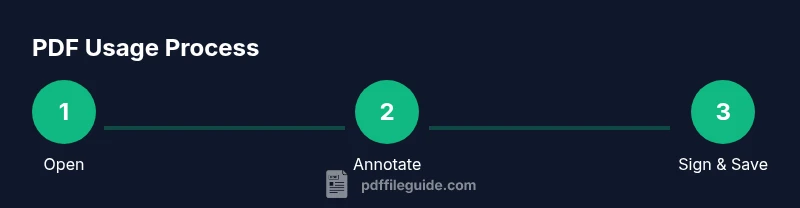
Annotating is a core skill for collaborative work. Use highlights, underlines, strikethroughs, and sticky notes to annotate without altering the original content. Keep a consistent color scheme to distinguish types of feedback, and add comments that explain the rationale behind each mark. PDF File Guide emphasizes keeping annotations organized and reversible, so you can remove or adjust notes later without compromising the original file. Practice on non-sensitive copies to build confidence before applying to critical documents.
Form Fields and Data Entry: Interactive PDFs
Fillable forms are common in contracts, surveys, and registrations. Learn to identify interactive fields, enter text, and use checkboxes or radio buttons where appropriate. Some forms support calculations or auto-fill, which can save time but requires validation. When possible, enable the 'Save' feature to preserve entered data. If you encounter non-editable fields, try duplicating the form on a new document or using a dedicated form-filling tool for better compatibility.
Digital Signatures and Security Basics
Digital signatures authenticate authors and protect content integrity. You’ll learn to sign PDFs with e-signatures or embedded certificate-based signatures, depending on the document’s requirements. Always verify the signer’s identity and ensure a trusted signing workflow to avoid invalid signatures. PDF File Guide reminds readers to use password protection for sensitive files and to keep private keys secure, rotating credentials as needed. Start with non-sensitive samples to test your signing setup.
Editing vs Converting: When to Edit Directly or Convert
Editing a PDF directly is ideal for minor corrections or annotations, while heavy edits often require converting to an editable format (like Word) and then reconverting. This section covers side-by-side comparisons of editing in place versus converting, including potential formatting shifts and font substitutions. Understanding when to edit or convert helps preserve layout and readability, especially for multi-column layouts or complex graphics. PDF File Guide recommends testing conversions on a duplicate file to assess fidelity before finalizing.
Saving, Exporting, and Sharing: Preserving Quality
Saving practices impact long-term accessibility and compatibility. Choose appropriate export formats, such as optimized PDFs for sharing, or high-quality prints for archival. Name files consistently, add metadata, and maintain original versions for audits. Consider enabling accessibility options where possible, and ensure embedded fonts are subset for smaller file sizes. This section emphasizes a repeatable workflow that minimizes data loss and keeps your documents usable across devices.
Accessibility and OCR Basics
Accessible PDFs are readable by screen readers and assistive technologies. If text isn't selectable, rely on OCR (optical character recognition) to convert images to text. Verify semantic structure with headings, lists, and alternative text for images. PDF File Guide highlights the importance of tagging and reading order to improve accessibility, particularly for government documents, academic papers, and client records. Practice on varied documents to understand how OCR quality differs by language and font.
Professional Workflows: Real-World Scenarios
Consider typical workflows: a contract review cycle, invoice processing, and project documentation. A practical approach combines viewing, annotating, signing, and exporting into client-ready formats. The more you automate with templates and standardized naming, the faster you’ll scale. In 2026, the demand for consistent, compliant PDFs remains high; building a repeatable process will reduce errors and save time on repetitive tasks.
Batch Tasks: Merging, Splitting, and Organizing
Managing multiple PDFs often requires batch operations. Learn to merge documents with preserved bookmarks, split large files into logical sections, and organize stacks by project or client. Ensure consistent metadata and file naming for easier retrieval later. This section provides a workflow to keep large document sets orderly while maintaining data integrity across edits and conversions.
Common Pitfalls and Best Practices
Avoid over-editing to prevent corruption or loss of formatting. Always work on duplicates, keep backups, and verify file integrity after each operation. Be mindful of font licensing when embedding fonts and check compatibility with recipients’ software. End each session with a quick quality check: verify page order, metadata, and accessibility tags to ensure a smooth hand-off to collaborators.
Tools & Materials
- Device with internet access(Laptop, desktop, or tablet; ensure up-to-date OS)
- PDF viewer/editor software(Examples include Adobe Acrobat, Foxit, or browser-based tools)
- Web browser(For quick viewing and online converters)
- Printer (optional)(For hard copies when needed)
- Practice PDF files(Sample documents to test features safely)
- Note-taking app(For jotting down steps and observations)
Steps
Estimated time: 60-90 minutes
- 1
Open the PDF
Launch your chosen PDF tool and open the file you’ll work with. Check that the document renders correctly on your screen and note any initial issues with layout or fonts.
Tip: Use a recent version to ensure compatibility with features like annotations and forms. - 2
Navigate efficiently
Familiarize yourself with page thumbnails, the navigation pane, and bookmark panels. Practice jumping between sections using shortcuts or a click-through table of contents.
Tip: Enable fit-to-width or full-screen modes for comfortable long-form reading. - 3
Annotate and comment
Highlight text, add sticky notes, and insert comments to capture feedback. Keep annotations organized by color and category, and avoid over-marking.
Tip: Draft comments before final edits to maintain a clear audit trail. - 4
Fill forms
Click into form fields, type data, and use checkboxes or radio buttons where available. Save a copy after filling to preserve input.
Tip: If fields don’t respond, try reloading the file or using a different editor. - 5
Sign securely
Insert an e-signature or attach a digital certificate as required. Verify authenticity and ensure the signing method is accepted by recipients.
Tip: Test signature verification on a duplicate before finalizing the document. - 6
Edit vs. convert
Decide whether to edit inline or convert to another format for heavier changes. Compare layout fidelity after conversion.
Tip: Always test a small section first to gauge quality before full conversion. - 7
Save and export
Save progress frequently and export to a universally accessible format when sharing. Preserve the original as a backup.
Tip: Use descriptive filenames with versioning: project_ver-date.pdf - 8
Compress if needed
Reduce file size without sacrificing essential quality. Choose a balance between visual fidelity and compression level.
Tip: Avoid aggressive compression on image-heavy documents. - 9
Ensure accessibility
Tag the document, add alt text to images, and confirm reading order for assistive technologies.
Tip: Verify with a screen reader to confirm navigable structure. - 10
Secure your PDFs
Apply password protection or restrictions when sharing sensitive files. Manage permissions to prevent unwanted changes.
Tip: Store passwords securely; rotate keys on a regular schedule. - 11
Create a repeatable workflow
Document steps you routinely perform and reuse templates for common tasks. This saves time and reduces errors over time.
Tip: Maintain a checklist for consistency and onboarding. - 12
Review and back up
Perform a final quality check and back up the original and edited versions in a secure location.
Tip: Test on multiple devices to ensure compatibility.
Questions & Answers
What is the best way to view a PDF across devices?
Use a modern PDF reader or browser that supports smooth zoom, bookmarks, and thumbnails. Ensure the viewer maintains page layout and text clarity across desktop and mobile for a consistent reading experience.
For best viewing, use a current PDF reader or browser with bookmarks and zoom. Make sure it looks good on both desktop and mobile.
Can I edit a PDF without converting it?
Some PDFs allow direct edits for minor changes, but many require converting to an editable format. When possible, edit in place for small tweaks and convert for larger reworks to preserve formatting.
You can edit some PDFs directly, but often converting to an editable format is better for bigger changes.
How do I sign a PDF digitally?
Choose a signing method compatible with the document (electronic signature or certificate-based). Verify the recipient’s requirements and test the signature before sending the final version.
Sign with an electronic or certificate-based signature, and verify it before sending.
What should I know about compressing PDFs?
Compression reduces file size but may affect image quality. Test the compressed file to ensure readability and preserve essential visuals and text.
Compress carefully and check readability after compression.
Is PDF accessibility important for all documents?
Yes, especially for government, education, or client-facing materials. Tag headings, provide alt text, and ensure proper reading order for assistive tech.
Accessibility matters for many PDFs; add tags and alt text for assistive tech.
What is the risk of embedding fonts in PDFs?
Embedding fonts can increase file size and licensing complexity. Subset fonts where possible to balance fidelity with size and licensing.
Embedding fonts can make files bigger; consider font subsetting.
Watch Video
Key Takeaways
- Define your PDF goals before starting.
- Choose the right tool for each task (view, edit, sign, convert).
- Test conversions and preserve backups.
- Sign and share with secure, auditable workflows.
- Apply accessibility and metadata best practices.