How to Edit PDFs: A Practical How-To Guide
A thorough, step-by-step guide to editing PDFs with professional results. Learn tools, workflows, and best practices from PDF File Guide for text edits, annotations, forms, and secure sharing.


Learn how to edit PDFs confidently with a capable editor, covering text edits, annotations, form fields, and preserving layout. Key requirements: a computer (Windows or macOS), a desktop PDF editor, and a clear plan for preserving formatting. By the end, you’ll confidently edit, annotate, and share professional PDFs.
Why PDF editing matters in professional workflows
In today’s document workflows, PDFs often serve as the final, shared format for contracts, reports, and forms. The ability to edit PDFs efficiently reduces back-and-forth, accelerates revisions, and helps you maintain a consistent brand appearance. For readers and reviewers, clean edits preserve readability and reduce confusion. If you’ve ever found yourself muttering the phrase “i love pdf edit” as you navigate a stubborn file, you’re not alone—many professionals crave reliable, repeatable edit workflows. According to PDF File Guide, mastering structured PDF editing can streamline collaboration and safeguard document integrity across teams. This article walks you through a practical, step-by-step approach that works across common desktop editors, with practical tips you can implement today.
How this guide is structured
- Quick-Answer for fast context
- Step-by-step actions you can perform in sequence
- Tools and materials you’ll need before starting
- Practical tips, warnings, and best practices
- A concise takeaway for quick recall
- FAQ to address common questions from real-world use
This structure helps you move from theory to hands-on editing without getting lost in jargon. PDF File Guide’s approach emphasizes clarity, accuracy, and repeatability, so your edits remain consistent across versions and devices.
Tools & Materials
- Desktop PDF editor (example: Adobe Acrobat Pro, Foxit PhantomPDF, or equivalent)(Choose one primary editor and consider a secondary tool for cross-checking edits)
- Computer with Windows or macOS(Ensure your OS is up to date and has adequate RAM for edits on large PDFs)
- Original PDF file(Always keep a pristine copy before edits)
- Backup/versioning method(Use cloud backup or local versioning to track changes)
- OCR capability (for scanned PDFs)(Needed only if the PDF isn’t text-searchable)
Steps
Estimated time: 1-3 hours per document, depending on complexity and reviewer feedback
- 1
Prepare your editing environment
Open your project folder, create a dedicated working copy of the PDF, and confirm the editor settings (font embedding, accessibility options, and export defaults). This step reduces risk if you need to revert edits later.
Tip: Enable automatic backups and save versions at key milestones. - 2
Inspect the document structure
Skim the pages to identify which sections require edits, where fonts are embedded, and where images or tables may shift when text changes. Note any locked elements or form fields.
Tip: Use the pane that shows the document’s layers or objects to plan edits. - 3
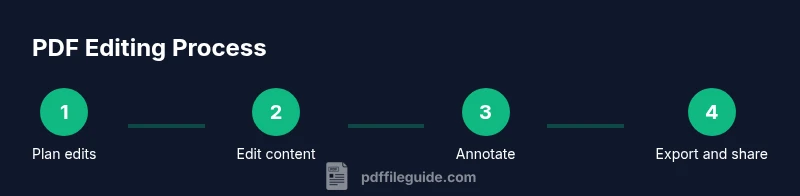
Plan the edits and capture references
Create a short list of edits with the exact text, image replacements, and any font changes. If possible, gather brand guidelines to maintain consistency.
Tip: Annotate the original PDF with a separate change log before editing. - 4
Edit text and replace images
Modify text in place where possible, or use the editor’s text-edit tool to reflow paragraphs. Replace images with appropriately sized assets that match the original resolution.
Tip: Avoid altering line breaks unless necessary to maintain layout. - 5
Manage fonts and typography
Ensure the correct font is used and embedded, so the document renders consistently on other machines. If the font isn’t available, substitute with a similar one that matches weight and spacing.
Tip: Always test a sample page to confirm font rendering after export. - 6
Add annotations and form fields
Insert comments, highlights, and stamps for review. If you’re updating forms, verify that interactive fields retain their properties and are keyboard accessible.
Tip: Label new fields clearly for downstream users and accessibility tools. - 7
Run accessibility and metadata checks
Verify that headings, reading order, alt text for images, and document metadata align with accessibility best practices. This helps with screen readers and search indexing.
Tip: Use built-in accessibility tools and export a test version for review. - 8
Review changes and obtain approvals
Perform a line-by-line review of edits, compare with the change log, and circulate for stakeholder sign-off. Maintain a record of approvals.
Tip: Use a side-by-side comparison view to catch subtle changes. - 9
Export and validate final output
Export the edited PDF with the desired settings (compression, font embedding, and metadata). Open the final file to verify all edits appear correctly and no pages are corrupted.
Tip: Test on multiple devices or PDF readers to ensure compatibility. - 10
Archive and document the process
Store the final file with a clear naming convention and attach the edit log. Document any deviations from the original and the reasons for edits.
Tip: Keep the original and edited versions in a clearly labeled folder structure.
Questions & Answers
Can I edit a scanned PDF without OCR?
No. Scanned PDFs are images; you need OCR to convert them to editable text. After OCR, you can edit the text, search, and select content.
For scanned PDFs, you’ll need OCR to turn images into editable text.
Will edits change the document’s formatting or layout?
Edits can affect layout if you alter fonts, spacing, or image placements. Always verify reflow and test a full export.
Editing can shift layout; check the final export for consistency.
What’s the best tool for beginners?
Look for a user-friendly editor with reliable export options and strong support for annotations and forms.
Choose a beginner-friendly editor with good export options.
Is it safe to edit PDFs with sensitive information?
Only edit PDFs when you have authorization and follow your organization’s data handling policies. Use secure storage for final files.
Only edit with authorization and store securely.
Can I edit PDFs on mobile devices?
Yes, there are mobile editors, but desktop tools typically offer more features and better accuracy.
Mobile editing exists but is usually less powerful than desktop editing.
How do I preserve accessibility after edits?
Ensure headings, alt text, and reading order remain intact, and re-run accessibility checks after edits.
Maintain accessibility by checking structure and alt text post-edit.
Watch Video
Key Takeaways
- Plan edits before touching content.
- Preserve layout by embedding fonts and testing exports.
- Use versioning to track changes and approvals.
- Check accessibility and metadata as part of the workflow.
- Choose a reliable editor and maintain source copies.