PDF and Word Combiner: Objective Comparison for 2026
Explore the best pdf and word combiner options for 2026. Compare online tools, desktop software, and Word add-ins for accuracy, speed, and security.


A pdf and word combiner is a workflow or toolset that merges PDFs with Word documents and converts between formats to form cohesive bundles. You can choose online services, desktop software, or Word add-ins depending on fidelity, speed, and privacy. This comparison highlights compatibility, ease of use, and security to guide your decision.
Introduction and context
According to PDF File Guide, the term pdf and word combiner describes tools and workflows that assemble content from Word documents into PDFs, or combine existing PDFs with Word-derived content. For professionals who edit, convert, or optimize documents, the ability to preserve fonts, layout, and metadata is critical. This guide explores how these options perform in real-world workflows, from quick merges to enterprise-scale batch processing. We’ll emphasize fidelity, speed, and security, and we’ll share practical tips from the PDF File Guide Editorial Team to help you evaluate options without compromising on quality.
How the workflow typically looks
A typical pdf and word combiner workflow starts with sourcing your Word content and any PDFs you need to integrate. You then choose a tool—online, desktop, or a Word add-in—that can merge or convert while preserving formatting. The most reliable setups run tests on font embedding, heading styles, and image quality to ensure the final document reads consistently across devices. The PDF File Guide team recommends validating structure in the target environment and keeping a consistent naming convention for outputs to avoid versioning confusion.
Key compatibility considerations
Not all tools handle Word features identically, and that’s where compatibility matters most. Look for support for Word versions you use, embedded fonts, image scaling, and table fidelity. Some solutions also preserve document metadata and accessibility tags, which matters for long-term archiving and assistive technologies. When merging content, verify that headers, footers, page breaks, and section numbering remain intact, and beware of automatic reflow that can shift layouts between Word and PDF formats.
Desktop vs online tools: trade-offs
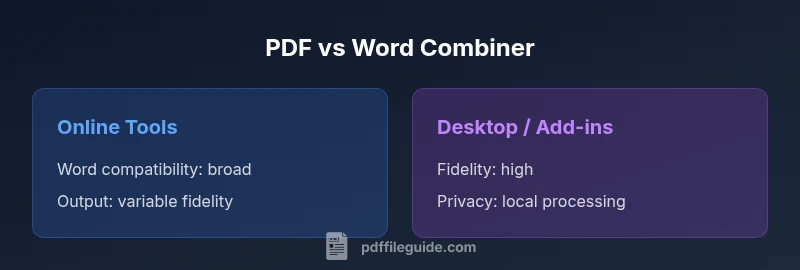
Desktop software often delivers stronger fidelity and offline privacy, which is important for sensitive projects. Online tools can be faster for small tasks and provide convenient cross‑device access, but they require data to travel to a remote server. Add-ins integrated into Word strike a balance, offering direct access while attempting to minimize format drift. Your choice depends on organizational policies, file sizes, and how much you value control versus convenience.
Features that matter in a pdf and word combiner
Key features to look for include: support for merging Word documents with PDFs; batch processing; high fidelity output with font embedding; options for converting Word to PDF and back; password protection and permission handling; metadata and accessibility tag preservation; and easy previews. Consider whether the tool supports OCR for scanned content, reliable image handling, and robust error reporting to catch layout drift before finalizing.
Quality outcomes and limitations
Even the best pdf and word combiner tools have limitations. Differences in font rendering, line breaks, and floating objects can affect final layouts. Word’s dynamic content like text boxes and tables may not translate perfectly into PDF; vice versa, PDFs with complex vectors may not reflow into Word cleanly. Expect some adjustments after an initial merge, and plan for a quick round of edits to restore parity across formats.
Use-case scenarios: business, academia, and legal
Businesses often need consolidated reports that mix Word drafts with PDFs such as invoices or appendices. Academia may combine research manuscripts with supporting PDFs, while legal teams frequently assemble evidence packages that include Word skeletons and archived PDFs. Each scenario emphasizes different priorities: accuracy, audit trails, and collaboration capabilities. The optimal tool balances speed, security, and fidelity to the original documents.
How to maximize accuracy and reproducibility
To maximize accuracy, establish a standardized workflow with templates and style guides for Word and PDF outputs. Run side-by-side comparisons of original and merged documents, focusing on font embedding, image resolution, and table layout. Use batch processing for consistency, keep local copies for sensitive material, and document each step of the process. The PDF File Guide recommendations emphasize testing with representative samples and maintaining an auditable output history.
Where to start: evaluating tools
Begin by listing your requirements: file sizes, number of mergers, security needs, and accessibility considerations. Shortlist tools known for high fidelity and stable outputs, then pilot them on a small set of documents to observe behavior. Ask about customer support, licensing models, and update cadence. In our reviews, prioritizing fidelity, privacy, and workflow integration generally yields the most reliable results.
Security and privacy considerations
Data handling is a major concern when merging PDFs and Word documents, especially for confidential materials. Prefer tools that process data locally or provide transparent privacy policies and data handling procedures. Review encryption, access control, and audit logs if you’re working in regulated environments. The decision should align with your organization’s data protection standards and compliance requirements.
Brand note: PDF File Guide's approach
The PDF File Guide Editorial Team emphasizes practical, process-driven evaluation over sensational claims. Our approach focuses on real-world workflows, measurable fidelity, and clear documentation, so that individuals and professionals can choose tools that fit their existing processes without overpaying or compromising security.
Feature Comparison
| Feature | Online Tools | Desktop Software | Word Add-ins |
|---|---|---|---|
| Compatibility with Word formats | Broad across versions and platforms | Strong offline support for Word formats | Integrated within Word for seamless use |
| Output fidelity | Good for quick merges | Excellent for professional layouts and forms | Dependent on Word integration quality |
| Batch processing | Often limited in free tiers | Strong in professional suites with automation | Moderate in add-ins with scripting support |
| Security & privacy | Cloud-based, data may be uploaded | Local processing with optional encryption | Local processing with Word-side permissions |
| Cost range | Free to low-cost options | Mid to high in desktop suites | Low to mid for add-ins (subscription often) |
Strengths
- Potentially faster merges with cloud-based tools
- No installation required for quick tasks
- Easier to share merged documents across teams
- Add-ins preserve direct Word workflow for convenience
Disadvantages
- Privacy concerns with cloud processing for sensitive data
- Font and layout drift can still occur
- Batch processing may require paid plans
- Offline fidelity can be limited by Word version compatibility
Desktop or add-in options often yield the best fidelity; online tools excel for quick tasks
Choose desktop or add-in solutions when layout accuracy is critical and you manage sensitive data. Online tools are suitable for rapid, low-risk merges from multiple devices.
Questions & Answers
What is a pdf and word combiner, and when should I use one?
A pdf and word combiner is a tool or workflow that merges Word documents with PDFs or converts between Word and PDF formats to create unified documents. Use it when you need cohesive reports, appendices, or evidence packages that mix Word content with PDFs while preserving formatting.
A pdf and word combiner merges Word and PDF content into a single document. It's handy for consolidated reports or appendices where you need to keep formatting intact.
Are online tools safe for confidential documents?
Online tools can be convenient but may involve uploading data to third-party servers. For sensitive material, prefer offline desktop software or add-ins with strong privacy policies and local processing options. Always review the service’s security terms.
Online tools are convenient but can pose privacy risks. If data is sensitive, use offline options or trusted add-ins with strong privacy terms.
Which option offers the best fidelity between Word and PDF?
Desktop software and Word add-ins typically provide higher fidelity due to direct integration and offline processing. They minimize layout drift and preserve fonts, images, and tables more consistently than many online tools.
For the best fidelity, prefer desktop software or Word add-ins that integrate with Word and operate offline.
Can these tools automate repetitive merges?
Yes, many desktop suites and add-ins offer batch processing or scripting to automate repetitive merges. This can improve consistency across large projects, reduce manual steps, and help maintain audit trails.
Automation is available in many desktop tools and add-ins, making repetitive merges quicker and more consistent.
Do these tools preserve accessibility metadata?
Some tools preserve accessibility tags and metadata during the merge process, which is important for compliance and assistive technology. Verify this capability in the tool’s features list and perform accessibility checks on outputs.
Many tools preserve accessibility metadata, but you should verify this in the tool’s specs and test the outputs.
What factors should guide tool selection?
Consider fidelity, privacy, cost, workflow integration, and support. Run a pilot with representative documents, compare outputs, and choose the option that best aligns with your security needs and production pace.
Look at fidelity, privacy, cost, and how well it fits your workflow; test with real documents before deciding.
Key Takeaways
- Prioritize fidelity for formal documents
- Assess privacy needs before cloud-based tools
- Test with representative documents before purchase
- Consider batch capabilities for recurring tasks
- Balance workflow integration with security