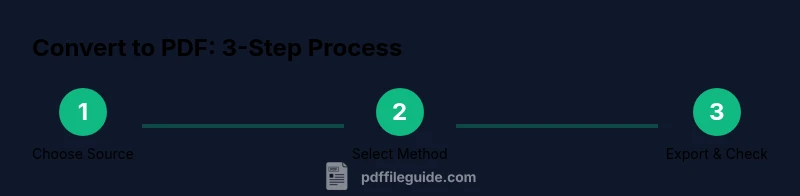
Transform to PDF: A Practical How-To for 2026
Learn how to transform to PDF using built-in tools, desktop apps, and trusted online options. This educational guide explains methods, best practices, and checks to ensure reliable, shareable PDFs across devices.


Transform to PDF means converting documents into the Portable Document Format for consistent viewing across devices. In this guide, you will learn reliable methods—print-to-PDF, built-in export options, desktop software, and trusted online converters—to transform files quickly while preserving layout and accessibility. By the end, you’ll select the best approach for your workflow and generate clean, reusable PDFs. According to PDF File Guide, a strong process keeps fonts embedded and metadata intact.
What transform to pdf unlocks for your workflow
Converting documents to PDF is a foundational skill for professionals who need consistent viewing across devices and platforms. The act preserves layout, embeds fonts, and prevents unintended edits, making PDFs ideal for client handoffs, official submissions, and archival records. The PDF File Guide team notes that successful PDF transformations balance fidelity with accessibility so colleagues using assistive technologies can access content. When you transform to pdf, you create a portable artifact that looks the same on Windows, macOS, iOS, and Android, regardless of the originating application. This content expands on when to convert, which tools work best for different file types, and how to validate results before sharing. You’ll see practical, real-world examples—turning a Word brief, a PowerPoint presentation, or a multi-image report into a clean, distribution-ready PDF. Throughout, you’ll learn to preserve hyperlinks, preserve print-ready color, and embed metadata so search and archiving stay reliable. By the end, you’ll feel confident selecting a method that fits your workflow while maintaining security and compliance.
As you read, consider how PDF File Guide’s recommendations apply to your everyday tasks—whether you’re preparing contracts, slides, or scanned forms. This awareness helps you avoid common pitfalls and deliver consistent PDFs that teammates can trust.
What transform to pdf unlocks for your workflow
Converting documents to PDF is a foundational skill for professionals who need consistent viewing across devices and platforms. The act preserves layout, embeds fonts, and prevents unintended edits, making PDFs ideal for client handoffs, official submissions, and archival records. The PDF File Guide team notes that successful PDF transformations balance fidelity with accessibility so colleagues using assistive technologies can access content. When you transform to pdf, you create a portable artifact that looks the same on Windows, macOS, iOS, and Android, regardless of the originating application. This content expands on when to convert, which tools work best for different file types, and how to validate results before sharing. You’ll see practical, real-world examples—turning a Word brief, a PowerPoint presentation, or a multi-image report into a clean, distribution-ready PDF. Throughout, you’ll learn to preserve hyperlinks, preserve print-ready color, and embed metadata so search and archiving stay reliable. By the end, you’ll feel confident selecting a method that fits your workflow while maintaining security and compliance.
As you read, consider how PDF File Guide’s recommendations apply to your everyday tasks—whether you’re preparing contracts, slides, or scanned forms. This awareness helps you avoid common pitfalls and deliver consistent PDFs that teammates can trust.
Methods to transform to pdf: an overview
There isn’t a single magic button for every document, but there are reliable paths to transform to pdf with predictable results. The simplest are built-in printer or export options that rely on the OS or application to generate a PDF. Desktop suites like Microsoft Office or Google Workspace often provide a direct Save as PDF or Export as PDF option, preserving layout and embedded elements with minimal tweaks. Dedicated PDF applications give you deeper control: font embedding, compression, tagging for accessibility, and metadata customization. Online converters can be convenient for quick tasks from any browser, but privacy, data retention, and file size limits vary widely. For sensitive material, lean toward offline methods to minimize exposure. In this section, we compare methods by file type—documents, slides, and images—and outline how to select the approach that best aligns with your privacy needs, time constraints, and deliverable requirements. We also discuss how to maintain accessibility and searchability while transforming files to pdf.
Overall, the choice hinges on three questions: Do you need offline processing? How important is fidelity (fonts, colors, and layout)? Is the data sensitive or proprietary? Answering these helps you pick the method that yields reliable PDFs every time.
Built-in options across platforms
Many operating systems include native capabilities to transform content into PDF, making it possible to produce a PDF without extra software. On Windows, the Print dialog offers a printer named “Microsoft Print to PDF” and many apps expose a Save as PDF option. macOS users can use the standard Print dialog and select Save as PDF, preserving page size and basic metadata. Linux environments often rely on CUPS print-to-PDF or software like LibreOffice's export to PDF for documents and slides. Practical examples: a Word document can be saved as PDF from the File menu, a web page can be printed to PDF via the browser’s print dialog, and a presentation can be exported from its program as a PDF. Each method has trade-offs in font fidelity and color accuracy; testing on multiple devices helps ensure consistent outputs. When using built-in options, you typically get quick results with strong fidelity for standard documents, small teams, and routine sharing tasks. As you adopt built-in tools, keep your expectations in check for higher-end features such as tagging, form fields, or accessibility metadata, which may require more specialized software.
Desktop software and apps for PDF creation
Desktop tools offer richer control over the final PDF, making them ideal for professional workflows. Popular options include Adobe Acrobat, Foxit, and Nitro, along with open-source alternates like LibreOffice for basics. These programs let you embed fonts, compress images, set security options, and add metadata to support search and archiving. For example, exporting a complex report with many images may require tweaking image resolution to balance clarity and file size. If your document contains interactive elements or forms, a capable PDF editor can ensure fields are correctly tagged and accessible. When choosing software, consider the total cost of ownership, platform compatibility, and whether you need batch processing or automation. Keep in mind that heavy edits or sensitive data may justify offline processing to protect confidentiality. This approach is favored by teams that produce client-ready deliverables or regulated documents and want fine-grained control over how PDFs display on different devices.
Online converters vs offline tools: trade-offs
Online conversion can be fast and accessible from any device with a browser, but it introduces privacy and security considerations. If data is sensitive, avoid uploading it to third-party services unless you fully trust the provider and understand their privacy policy. Offline tools protect confidentiality and typically provide stronger control over font embedding, metadata, and accessibility tagging. For occasional tasks, a trusted offline workflow (e.g., exporting from a familiar app or using a built-in printer) is often enough. If you’re collaborating with others, consider whether your team requires centralized templates and consistent font usage, which offline tools can enforce. When evaluating tools, examine supported file types, available compression settings, and the ability to preserve hyperlinks and interactive elements. Finally, test the resulting PDFs on equipment and software your audience uses to avoid surprises at delivery time.
Quality considerations: fonts, color, accessibility
High-quality PDFs reproduce the original document’s typography and color intent. Always embed fonts when possible to ensure text renders identically on all devices. Check color profiles and compression settings to avoid washed-out images or pixelation in print. If your project requires accessibility, ensure tagging and reading order are correct so screen readers can interpret the content accurately. For forms and interactive elements, verify that fields are functional, tab order is logical, and the document structure supports navigation. Small preferences—such as preserving hyperlinks and including document metadata—improve discoverability and verification later on. When you prioritize fidelity, you’ll produce PDFs that look right in meetings, print well, and remain usable in archives.
Validation, security, and next steps
After transforming to pdf, verify the result by opening it in multiple viewers and devices. For sensitive material, apply password protection or encryption only when needed, and maintain an audit trail of who accessed the file. If you’re distributing PDFs widely, consider adding digital signatures or watermarks as appropriate for your workflow. Regularly review PDFs for accessibility and compliance standards relevant to your work. As you advance, establish a repeatable workflow with defined steps, decision criteria, and quality checks so that every transformed PDF meets your organization’s standards. The PDF File Guide team recommends documenting your process to deliver consistent results across teams and projects.
Tools & Materials
- Computer or mobile device with internet access(Windows/macOS/Linux or iOS/Android; ensure access to the required apps)
- Document source file(Word, Excel, PowerPoint, image, or webpage you intend to transform)
- PDF-capable tool(Built-in print/export or third-party software)
- Optional offline PDF editor(For metadata edits or form-field adjustments)
- Trusted online conversion option (optional)(Review privacy policy before uploading sensitive data)
Steps
Estimated time: 15-30 minutes
- 1
Identify the source file type
Locate the file you want to transform and confirm you’re using the final version. Check for sensitive data and remove anything you don’t want to share before conversion.
Tip: Keep a clean, clearly named source file in a dedicated folder. - 2
Choose transformation method
Decide between built-in print-to-PDF, Save/Export as PDF, desktop software, or online converter based on privacy needs and file type.
Tip: Offline methods are preferable for confidential content. - 3
Configure PDF options
Set font embedding, image compression, color handling, metadata, and accessibility tagging if needed.
Tip: Embed fonts to maintain typography across devices. - 4
Execute the conversion
Run the conversion, then save with a descriptive filename and in a dedicated output folder.
Tip: Use versioning like document_v2.pdf for updates. - 5
Review the result
Open the PDF in multiple viewers to verify layout, fonts, links, and form fields. Check accessibility tagging if relevant.
Tip: Test on a mobile device to ensure readability. - 6
Secure or compress if needed
Apply password protection or adjust compression to balance quality and size.
Tip: Avoid over-compression that reduces legibility.
Questions & Answers
What is the simplest way to transform a Word document to PDF?
In Word, use File > Save As > PDF or File > Export > Create PDF/XPS. This preserves most formatting. For complex layouts, export from the source app or use a PDF editor for adjustments.
In Word, you can Save As PDF, which is quick and usually preserves formatting. For complex layouts, consider exporting or using a PDF editor for tweaks.
Can I transform images or slides to PDF?
Yes. Images can be converted with image-to-PDF tools, and slides can be exported from presentation software as PDF. Check resolution settings to maintain clarity.
Yes. Use an image-to-PDF tool or export slides as PDF, and make sure the resolution is appropriate for your needs.
Will fonts and formatting stay the same after transformation?
Most built-in exports preserve layout, but font embedding ensures consistency. If your document uses custom fonts, embed them during export to prevent font substitution.
Fonts can stay the same if you embed them during export; otherwise, substitutes may occur.
Is online conversion safe for confidential documents?
Online converters can be convenient but pose privacy risks. Use offline methods for sensitive content and read the service’s privacy policy before uploading.
Online tools are fast but risky for sensitive data; prefer offline methods and check privacy terms.
What is a tagged PDF and why does it matter for accessibility?
A tagged PDF includes accessible structure information for screen readers. Ensure tagging and reading order are correct if accessibility is a priority.
Tagged PDFs include structure for screen readers; verify tagging if accessibility matters.
How can I password-protect a PDF?
Many PDF creators offer encryption and password protection. Apply a strong password and share it securely with intended recipients.
You can encrypt PDFs with a password; use a strong password and share it securely.
Watch Video
Key Takeaways
- Choose the method based on file type and privacy needs.
- Embed fonts and preserve metadata for fidelity.
- Verify the PDF on multiple devices before sharing.
- Prefer offline tools for sensitive documents.
- Ensure accessibility features are correctly tagged when required.