How to Change to PDF File: A Practical Conversion Guide
Learn how to change to pdf file across Word, images, web pages, and more. This comprehensive guide covers native options, best practices, and troubleshooting for reliable PDF conversions in 2026.


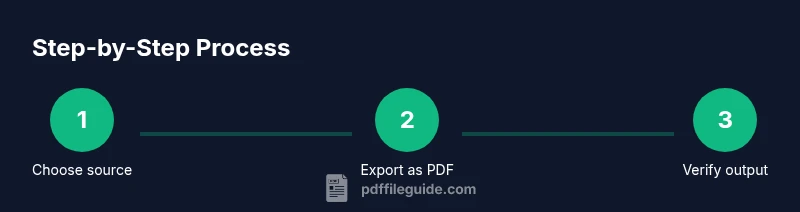
According to PDF File Guide, changing to PDF is a practical skill for preserving layout and accessibility. This quick answer shows you how to change to pdf file across common formats, using built‑in printers, Word/Google Docs, and standalone tools. Expect reliable results with careful font embedding, image handling, and metadata preservation.
What It Means to Change to PDF File and Why It Matters
In the realm of document management, knowing how to change to pdf file is a foundational skill. PDFs preserve fixed formatting, fonts, and layout, ensuring your content appears the same on any device or operating system. The PDF File Guide team notes that PDFs are universally accessible, support text search, and can be secured with permissions and passwords. By converting files to PDF, you create a portable, archivable version that’s less prone to accidental edits or font substitutions. Whether you’re sharing a resume, a project brief, or an invoice, PDF remains a dependable standard across industries. In this guide, you’ll learn practical methods for Word documents, images, and web content, plus tips for maintaining quality and accessibility during conversion.
Native Windows/
Tools & Materials
- A computer with internet access(Needed to download tools and access online converters if required)
- Word processor (e.g., Microsoft Word, Google Docs)(Used to export or print to PDF from source documents)
- PDF viewer/editor (e.g., built-in viewer, free editors)(For verifying and editing PDFs after conversion)
- Virtual PDF printer or built-in Save as PDF(Select this as destination when printing from apps)
- Reliable internet connection(Optional for online converters or cloud storage)
- Batch conversion tool (optional)(Useful for converting many files at once)
Steps
Estimated time: 30-60 minutes
- 1
Identify the source file
Locate the document or image you want to convert to PDF. Confirm the file type and ensure you have access to the original content. If you’re unsure, create a copy to preserve the original. This step helps prevent accidental edits and makes the process repeatable.
Tip: If batching, list all files beforehand and sort by type to streamline processing. - 2
Open the file in the appropriate app
Open Word, Google Docs, an image viewer, or your browser with the source file. Use the app that offers the most faithful rendering of fonts and layout for your source material. Close other programs to reduce font substitution risks.
Tip: For graphics-heavy files, ensure the application is configured to display embedded fonts. - 3
Choose the PDF export or print option
In most apps, select Export or Save As and choose PDF as the format. If your app only offers printing, use the Print dialog and pick a PDF printer or Save as PDF. This step defines the destination and affects fidelity.
Tip: If you see multiple PDF options (e.g., Standard vs. High Quality), choose the one that matches your distribution needs. - 4
Configure page setup and font handling
Set page size, orientation, margins, and image compression as needed. Ensure fonts are embedded if the option is available, so the PDF renders correctly on devices without fonts installed.
Tip: Enable font embedding when available to prevent font substitution issues on other devices. - 5
Save or export with a descriptive name
Choose a clear filename that reflects the content and date. Include versioning if you expect multiple revisions. This makes future retrieval easier and reduces confusion among collaborators.
Tip: Use hyphens or underscores instead of spaces for better compatibility in cross-platform workflows. - 6
Validate the output PDF
Open the resulting PDF in a viewer and verify text search, hyperlinks, embedded images, and any forms. Confirm there are no broken visuals and that accessibility features like Alt text are present if applicable.
Tip: Test on another device or reader to catch rendering differences early. - 7
Optimize or compress if needed
If the file is too large for email or storage, adjust compression settings or downscale images while preserving readability. Re-check after compression to ensure content remains clear.
Tip: Avoid aggressive compression for documents with fine details or small fonts.
Questions & Answers
What formats can be converted to PDF?
Common formats include Word, Excel, PowerPoint, images (JPG, PNG), and web pages. Most apps support exporting these types as PDF. For complex documents, consider verifying font embedding and image resolution after conversion.
You can convert Word, Excel, images, and web pages to PDF, and you should check font embedding after conversion.
Do I need paid software to convert to PDF?
Many free options exist, including built‑in OS features and free online tools. Paid software often adds features like batch conversion, OCR, and advanced compression, but for basic needs, free options are usually sufficient.
Free OS features or online tools often handle basic PDF conversions; paid software adds extra features.
How can I ensure fonts are embedded in the PDF?
Choose the Export/Save as PDF option and look for a setting like 'Embed fonts' or 'Subset fonts.' If the option isn’t available, use a dedicated tool to ensure font embedding.
Embed fonts by selecting the font embedding option during export or using a tool that supports embedding.
Can I convert multiple files at once?
Yes. Many tools and apps support batch conversion. Prepare a folder with all sources, choose batch mode, and verify each output file after conversion.
Yes—use batch mode in your converter and check outputs afterward.
What’s the difference between Save as PDF and Print to PDF?
Save as PDF typically exports the document with layout preservation and optional features like bookmarks. Print to PDF is a virtual printer route that captures the output as shown, useful if Save as PDF isn’t available.
Save as PDF exports with layout and options; Print to PDF acts like printing to a virtual printer.
What should I do if the PDF is too large to share?
Try re-saving with lower image resolutions, downsampling, or using a compression feature. Ensure readability remains acceptable after compression.
Compress the PDF by lowering image resolution or using a compression feature, then verify readability.
Key Takeaways
- Know when to use native PDF options for quick results.
- Embed fonts and check hyperlinks to maintain fidelity.
- Name PDFs descriptively for easy retrieval.
- Test PDFs across devices to ensure consistent appearance.