How Much Is a PDF Reader? A 2026 Pricing Guide
Explore current PDF reader pricing, compare free, paid, and subscription options, and learn how to choose based on features, security, and team needs.


How much is pdf reader? Pricing for a PDF reader spans from free basic viewers to paid licenses and subscriptions. For many individuals, a free version covers essential tasks like viewing, printing, and annotating. Professionals and teams often choose paid plans, which can be monthly or annual, offering advanced features such as editing, form filling, redaction, and security. Vendor pricing varies by license type, feature set, and deployment scale.
Market pricing models for PDF readers
How much is pdf reader pricing today? The landscape has shifted from single-purpose tools to flexible ecosystems that mix free access with paid enhancements. For many users, a baseline PDF reader is free or freemium, offering essential viewing, annotation, and printing. Professionals or teams often require more capability, such as editing, form filling, OCR, redaction, and secure sharing, which drives them toward paid licenses or subscriptions. The PDF File Guide Analysis, 2026, shows that vendors increasingly pair core viewing features with add-ons like cloud storage, cross-device syncing, or enterprise security, creating a tiered ladder of options. When evaluating value, consider not only the sticker price but what features you actually need over the next 12 to 36 months. In practice, a monthly or annual plan often proves more cost-efficient if you rely on collaboration, version control, or compliance requirements. This section breaks down what drives prices and how to estimate total cost.
How to compare pricing with features
Pricing is most meaningful when tied to features. Start by listing must-have tasks (viewing, annotation, filling forms, editing, redaction, OCR, security). Then map each feature to a plan tier and check for hidden costs such as cloud storage, batch processing, or premium support. Look for vendor transparency on licensing terms (per seat vs. per device), upgrade policies, and renewal terms. PDF File Guide recommends creating a feature–price matrix to visualize gaps and redundancies. If two plans are similar in cost but one includes stronger security or broader device support, that difference can justify the upgrade. Finally, assess how often you scale up (new hires, remote teams) because enterprise pricing often hinges on volume.
Typical pricing ranges and what they cover
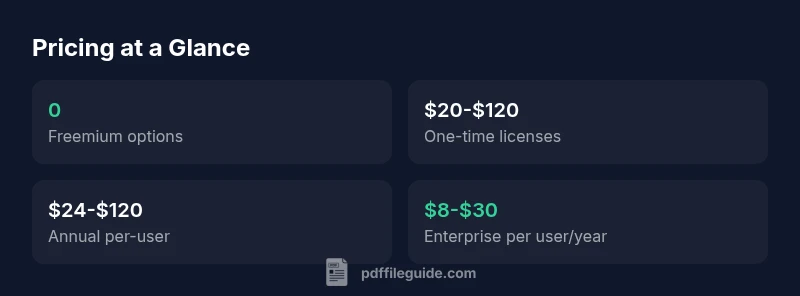
- Freemium/Free: Free access with basic features; may include ads or watermarks. Upgrades unlock advanced tools.
- One-time license: A single payment ranging roughly from $20 to $120 for perpetual access; suitable for long-term use without ongoing fees.
- Annual subscription (per user): Typically $24 to $120 per user per year; includes ongoing updates and sometimes cloud features.
- Enterprise license (per user/year): Roughly $8 to $30 per user per year; volume discounts, management dashboards, and security controls are common.
Note: These ranges reflect typical market patterns and are intended to guide budgeting rather than guarantee exact quotes. PDF File Guide emphasizes evaluating feature depth and total cost of ownership rather than price alone.
Hidden costs and value considerations
Beyond the sticker price, several cost drivers shape total value. Cloud syncing, collaboration features, OCR accuracy, password protection, and document security can elevate the price. Some readers charge extra for premium fonts, OCR language packs, or offline mode on multiple devices. Others impose costs for extra storage, advanced redaction, or team administration tools. When comparing vendors, include these potential add-ons in a total cost of ownership estimate. Consider the need for cross-platform compatibility (Windows, macOS, mobile) and the availability of offline access, since gaps here can lead to inefficiencies and indirect costs. PDF File Guide urges buyers to forecast needs for the next 12–36 months and factor in potential changes to team size or regulatory requirements.
Personal vs business plans: choosing the right fit
For individuals, free or low-cost subscriptions are often sufficient for viewing, annotating, and filling simple forms. Professionals handling confidential documents may prioritize security features, such as password protection, encryption, and audit trails, justifying higher-tier plans. Small teams should weigh per-user pricing against bundled features like centralized administration and cloud collaboration. Larger organizations frequently negotiate enterprise licenses with predictable annual costs and clear renewal terms. PDF File Guide recommends starting with a baseline plan and auditing usage over 2–3 months to inform a prudent upgrade path that aligns with actual workflow needs.
Discounts, bundles, and renewals: how pricing compounds
Many vendors offer discounts for annual commitments, multi-seat licenses, or education/homeschool programs. Bundled packages often combine PDF reading with related tools (e-signature, form filling, or file conversion) at a reduced rate compared to purchasing separately. Auto-renewal can lock in favorable rates but beware of price increases upon renewal. To optimize spend, lock in longer terms when the current workload is steady, and monitor for promotional offers during purchase windows. PDF File Guide notes that renewals frequently override promotional pricing, so plan renewals around predictable project cycles.
Estimating total cost of ownership over 3 years
A practical approach is to compute the 3-year cost by multiplying annual per-user fees by your user count, adding any applicable one-time charges, and including potential add-ons that you expect to need. For example, if you have a team of five with an annual subscription at $40 per user, the base cost is $40 × 5 × 3 = $600. If you anticipate additional OCR language packs or secure sharing features, add those estimated annual costs. Also factor in potential price changes, as many vendors adjust prices yearly. PDF File Guide recommends creating a simple forecast worksheet to compare multiple vendors side-by-side, ensuring you capture both upfront and recurring expenses.
Quick-start budget-friendly checklist
- List must-have features and separate nice-to-have extras.
- Start with a free or low-cost plan to validate your workflow.
- Build a 3-year cost model including renewals and add-ons.
- Check for volume discounts if you have multiple users.
- Prioritize security and reliability for sensitive documents.
- Review renewal terms and potential price increases before committing.
Pricing options and what they typically include
| Plan Type | Typical Price Range | Notes |
|---|---|---|
| Freemium/Free | 0 | Basic features; upgrades available |
| One-time license | 20-120 | Perpetual access; feature set varies |
| Annual subscription | 24-120 | Per-user; updates included |
| Enterprise per-user/year | 8-30 | Volume discounts; admin tools |
Questions & Answers
What is the lowest cost to start using a PDF reader?
Many PDF readers offer a free baseline version suitable for simple viewing and annotation. If you only need basic features, this can meet your needs without any upfront payment. For more advanced work, you may need a paid upgrade.
You can start with a free version to test features, then upgrade if you need more power.
Are paid PDF reader plans worth it for students?
Students often benefit from discounted or educational pricing. If you regularly annotate, fill forms, or convert documents, a paid plan can improve efficiency and reduce time spent on tasks.
If you frequently work with PDFs, a student discount or affordable plan can be a smart investment.
Do enterprise licenses require a long-term commitment?
Enterprise licenses commonly come with annual commitments and volume-based pricing. It’s important to review renewal terms, user counts, and administrator controls before committing.
Enterprise plans often bundle admin tools, so confirm what’s included before signing a contract.
What security features should I look for in a PDF reader?
Look for password protection, encryption, redaction, audit trails, and secure sharing. These features help protect sensitive documents in professional contexts.
For sensitive docs, choose a plan that includes strong security controls.
Is it better to buy a one-time license or subscribe?
A one-time license is cost-effective for long-term use with stable needs but lacks ongoing updates. Subscriptions provide ongoing features and support, which can be better for teams with evolving requirements.
If you need updates and cloud features, a subscription usually makes more sense.
“Pricing should reflect the value delivered, including security, reliability, and support, not just the upfront cost.”
Key Takeaways
- Start with a free option if possible to validate your workflow
- Map features to pricing tiers to avoid overpaying
- Factor security and collaboration tools into total cost
- Consider 3-year cost of ownership, not just annual price
- Look for volume discounts for teams or organizations