How to Print PDF on Long Bond Paper: A Practical Guide
Learn how to print PDFs on long bond paper with step-by-step Windows and macOS workflows, proper paper setup, scaling, and troubleshooting tips for crisp, professional output.


This guide explains how to print a PDF on long bond paper by configuring your printer, selecting the correct paper size, and adjusting margins, scaling, and orientation. It covers Windows and macOS workflows, common driver settings, and practical tips to ensure clean, legible output on long bond stock.
Why printing on long bond paper matters
Long bond paper is favored for professional documents, legal drafts, and presentations where a larger sheet improves readability. If you’re wondering how to print pdf long bond paper, the answer lies in aligning file setup, printer capabilities, and driver options. According to PDF File Guide, preparing your PDF with compatible page size and safe margins reduces cropping and improves legibility on larger sheets. In practice, you’ll balance readability with economy by adjusting font size and line length. This section explains how print hardware and file preparation work together to produce crisp, accurate output and why choosing the right stock matters for durability and presentation.
Understanding page size, margins, and units
To print on long bond paper, the first step is to confirm the exact paper size your printer supports, then configure your PDF and printer margins accordingly. Use consistent units (inches or millimeters) throughout the workflow to prevent misalignment. Keep margins generous enough to accommodate printer teeth and scannable edges, while preserving important content. If your document uses a fixed layout, ensure the page dimensions match the chosen stock so nothing gets cropped. This alignment minimizes surprises when you print the final version.
PDF prep: fonts, vectors, and embedded sizing
Before printing, embed fonts in the PDF and convert text to outlines if needed to avoid font substitution. Use vector graphics where possible to maintain sharpness at large sizes. Ensure that the document’s page size exactly matches the selected printer paper size. If your PDF was created in a different program, re-export with the target dimensions and check that any raster images are sufficiently high resolution for large-format output.
Windows printing workflow: setup, size, and scaling
On Windows, open the Print dialog from your PDF viewer and select the target long bond size under Page Setup or Printer Properties. Set Orientation (Portrait or Landscape) to match your document’s layout. Use the Scale option to fit or fill the page, and consider printing as Image if you encounter font or driver issues. If the option is available, enable Borderless Printing to maximize edge-to-edge output. Save your settings as a custom preset for future jobs.
macOS printing workflow: precise control and previews
On a Mac, access the Print dialog from the PDF viewer and choose Page Setup to define the paper size. Use Layout or Scale to fit and preview how your content will appear on the long bond sheet. If Borderless printing is supported, enable it for cleaner edges. macOS users can leverage the Preview or Acrobat reader’s built-in presets to reuse frequently used configurations.
Troubleshooting: cropping, margins, and print quality
Crop and margin issues often arise from mismatched paper sizes or driver defaults. Verify that the actual printer paper tray matches the PDF page size, and check the Print Preview for clipping. If text appears blurry, try a higher print resolution or embed fonts to ensure consistent rendering. Always run a test print on a single sheet before committing to a larger batch.
Best practices for reliable results
Maintain consistent stock quality and weight suitable for long bond printing. Save custom printer presets to reduce setup time. Run periodic nozzle checks on inkjet printers or calibration on laser printers. Keep firmware up to date and test print after any driver update to ensure predictable output. These habits minimize waste and preserve document integrity.
Tools & Materials
- Printer capable of printing long bond paper(Check the manufacturer’s specs for supported paper sizes)
- Long bond paper stock(Verify the size and weight match your region's long bond definition)
- USB cable or network connection(Needed for driver installation and printing)
- PDF viewer/engine (e.g., Adobe Acrobat Reader or Preview)(Used to access page setup, scaling, and print previews)
- Optional: borderless-capable printer profile(Useful for edge-to-edge output if your stock and printer support it)
Steps
Estimated time: 30-60 minutes
- 1
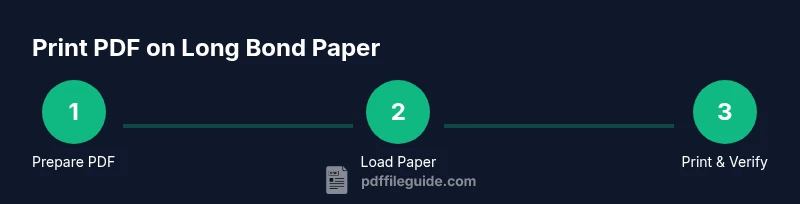
Prepare the PDF for the target size
Open the PDF and verify its page size matches the long bond sheet you’ll use. If needed, export or save a new version with the correct page dimensions and embedded fonts to prevent substitutions. This minimizes cropping and ensures consistent print results.
Tip: Embed fonts in the PDF to avoid font changes during printing. - 2
Load the correct paper and tray alignment
Place the long bond paper in the tray and align the stack to prevent jams. Use a clean, flat surface and ensure the paper is within the tray’s guides. Misalignment can cause skewed prints or paper jams.
Tip: Fan the stack slightly before loading to prevent feeding issues. - 3
Open the print dialog and select the correct size
In your PDF viewer, open Print and choose the target long bond paper size in Page Setup or Printer Properties. If the size isn’t listed, select Custom Size and enter the exact dimensions your printer supports.
Tip: Always preview the page in the dialog to catch cropping before printing. - 4
Set scaling and orientation
Choose Scale to Fit or 100% scale depending on whether you want borders. Set Orientation to match your document layout (Portrait or Landscape). For accurate margins, avoid excessive scaling that crops content.
Tip: If your content must fill the page, use Fit to Page and verify margins in Preview. - 5
Print a test page first
Print a single sheet to check alignment, margins, and text sharpness. Review the test page for any cropping or misalignment before running a full batch.
Tip: Adjust printer margins or PDF page margins based on the test output. - 6
Print final copies and save presets
Once the test looks correct, print the full run. Save the printer settings as a preset for future use, ensuring consistency across prints.
Tip: Document the exact paper size, margin values, and scaling for quick reuse.
Questions & Answers
Can all printers handle long bond paper?
Not all printers support similar sheet sizes. Check your device specifications for compatible paper sizes and weights before attempting long bond printing.
Check the printer's specs to confirm if long bond paper is supported; if unsure, consult the user manual.
How do I know my PDF will print correctly on long bond paper?
Ensure the PDF page size matches the paper size and that fonts are embedded. Preview the print to confirm margins, scale, and orientation before printing.
Make sure the page size matches the paper and fonts are embedded; always preview before printing.
What if my printer doesn’t support custom sizes?
If custom sizes aren’t available, choose the closest supported size and adjust margins to fit. In some cases, printing from a PDF editor with a borderless option can help.
If you can’t select a custom size, pick the nearest option and tweak margins to fit.
Should I print PDFs as images for long bond paper?
Printing as an image can improve reliability for fonts, but it may reduce clarity for text and increase file size. Use this option if you encounter font issues.
Printing as an image can fix font problems, but may reduce sharpness; use when needed.
Is borderless printing necessary for long bond paper?
Borderless printing is not required, but it can improve edge-to-edge appearance if supported by both printer and stock. Otherwise set appropriate margins.
Borderless is optional; use it if both printer and paper support it.
Watch Video
Key Takeaways
- Verify printer supports long bond paper before starting.
- Embed fonts and match page size to avoid cropping.
- Test print first; adjust scaling and margins as needed.
- Save settings as presets for repeatability.
- Use borderless printing only if your hardware supports it.