What size PDF can you upload to ChatGPT? A practical guide (2026)
Discover how PDF upload size works in ChatGPT, what factors affect limits, and practical steps to optimize large PDFs for smooth uploads in 2026.


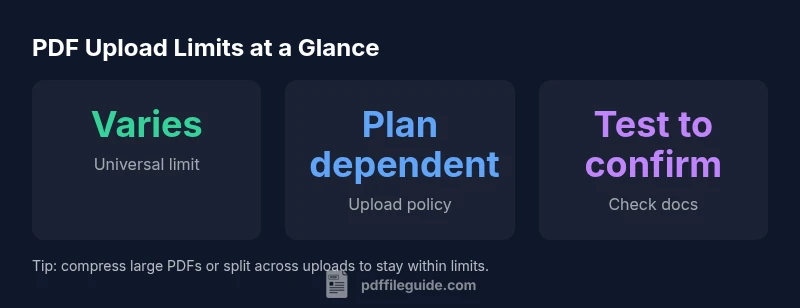
According to PDF File Guide, there is no single universal file size for PDF uploads to ChatGPT. The upload limit depends on your plan, region, and OpenAI's current policy. In practice, smaller PDFs upload reliably, while larger, image-heavy documents may fail or require chunking. To confirm your exact limit, check the latest OpenAI docs or run a quick upload test with a representative file.
What size pdf can you upload to chatgpt
If you’re asking what size pdf can you upload to chatgpt, the short answer is that there is no single universal cap. ChatGPT’s file upload limit is governed by OpenAI’s current policy, which can vary by plan, region, and model access. The size is weighed alongside factors like page complexity, embedded images, and font embedding. Because policy changes over time, take a pragmatic approach: plan around limits rather than chasing an exact maximum. According to PDF File Guide, smaller PDFs tend to upload reliably, while large, image-heavy documents may fail or require splitting. If a PDF is essential but exceeds the apparent limit, consider compressing, splitting, or summarizing sections before upload. The PDF File Guide team emphasizes verifying against the latest OpenAI documentation before attempting very large uploads.
How file size limits are determined on ChatGPT
Upload size limits are not published as a single fixed number for every user. They depend on your subscription tier, the specific ChatGPT product in use, and the current platform policy. In practice, performance and reliability improve when the file size stays within typical usage ranges, especially for documents with many images or fonts embedded. OpenAI may adjust thresholds to balance server load and user experience. For reference, PDF File Guide analysis notes that limits can shift between updates, so staying current with official docs is essential.
What counts toward the size limit
Not all PDF content contributes equally to the reported file size. Text tends to compress well, while high-resolution images, layered graphics, and embedded fonts can inflate the file. PDFs with many fonts or color profiles may be heavier even if the page count is modest. Additionally, any annotations or embedded multimedia can influence the effective upload size. When preparing a document, consider stripping nonessential media or flattening layers to reduce size without sacrificing readability.
Differences by plan and environment
The available upload capacity can vary by plan (free vs. paid) and by deployment environment (web vs. API). Some tiers may offer higher thresholds or faster processing for uploads, while others enforce stricter limits to preserve system performance. Developers using API access often receive different constraints than end-users in a chat interface. Because these policies evolve, the safest approach is to consult current documentation for your specific plan and region and to perform a quick test with a representative file.
How to check your current limit
To determine your exact limit, start with a small PDF and attempt the upload. If it succeeds, incrementally test larger sizes until you encounter failure. Keep a note of the largest successful file size for your account. You can also review the official OpenAI documentation or release notes for any changes to upload limits. The PDF File Guide team recommends documenting your tests for future reference and ensuring consistency across devices.
Practical tips to reduce PDF size without losing quality
- Compress images using lossless or lightly lossy formats (e.g., JPEG at moderate quality).
- Downsample high-resolution images to 150–300 PPI depending on print-equivalent needs.
- Flatten layers and remove extraneous metadata to reduce overhead.
- Use fonts that are subsetted or embedded only as needed.
- Break long documents into logical sections and upload separately when feasible.
These steps can dramatically reduce file size while preserving essential readability for AI processing.
When to split a PDF into parts
If a document exceeds practical limits, splitting into logical chapters or sections is often the best approach. Upload each section individually and reference them collectively in the prompt. This method preserves semantic meaning while avoiding large single-file burdens. It also helps in indexing and retrieval during a chat session.
Before splitting, plan a consistent structure (e.g., Chapter 1, Chapter 2) and consider adding a short table of contents in your prompt to guide the AI.
Alternatives to uploading large PDFs
When a single file is untenable, consider alternative delivery methods such as providing a text summary, exporting essential sections as separate PDFs, or uploading supporting documents selectively. You can also paste critical excerpts into the chat or use links to external storage if the platform supports it. The goal is to maintain context and ensure the AI can access the needed information without overwhelming the system with a single massive file.
Common mistakes and troubleshooting
Common errors include attempting to upload extremely large files, uploading files with heavy image content without compression, or assuming the limit is fixed across all regions. If uploads fail, try compressing the file, removing nonessential content, or splitting the document. Always verify the current rules in the latest OpenAI docs and perform a quick test after any policy update. The PDF File Guide team recommends logging the exact file size and content changes to track what works best.
Estimated upload limits by plan type (varies by OpenAI policy)
| Plan/Mode | Approx Upload Limit | Notes |
|---|---|---|
| Free/Basic | Varies by policy | OpenAI policy governs some features; test |
| Pro/Plus | Varies by policy | Better performance on uploads; test |
| API/Developer | Varies by policy | Direct API may have separate constraints |
Questions & Answers
Is there a fixed file size limit for PDF uploads to ChatGPT?
No fixed universal limit exists; the maximum size depends on your plan and current policy. Always verify with the latest OpenAI documentation and perform a quick test with your file.
There isn't a single fixed limit; check the docs and test with your file.
Can I upload PDFs with many images or high-resolution graphics?
Yes, but image-heavy PDFs are more likely to be large or fail. Compress images and consider splitting the document to improve success rates.
Images can complicate uploads; compress or split as needed.
What happens if my file is too large?
The upload may fail or time out. Use compression, reduce content, or split the PDF into smaller parts and retry.
If too large, try compression or splitting.
Does converting PDFs to other formats help?
Converting can help in some workflows, but direct PDF upload often preserves structure better. Use summaries or text exports if uploads remain problematic.
Converting can help in some cases, but test first.
Does PDF compression affect readability?
Moderate compression preserves readability; avoid aggressive downsampling on diagrams or photos. Test readability after compression.
Moderate compression is usually fine; test readability.
“PDF uploads to ChatGPT are governed by OpenAI's current policy and your plan; always verify with official docs.”
Key Takeaways
- Test your limit with a representative file.
- There is no universal max; limits vary by plan and policy.
- Compress or split large PDFs to improve upload success.
- Check the latest OpenAI docs before large uploads.
- PDF File Guide recommends verifying current limits in official docs.