How Can PDF to Word Be Done: A Step-by-Step Guide
Learn how can pdf to word using offline tools, OCR, and online converters. This educational guide covers methods, best practices, and troubleshooting to convert PDFs into editable Word documents with preserved formatting.


Converting PDF to Word is about choosing the right method for your file type—text-only, rich formatting, or scanned images. You can use offline software for reliability, online converters for speed, or OCR-enabled tools for image-based PDFs. According to PDF File Guide, start with the simplest method and escalate to OCR if formatting or text is missing.
What does 'PDF to Word' mean and when to use it?
PDF to Word conversion translates a fixed-layout PDF into an editable Word document (DOCX). The goal is to preserve as much text, structure, and basic formatting as possible while enabling edits. The process varies depending on whether the PDF is text-based, image-based, or scanned. For text PDFs, straightforward extraction works well; for image-based PDFs, OCR is essential to recover characters; and for scanned documents, accuracy depends on OCR quality and font recognition. When you ask how can pdf to word, you’re balancing fidelity, speed, and privacy. In professional contexts, PDF File Guide notes that selecting the proper method early saves hours of cleanup and reduces data loss risk. Expect occasional manual tweaks, especially in tables and multi-column layouts.
Why accuracy matters in PDF to Word conversions
Accuracy determines how closely the Word document mirrors the source. Small errors in spacing, hyphenation, or font metrics can compound across a long document. If the PDF contains complex tables, footnotes, or embedded images, you’ll need to inspect each element after conversion. The best practice is to set clear expectations before starting: decide which sections must be perfectly preserved and which can be revised later. The concept of how can pdf to word is not only about text extraction; it’s about choosing a workflow that minimizes post-processing while meeting your quality requirements.
Common PDF types and their implications for conversion
Text-based PDFs typically convert cleanly with a few adjustments. Image-based PDFs require OCR, which may introduce misreads for unusual fonts or poor scan quality. Scanned documents often benefit from pre-processing steps like deskewing and reducing noise. If you routinely convert PDFs with complex formatting, you’ll want a strategy that blends OCR accuracy with layout-aware rendering. Understanding the nature of your PDF informs whether you should lean on offline tools, online services, or hybrid workflows. The goal is to reduce manual corrections and improve consistency across chapters or sections.
How Industry best practices shape your approach
Industry guidance for PDF to Word emphasizes starting with a non-destructive workflow. Save milestones as separate files to track changes and preserve an original copy. When dealing with sensitive material, prefer offline software to avoid uploading your document to the cloud. For high-volume conversions, batch processing with consistent templates ensures uniform results. This approach aligns with the PDF File Guide recommendations: evaluate document type, privacy needs, and required fidelity before choosing a tool or method. The method you pick should minimize time spent on edits while maximizing legibility.
The impact of fonts, spacing, and layout on results
Font choices, line spacing, and table structures heavily influence how well a PDF converts to Word. Some fonts do not embed well, causing substitutions that alter line breaks. Tables may lose borders or merge cells if the converter does not recognize table headers. In many cases, you’ll need to reflow text in Word, reapply styles, and adjust margins. A pragmatic rule is to set up paragraph styles in Word before importing, so you can apply consistent formatting with a few clicks. The question of how can pdf to word improves when you pre-plan typography and layout rules.
Tools & Materials
- PDF viewer/editor(Open the original PDF and verify content before conversion)
- Word processor (e.g., Microsoft Word or equivalent)(Edit and format the converted document)
- OCR-enabled software (if handling scans)(Enable text recognition for image-based PDFs)
- Offline converter app or installer(Useful for privacy and reliability; keep as a backup option)
- Internet connection(Needed for online conversion tools)
- Font reference list(Helpful to match fonts in Word after conversion)
Steps
Estimated time: 1-2 hours
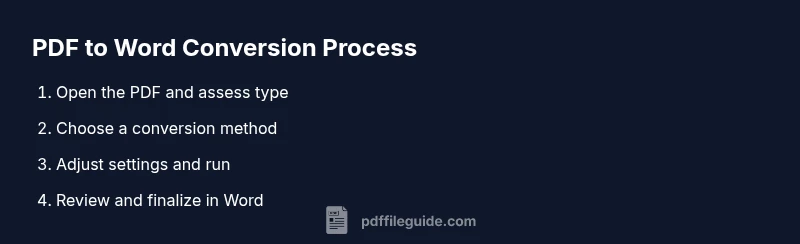
- 1
Open the source PDF
Launch your PDF in a viewer to inspect content and identify sections that may require OCR. If the PDF is large, consider extracting chapters to work piece by piece. Verify language, embedded fonts, and whether layers affect selectable text.
Tip: Note page count and any non-text elements like images that will need separate handling. - 2
Select a conversion method
Choose offline software for privacy, an online tool for speed, or an OCR-enabled workflow for scans. Prioritize the method that matches your PDF type and privacy needs. If unsure, start with the simplest offline option first.
Tip: For sensitive documents, avoid cloud-based tools when possible. - 3
Adjust conversion settings
In the tool’s settings, enable options like preserve layout, retain headings, and embed fonts if available. Disable automatic font smoothing that can alter spacing. Set language and recognition accuracy for OCR if applicable.
Tip: Predefine a target Word template to speed up formatting later. - 4
Run the conversion
Execute the conversion and save the output as a Word DOCX. If processing a long document, save intermediate results to separate files to track changes and recover from any issues.
Tip: Always save a copy of the original PDF before starting. - 5
Review and correct formatting
Open the Word document and check text flow, headings, and list formatting. Reapply styles for consistency, adjust tables, and reinsert images as needed. OCR results may require manual correction of misread characters.
Tip: Use Find and Replace to fix recurring font or spacing issues quickly. - 6
Validate fonts and embed options
Ensure fonts are legible and that the chosen font is available on your system. If necessary, embed fonts in Word to preserve appearance when sharing the document.
Tip: Keep a separate note listing fonts used so others can view or install them. - 7
Save and export a final version
Save a final DOCX, then export a PDF back for verification of layout integrity. Compare both versions to confirm no critical elements were lost in conversion.
Tip: Create a versioned file name that includes the date and method used. - 8
Troubleshoot and try alternatives
If sections are garbled or formatting is off, try a different tool or toggle OCR settings. For highly structured documents, consider a hybrid approach: text extraction followed by manual layout recreation.
Tip: Keep a log of attempts and outcomes to streamline future conversions.
Questions & Answers
What is the best tool to convert PDF to Word?
The best tool depends on your PDF type and privacy needs. Use offline software for sensitive documents and high fidelity on text PDFs; choose OCR-enabled or online tools for scanned PDFs when privacy is less critical.
The best tool depends on your document type and privacy needs. For sensitive files, offline software is usually safest.
Can PDF to Word preserve formatting exactly?
No method guarantees perfect fidelity in every case. Text PDFs convert well, but complex layouts, fonts, and tables may require manual tweaks after conversion.
Not always. Some formatting may require manual adjustments after conversion.
Is OCR required for scanned PDFs?
Yes. OCR is required to convert image-based content into editable text. The quality of OCR determines initial accuracy, which usually needs verification.
Yes, OCR is needed for scanned PDFs to turn images into editable text.
Are free online tools safe for confidential PDFs?
Free online tools can pose privacy risks. If content is sensitive, use offline software or trusted paid services with clear data handling policies.
Online tools can risk privacy — prefer offline options for sensitive documents.
Why is the converted Word document garbled?
Garbled results often come from complex layouts, unusual fonts, or OCR errors. Try a different tool or adjust OCR settings and reformat in Word.
Garbled results usually happen due to fonts or OCR errors; switch tools or tweak settings and rewrite formatting.
Should I keep the PDF after conversion?
Yes. Keeping the original PDF acts as a reference and backup in case you need to re-check content or re-run the conversion with different settings.
Yes, keep the original as a reference and backup.
Watch Video
Key Takeaways
- Choose the right method based on PDF type and privacy needs.
- OCR is essential for image-based scans; expect manual adjustments.
- Preserve formatting by pre-setting Word styles and fonts.
- Always back up the original PDF before converting.
- Verify results by comparing Word output with the source.