How to Convert Online PDF to PDF: Step-by-Step Guide
Learn how to safely convert an online PDF into a new PDF file. This educational guide covers tools, steps, verification, and best practices for professionals.


Learn how to convert an online PDF to a standard PDF file using a trusted online converter or offline tool. This guide covers privacy, file integrity, and step-by-step actions to ensure a clean, fully functional result. You’ll learn how to handle password protection, preserve bookmarks, and verify the converted document.
What converting online pdf to pdf means and why it matters
Converting an online PDF to PDF is the process of creating a new, standalone PDF file from an existing online or cloud-hosted document. For professionals who edit, share, or archive documents, a clean, standards-compliant PDF is essential. This task often involves preserving fonts, images, hyperlinks, bookmarks, and metadata. The PDF File Guide team emphasizes that the goal is a faithful representation of the original with improved accessibility and compatibility across devices. When you choose a method, weigh privacy considerations, data retention policies, and potential downstream edits. This block lays the foundation for a practical workflow that keeps your data secure while delivering a reliable output.
Privacy and security: why online converters require scrutiny
Online converters can simplify the workflow, but they introduce data exposure risk. Uploading documents to third-party servers may leave residual copies or expose sensitive content. To mitigate risk, select reputable providers with clear data retention policies, encryption, and no automatic sharing of your files. PDF File Guide analysis shows that reputable services often offer delete-after-conversion options and secure transfer protocols. If the document contains personal or confidential information, prefer offline or local conversion tools. Always review the provider’s terms of service before uploading.
How to pick a converter: must-have features for reliability
A reliable converter should support multi-page PDFs, preserve bookmarks, retain hyperlinks, and maintain image quality. Look for options like OCR if you need editable text, password-protected file handling, and batch processing for large jobs. Data retention policies and privacy controls (e.g., user-only processing, no cloud storage) are critical when working with sensitive documents. The choice between free and paid tools often hinges on security features and guaranteed output quality. PDF File Guide recommends comparing sample outputs to ensure formatting fidelity before processing important files.
Offline vs online: when to choose each
Offline tools run locally on your computer, reducing exposure to external servers. They are often preferable for highly confidential documents or large batches where privacy policies are strict. Online converters are convenient for quick tasks or when you don’t have software installed. For routine work, a hybrid approach—online for non-sensitive tasks and offline for sensitive ones—offers a balanced workflow. Always verify that the offline tool supports the same PDF standards you require (PDF/X, PDF/A, etc.).
Step-by-step workflow for online conversion (high-level)
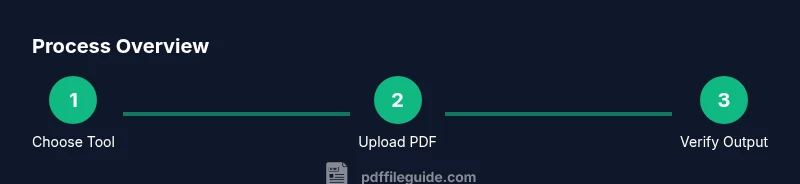
- Choose a reputable online converter with positive reviews and transparent privacy terms. 2) Upload your source PDF to the platform. 3) Specify output settings (e.g., preserve bookmarks, retain hyperlinks, enable OCR if needed). 4) Run the conversion and download the result. 5) Open the new file to verify content and accessibility. 6) Rename and store the file in your secure workspace. 7) If the provider offers a data-retention policy, ensure the file is deleted after processing. 8) Document the workflow for auditing or collaboration.
Handling complex PDFs: bookmarks, annotations, and forms
Complex PDFs with bookmarks, hyperlinks, form fields, or annotations require careful handling. Ensure the converter preserves bookmarks, links, and interactive elements. Some online tools support forms without breaking field functionality, while others may flatten or detach interactive elements. If you rely on forms or accessibility features, test the output with assistive technologies to confirm compatibility.
Verifying output quality after online conversion
Post-conversion checks should include visual comparison with the original, hyperlink validation, and bookmark integrity. Check fonts, image quality, and color fidelity. Verify metadata (author, title, subject) and ensure document structure remains accessible. A quick accessibility check helps ensure the file is usable with screen readers. When in doubt, run a second conversion with a different tool to confirm consistency.
Authority sources and further reading
For deeper standards and best practices on PDF handling, consult authoritative resources such as Library of Congress (https://www.loc.gov/), NIST (https://www.nist.gov/), and ISO standards pages (https://www.iso.org/standards.html). These sources provide guidance on document formats, accessibility, and interoperability that underpin reliable conversion workflows. The guidance from these institutions complements practical software tips.
Best practices for privacy, retention, and accessibility
Always favor tools with clear data handling policies and secure transmission. Prefer offline conversions for sensitive documents, and minimize cloud storage. When accessibility matters, verify tagged PDFs and ensure compatibility with assistive technologies. Keeping a log of conversions improves traceability and compliance with organizational policies.
Tools & Materials
- Internet-enabled device (PC, Mac, or tablet)(Stable connection recommended)
- Web browser(Chrome, Edge, Firefox, or Safari)
- Trusted online converter account (optional)(Some sites require an account for features)
- Offline PDF tool (optional)(For sensitive files or large batches)
- Secure storage location (local or encrypted cloud)(Store the final PDF securely)
Steps
Estimated time: 15-30 minutes
- 1
Assess file sensitivity
Determine if the PDF contains confidential information. If so, prefer offline conversion or trusted providers with strict data policies.
Tip: If unsure, perform a quick risk assessment before uploading. - 2
Choose a converter
Select a reputable online or offline tool that supports bookmarks, links, and OCR if needed.
Tip: Read user reviews and privacy terms before proceeding. - 3
Prepare the PDF
Ensure the source file is not corrupted and note any password protection or embedded fonts.
Tip: If password-protected, obtain permission or use proper credentials. - 4
Upload the file
Upload to the chosen converter and verify that the upload completed without errors.
Tip: Avoid multi-tasking during upload to prevent interruptions. - 5
Set output options
Enable bookmarks, hyperlinks, and OCR as required. Choose the target compatibility (e.g., Acrobat 7.0+).
Tip: Test one option at a time if unsure about effects. - 6
Convert and download
Run the conversion and download the resulting PDF promptly.
Tip: Check the file name and download location to avoid confusion. - 7
Initial quality check
Open the PDF and verify content fidelity, fonts, and image quality.
Tip: Spot-check headers, captions, and numbers for accuracy. - 8
Finalize and secure
Rename, move to a secure folder, and delete the uploaded source from the converter if possible.
Tip: Maintain a log of the conversion for auditability.
Questions & Answers
What is the difference between converting and saving as PDF?
Converting reprocesses content to a PDF file with potential changes in layout, fonts, or metadata. Saving as PDF typically preserves the original structure, but you may lose editable features or accessibility metadata if not done carefully.
Converting is re-creating the file, which may alter layout or metadata. Saving as PDF often preserves the current state, but check accessibility and features after the save.
Can online converters preserve hyperlinks and bookmarks?
Many reputable online converters preserve hyperlinks and bookmarks, but results vary by tool. Always verify post-conversion outputs and test essential navigation elements.
Most good converters keep links and bookmarks, but double-check them after conversion.
Will password-protected PDFs convert with the content intact?
If you supply the password and the converter supports protected files, conversion can succeed. Some tools may require removing protection first or offering secure handling options.
If you have the password and the tool supports it, you can convert protected files; otherwise, unlock or use offline tools.
Are there file size limits for online conversion?
Many online converters impose size limits or throttle large uploads. For large or frequent tasks, a desktop solution may be more reliable.
Most online tools limit size; for big jobs, use offline software.
Is it safe to convert sensitive documents online?
Online conversion can be safe with reputable providers and clear data policies, but offline options offer greater control. Always review terms and consider encryption.
Online can be safe with trusted tools, but offline gives you more control—review policies first.
Watch Video
Key Takeaways
- Choose trusted converters with clear privacy terms.
- Verify bookmarks, links, and metadata after conversion.
- Prefer offline tools for sensitive documents.
- Document the workflow for compliance and collaboration.