Make Image to PDF Online: A Practical Conversion Guide
Learn how to make image to pdf online with secure tools, clear steps, and best practices for preserving quality and accessibility. This guide covers free and paid options, privacy tips, and verification steps.


With a simple online tool, you can make image to pdf online in minutes. This quick answer shows the essential approach, safety considerations, and what to expect from free vs. paid options. You'll learn the core steps, how to choose the right converter, and how to verify the resulting PDF meets your quality and accessibility needs.
What "make image to pdf online" means and why it matters
Converting an image or a collection of images to PDF is a common task for sharing visuals in a stable, universally readable format. When you choose to make image to pdf online, you benefit from convenience, quick results, and the ability to access your files from anywhere. For professionals and students alike, PDFs preserve layout, fonts, and image integrity across devices. According to PDF File Guide, the online conversion landscape ranges from free, fast options to paid tools that offer privacy controls, batch processing, and higher-quality output. This guide will help you decide when an online converter is the right move and how to maximize results while protecting sensitive data.
Top reasons to convert images to PDF online
- Accessibility: PDFs render consistently across platforms and devices.
- Consolidation: Combine multiple images into a single document for easy sharing.
- Portability: PDFs are compact and widely supported on mobile and desktop.
- Accessibility compliance: Some tools offer tagging and text extraction to improve screen reader compatibility.
Common online tools at a glance
Online converters fall into three broad categories: free browser-based services, premium paid platforms, and mobile apps with cloud syncing. Free tools are quick and convenient for casual use, but may impose size limits, watermarks, or occasional performance trade-offs. Paid services often offer batch conversion, privacy assurances, higher resolution, and optional encryption. When selecting a tool, consider file size limits, image formats supported, page orientation options, and whether you need batch processing for future projects. PDF File Guide analysis shows that choosing a trusted provider reduces surprises in output quality and privacy.
Preparing your images before upload
Ensuring your images are in the best shape before converting helps prevent surprises after download. Start with a consistent resolution (roughly 150–300 PPI for screen-friendly PDFs; higher for print), correct orientation, and a predictable order. If possible, rename files to reflect the desired page order (e.g., 01_Title, 02_License). Where relevant, crop extraneous borders and remove metadata you don’t need. Keeping the original source images in a dedicated folder makes it easier to reorder during the online conversion process. This preparation saves time and helps you avoid repeated re-uploads.
Step-by-step: converting a single image online
- Pick a trusted online converter with good reviews and clear privacy terms. 2) Upload your image in the intended orientation. 3) Review page size (A4, Letter, etc.) and any compression settings. 4) Execute the conversion and download the PDF. 5) Open the PDF to verify fidelity, color accuracy, and page dimensions. 6) Rename the file to a meaningful title. 7) If needed, repeat with additional images to create a multi-page PDF.
Tip: Always preview the first page after upload to ensure correct orientation and colors before completing the conversion. If you notice issues, cancel the session and try another reputable tool. The PDF File Guide recommends verifying output in both a desktop PDF viewer and a browser-based reader for consistency.
Batch conversion: multiple images into one PDF
Batch conversion lets you select several images and produce a single document. Start by sorting the images in the intended order, then upload them in that sequence. Most converters provide options to adjust page size, margins, and image fitting. After processing, download the combined PDF and review each page for alignment and consistency. If you need a specific front cover, include a title slide in your first image. This workflow is popular for portfolios, event photos, and project reports. PDF File Guide emphasizes checking the final file for any missing pages or corrupted images.
Quality, compression, and color management
Image-to-PDF output quality depends on the source resolution and the converter’s compression. High-resolution originals preserve detail but yield larger file sizes; aggressive compression saves space but may blur fine text or sharp edges. If color accuracy matters, select
or
depending on the tool. For archival projects, consider lossless compression or higher DPI settings. When possible, test output on multiple devices to ensure the appearance remains consistent across screens. Remember that some online converters strip EXIF data; if metadata matters, choose a tool that preserves it or add it later.
Accessibility and metadata considerations
A PDF that serves as a document for wide audiences benefits from accessibility features. If you convert images to PDF with accessibility in mind, consider tagging pages, adding alternative text to images, and including a simple reading order. Some online converters offer basic tagging; more advanced workflows may require a dedicated PDF editor. PDF File Guide notes that accessibility improvements are more likely when you start with well-structured images and provide descriptive filenames for screen readers.
Security and privacy when using online converters
Uploading images online carries privacy considerations. Use reputable services with transparent privacy policies, preferably those that delete uploads after processing. If the content is sensitive (contracts, IDs, personal data), prefer offline or desktop tools. Some services offer encryption in transit and at rest; others do not. Always read the terms, and consider using temporary or non-sensitive test images when evaluating a service. PDF File Guide suggests verifying the service’s data retention policy and reviewing user reviews for hints about data handling.
Verifying your final PDF: what to check
After downloading, verify that the PDF has the correct page order, image fidelity, and color accuracy. Open the file in multiple viewers to ensure consistent rendering. Check that all images are present and sharp, and that any text overlays or captions appear legibly. Confirm file size is reasonable and that the document is not password-protected unless needed. If you used batch conversion, skim pages to confirm none are cropped or misaligned. If you spot issues, re-run the conversion with adjusted settings or try a different converter.
When to use offline or desktop tools
For high-security needs or large volumes, offline tools can be preferable. Desktop applications often provide stronger privacy controls, advanced compression options, and batch processing without uploading files to the cloud. If you frequently convert images to PDF for print-ready documents, a desktop workflow paired with a professional PDF editor gives you more control over color profiles, page layouts, and accessibility tagging. PDFs created offline can later be shared via secure channels or stored in an on-premises archive, reducing exposure to online services.
Quick-use checklist and best practices
- Preview output on at least two devices to confirm rendering.
- Choose a reputable converter with clear privacy terms.
- For sensitive content, prefer offline tools when possible.
- Keep an organized source folder and consistent naming.
- Verify that multi-image PDFs maintain the intended order.
- Consider accessibility options if the PDF will be used publicly or by assistive technologies.
How to decide between free vs. paid online converters
Free online converters are great for quick, one-off tasks or light usage. They often impose file-size limits, watermarks, or reduced image quality on outputs. Paid converters or premium plans typically remove limits, improve compression, provide batch processing, stronger privacy controls, and direct support. If you regularly convert images to PDF for professional documents, a paid option can save time and reduce risk, especially for files containing sensitive information. PDF File Guide advises weighing cost against reliability and privacy features when choosing a plan.
Tools & Materials
- A computer or smartphone with internet access(To access online converters and download PDFs.)
- A modern web browser (Chrome, Firefox, Safari, Edge)(Ensure it is up to date for best compatibility.)
- Images in JPG/PNG format(Aim for high resolution (at least 1200 px wide) for better PDF quality.)
- Optional: a dedicated PDF viewer or editor(Useful for quick checks and minor edits after conversion.)
- Optional: a paid online converter for batch or privacy features(Consider if you need higher privacy or batch processing.)
Steps
Estimated time: 30-60 minutes
- 1
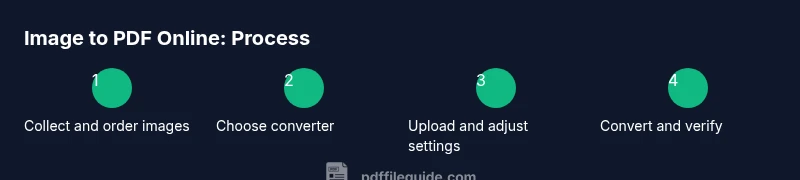
Collect and organize images
Gather all images you want to include and arrange them in the exact order you want in the final PDF. Rename files to reflect the sequence (e.g., 01_Intro, 02_Summary).
Tip: A clear naming convention reduces chance of misordering during upload. - 2
Choose a trusted online converter
Select a reputable tool with transparent privacy terms, upload limits that fit your needs, and clearly stated output options.
Tip: Read privacy terms before uploading sensitive content. - 3
Set page size and orientation
Decide if you want A4, Letter, or another size, and choose the orientation (portrait or landscape) for each page as needed.
Tip: Mismatched orientation can crop important details. - 4
Upload images in order
Upload the images in the exact sequence you planned. Some tools allow drag-and-drop for easier ordering.
Tip: Double-check the order before proceeding to convert. - 5
Adjust compression and quality
If available, adjust image quality or compression to balance file size and clarity. Higher quality increases size.
Tip: Preview a sample page before converting the entire batch. - 6
Convert and download the PDF
Execute the conversion and save the resulting PDF to your device. Prefer a descriptive filename.
Tip: If the tool offers password protection, decide if you want added security. - 7
Verify the final document
Open the PDF in a viewer and check each page for clarity, order, and margins. Ensure accessibility elements where needed.
Tip: Test on multiple devices or apps for consistency. - 8
Optional: reorder or re-run
If you发现 issues, reorder files and re-run the conversion, or try another tool for the same task.
Tip: Keep a copy of the original images in case you need to redo.
Questions & Answers
What is the easiest way to make an image into a PDF online?
The easiest way is to pick a reputable online converter, upload your image(s), confirm page settings, and download the PDF. Start with a single image to see how the tool handles quality and orientation, then extend to multiple images if needed.
Use a trusted online converter, upload your image, check the page settings, and download the PDF to get started.
Will online image-to-PDF converters keep my data private?
Privacy varies by service. Choose tools with clear privacy policies, data deletion after processing, and encryption in transit. If you’re handling sensitive content, prefer offline conversion.
Privacy varies by service; check the policy and opt for offline options for sensitive files.
Can I convert multiple images into a single PDF?
Yes. Most online converters support batch uploads to create a single multi-page PDF. Arrange images in the desired order before uploading, then review the final document carefully.
Yes, you can combine several images into one PDF by batch uploading and ordering them before converting.
What image formats are supported by online converters?
Common formats like JPG and PNG are widely supported. Some tools also accept GIF, BMP, or TIFF. Check the tool’s supported formats before starting.
Most online converters support JPG and PNG; some also support GIF, BMP, or TIFF.
Is there a size limit for online conversions?
Many free tools impose size limits per file or per batch. If you exceed the limit, try a paid plan or compress images before upload.
Free tools often have size limits; consider upgrading or compressing large images if needed.
Can I do image-to-PDF conversion on mobile?
Yes. Many services offer mobile-friendly sites or apps. Ensure you have a stable connection and enough storage for the resulting PDF.
Absolutely—use a mobile browser or app to convert images to PDF on the go.
Watch Video
Key Takeaways
- Choose a trusted online converter to protect privacy.
- Prepare images with consistent size and order before upload.
- Always verify the final PDF across devices for consistent rendering.
- Use offline tools for highly sensitive or large-volume conversions.
- Keep a clear naming convention to simplify batch workflows.