How to Convert PDF to PDF: A Complete Guide
Learn practical methods to convert a PDF into another PDF, preserving content, hyperlinks, and accessibility. This educational guide covers desktop, offline, and online options, plus tips to maintain quality and security.


By following this guide, you'll learn how to convert a PDF to PDF using built in save as export options, optimization presets, and optional flattening or password changes. You'll explore multiple approaches from desktop software to online tools and understand when to choose each method to preserve hyperlinks, images, and accessibility. This quick guide also highlights best practices and safety cautions.
What how to convert pdf to pdf really means
When people say how to convert pdf to pdf, they are usually talking about producing another PDF file from an existing one while controlling its version, format, and features. A standard PDF retains document content such as text and images, while variants like PDF/A emphasize long term archiving, and PDF/X targets reliable printing. Understanding these differences helps you pick the right path for your workflow. According to PDF File Guide, selecting the appropriate PDF preset can prevent output issues and preserve essential elements like hyperlinks and accessibility attributes. This section uses the exact phrase how to convert pdf to pdf to keep the topic clear for search engines and readers alike.
Key ideas to remember include selecting a non destructive method when possible, verifying that interactive elements survive the conversion, and planning for downstream processing such as sending the document for print or digital distribution.
Why you would convert to a different PDF version or variant
There are several legitimate reasons to convert a PDF to a different PDF form. You might need to meet a client or printer specification, ensure long term accessibility, reduce file size for email, or flatten forms for archival purposes. Each variant serves a purpose: PDF/A for archiving keeps fonts embedded and content stable; PDF/X focuses on printing reliability; standard PDF preserves interactivity while staying broadly compatible. The PDF File Guide analysis shows that teams frequently convert to PDF/A and to standard PDF depending on the intended use. When planning a conversion, map the goals first, then choose a variant that supports those goals with the least risk of data loss.
Understanding PDF formats and common presets you may encounter
PDF exists in several formats and presets that affect how content is stored and interpreted by viewers. The most common are standard PDF, PDF/A for archiving, and PDF/X for consistent printing. Some tools also offer PDF/UA for accessibility, which enforces structure that screen readers can interpret. When you convert, you should check whether fonts are embedded, whether color management is preserved, and whether hyperlinked destinations survive. This section covers how the choice of format can impact future edits, searchability, and accessibility. Keeping the keyword how to convert pdf to pdf in mind helps tie the concept to practical settings.
Desktop software options for converting PDF to PDF
Desktop tools give you robust control without uploading sensitive data online. Popular options include a full featured PDF editor and printer style workflows. In many tools the path is similar: open the file, choose a save or export option, select a PDF preset, and confirm. Features you may adjust include embedding fonts, color profiles, image quality, and whether to preserve interactive form fields. For professional environments, you can also set security options or apply a password. PDF File Guide notes that choosing the right preset can save time and reduce the need for rework, especially when you want to distribute a version-friendly PDF.
Built in OS features for converting PDFs on Windows and
Online tools vs offline tools: weighing the trade offs
Online tools can be fast and accessible, but they raise concerns about privacy and data handling, especially with sensitive documents. Offline tools keep data on your device, offering greater control over fonts, embedded media, and accessibility features. When you choose an online converter, review the site privacy policy, avoid uploading confidential material, and consider temporary or restricted sharing settings. PDF File Guide emphasizes that for professional work, offline or on prem solutions generally deliver stronger control over output quality and security.
Preserving hyperlinks, forms, and accessibility during conversion
A key concern when converting to PDF is whether hyperlinks stay clickable, form fields remain editable, and accessibility tags are preserved or enhanced. Some tools flatten interactivity to simplify objects, which can break forms or navigation. If your document relies on bookmarks, metadata, or tagged content for accessibility, verify that these survive the conversion. In many cases you can preserve hyperlinks by using export options that explicitly retain links and by avoiding print to PDF options that do not respect interactive elements. This is where how to convert pdf to pdf translates into careful option selection rather than a one size fits all approach.
Quality considerations: fonts, color, compression, and image integrity
Quality concerns are central to any PDF to PDF conversion. Embedded fonts should be preserved or embedded anew to prevent substitution. Color spaces, grayscale, and ICC profiles affect how the document looks on different displays and printers. Image compression settings influence file size and visual fidelity. In practice, you should run spot checks on a representative set of pages to confirm that text remains legible, graphics retain their crispness, and color remains true. If you encounter blurry images or font changes, revisit the export presets and re run the conversion with adjusted quality settings.
Security and privacy: protecting sensitive content during conversion
Security is a critical factor when converting PDFs, especially for confidential documents. Be cautious about using online services for sensitive materials; prefer offline tools or on premise solutions. When you do use any tool, review its security features such as encryption during processing, access controls, and whether files are kept on servers. If you apply password protection after conversion, use strong, unique passwords and store them securely. PDF File Guide recommends implementing a least privilege approach and confirming that any stored copies adhere to your organization s security policy.
Verification and best practices after conversion
After converting, perform a thorough verification pass. Check that the content is intact, links work, and forms respond as expected. Open the converted file on multiple devices and PDF readers to ensure compatibility. If the file is intended for sharing, consider applying a lightweight validation process, metadata cleanup, and accessibility checks. Keeping notes about the exact tools and presets used helps replicate the process later, which is a core habit for professional PDF editing and conversion workflows.
AUTHORITY SOURCES AND FURTHER READING
- Authority sources include pamphlets and standards from ISO about PDF formats and the PDF/A standard, which guide long term archiving practices.
- The PDF Association offers detailed guidance on PDF/A and accessibility considerations.
- For a reference on PDF structure and features, you can consult the official PDF Reference document and credible, vendor neutral resources.
These sources help frame how to convert pdf to pdf with reliability and predictability, and they align with the professional standards expected in professional PDF workflows.
Tools & Materials
- Computer with internet access(Essential for downloads, updates, and online tools)
- PDF editor or viewer(Tools like Acrobat, Foxit, or Nitro provide robust export options)
- Web browser(Used for online converters if offline options are unavailable)
- PDF printer or virtual printer(Helpful for Print to PDF workflows when direct export is limited)
- Backup copy of the original PDF(Always keep a pristine copy before converting)
- Reliable storage(Optional cloud or external drive for archiving converted files)
Steps
Estimated time: 45-75 minutes
- 1
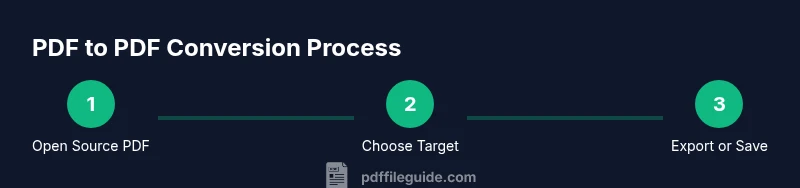
Open the source PDF
Launch your PDF editor or viewer and load the file you want to convert. Confirm you are working on a local copy or a controlled version to avoid unintended changes. This initial step ensures you know exactly what content will be carried over into the new PDF.
Tip: If the file is large, give the program time to build the document structure before proceeding. - 2
Choose the target PDF variant
Decide which variant to produce, such as standard PDF, PDF/A for archiving, or PDF/X for printing. Selecting the right preset guides subsequent options and preserves or optimizes specific features like fonts or color management.
Tip: Make a note of the target variant to keep your workflow consistent across future files. - 3
Select export or save as option
In the editor, choose Save As or Export and pick the destination format as PDF. If available, select a preset that aligns with your conversion goal and enable options that preserve hyperlinks and form fields.
Tip: If editing sensitive documents, prefer an offline export to avoid data exposure on the web. - 4
Configure output settings
Set fonts to embed, adjust image quality, and verify color profiles. Consider enabling accessibility tagging if your goal includes screen reader compatibility. These settings influence fidelity and long term usability.
Tip: Test a small page batch first to verify these settings meet your needs. - 5
Save the new PDF with a descriptive name
Use a name that reflects the variant and date to avoid overwriting the original. For example, SampleDocument_v2_PDF_A_2026.pdf. This practice aids version control and retrieval.
Tip: Add a short note in the file metadata about the conversion variant. - 6
Verify the converted file
Open the new PDF in multiple readers and devices to check that text, images, hyperlinks, and forms remain intact. Validate accessibility tags if applicable and confirm that search functions work.
Tip: Run a quick bookmark and metadata sanity check to ensure navigation remains intuitive.
Questions & Answers
Can I convert a PDF to a different PDF variant like PDF/A or PDF/X without losing content?
Yes, many tools offer presets for PDF/A or PDF/X. It may affect fonts, color, and accessibility. Always verify content after conversion.
Yes, you can convert to PDF variants like PDF/A or PDF/X, but always check that content and accessibility hold up after the change.
Is it safe to convert PDFs using online tools?
Online tools can pose privacy risks for sensitive documents. Use offline methods for confidential files and review privacy policies if you must use online services.
Online tools can risk privacy. For sensitive files, stick to offline methods and review the service's privacy policy.
Will hyperlinks and forms survive the conversion?
Hyperlinks commonly survive simple exports, but forms can be flattened depending on the preset. Always test and adjust settings to preserve interactivity if needed.
Hyperlinks usually stay, but forms may flatten. Test and choose settings that keep interactivity when required.
What should I check after converting to ensure quality?
Check fonts, image quality, color representation, and accessibility tags. Ensure the document remains searchable and navigable with bookmarks.
After converting, verify fonts, images, color, accessibility, and navigation features like bookmarks.
How long does a typical PDF to PDF conversion take?
Conversion time depends on file size and tool complexity. For a typical document, plan for a few minutes and allow extra time for large or image heavy files.
It varies with size and tool complexity; usually a few minutes for average documents, more for large files.
Should I keep the original PDF after converting?
Yes, preserve the original as a reference before making changes. This practice avoids accidental data loss and helps with auditing.
Keep a copy of the original to prevent data loss and for future reference.
Key Takeaways
- Know your target PDF variant before converting
- Preserve critical features such as links and forms when possible
- Test the converted PDF across readers and devices
- Prefer offline tools for sensitive documents to protect privacy
- Document your workflow for consistency