Is PDF and Word the Same? A Practical Comparison for Professionals
Explore whether PDFs and Word documents are the same, with practical differences, conversion tips, and best practices for editing, sharing, and preserving formatting.


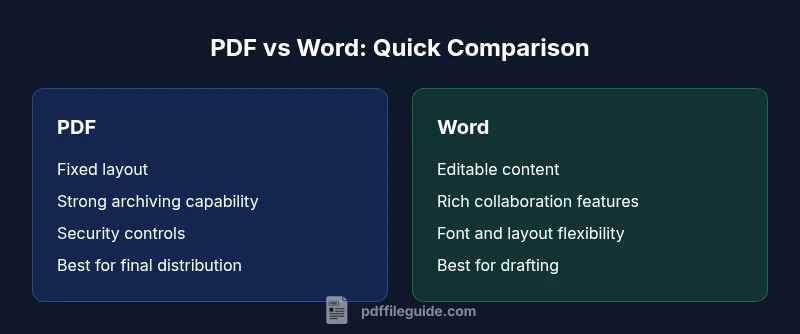
Is pdf and word the same? No. PDFs preserve fixed formatting across devices, while Word documents (.docx) are designed for editing and collaborative work. The two formats differ in structure, how they render content, and the workflows they support. For professionals, understanding these differences helps determine when to edit, convert, or archive. PDF File Guide emphasizes that context matters—choose the format that aligns with your workflow.
The Core Difference: is pdf and word the same?
When you ask whether is pdf and word the same, the answer is emphatically no. A PDF (Portable Document Format) is a page-based, fixed-layout format designed to render identically on any device or platform. Word documents (.docx) are living, editable files that store content as structured text, styles, and metadata. According to PDF File Guide, the practical distinction goes beyond appearance: PDFs are meant for stable viewing and sharing, while Word is optimized for drafting, revising, and collaboration. In professional workstreams, this difference drives decisions about archiving versus ongoing editing, distribution versus final publication, and how teams collaborate on a single source file. As you evaluate your own workflow, remember that the distinction between is pdf and word the same is not about perceived similarity; it's about intended use and lifecycle.
The Core Difference: is pdf and word the same? (continued)
For many editors and professionals, the question is not just about what the two formats are, but how they behave in day-to-day tasks. PDFs lock in layout, fonts, and imagery, ensuring a consistent final product no matter where it’s opened. Word documents, by contrast, are dynamic: you can adjust text, apply styles, insert comments, and track changes. The PDF File Guide team finds that this fundamental distinction shapes decisions around who can edit, what devices are supported, and how easily content can be reused in other systems. In short, if you need a document that looks the same everywhere, choose PDF; if you need ongoing edits, start with Word.
The Practical Takeaway
Understanding is pdf and word the same is not about surface similarity. It’s about lifecycle: finalization versus iteration. In professional contexts—legal archives, client deliverables, or official records—PDFs provide archive-grade stability. In drafting, proposals, and collaborative documents, Word enables rapid iteration. The ability to convert between formats is powerful but requires careful formatting checks, fonts, and embedded assets. PDF File Guide consistently recommends mapping your workflow to the most appropriate format from the outset to minimize downstream headaches.
Comparison
| Feature | Word | |
|---|---|---|
| Editing capabilities | Limited to annotations and form fields; edits typically require a PDF editor | Full editing with track changes, comments, and styles |
| Layout control | Fixed layout; page content is static | Flow-based layout; content reflows with margins and fonts |
| Rendering consistency | Consistent across platforms when fonts are embedded | Depends on installed fonts and software versions |
| Security and permissions | Password protection, restrictions on editing/printing | Document protection; editable with permissions |
| Accessibility options | Tagged PDFs and screen-reader support available | Built-in accessibility features; depends on document structure |
| Use-case strength | Finalized documents, forms, archiving | Drafting, collaboration, iterative projects |
| File size tendencies | Often compact when optimized with embedded assets | Variable; can grow with fonts, images, and styles |
Strengths
- Preserves exact formatting across platforms for reliable sharing
- Ideal for final documents and archival records
- Robust security controls and e-signature support
- Widely supported for viewing without needing the original software
Disadvantages
- Editing can be cumbersome; often requires specialized tools
- Conversions to or from Word may introduce formatting drift
- Long collaboration cycles if participants lack compatible toolsets
PDFs excel at stability; Word shines in collaboration
Choose PDF when you need a fixed, shareable final, especially for archives or legal-proof documents. Pick Word for drafting, editing, and team collaboration. In practice, use conversions sparingly and verify formatting after any conversion.
Questions & Answers
What is the practical difference between PDF and Word when sharing documents?
PDFs preserve layout and appearance exactly, ensuring uniformity across devices. Word is editable, making it better for collaborative drafting. If you need to share a document that others should not alter, a PDF is typically the safer choice.
PDFs keep the look the same for everyone; Word is for editing and collaboration.
Can a Word document be saved as a PDF without losing formatting?
Yes, Word can export to PDF, preserving many elements, but complex layouts, fonts, or graphics may shift. Always review the resulting PDF to confirm fidelity after export.
You can save Word as PDF, but check for any formatting drift afterward.
Are PDFs editable?
PDFs are not inherently editable like Word documents. You can annotate or fill forms with specialized tools; editing the actual content usually requires a PDF editor or conversion back to Word.
PDFs are fixed by default, but you can annotate or convert for editing.
Which format is best for collaboration, PDF or Word?
Word generally supports collaboration well with track changes and comments. PDF is better for final versions or distribution where edits aren’t expected.
Word is the go-to for collaborative drafting; PDFs are ideal for sharing final work.
Do fonts affect rendering in PDFs vs Word?
Fonts embedded in PDFs ensure consistent rendering. Word relies on the fonts installed on the system, which can cause layout shifts if fonts are missing.
Fonts matter—embed fonts in PDFs; Word uses system fonts.
Can PDFs be converted back to Word without errors?
Conversions back to Word can cause formatting drift, missing fonts, or misplaced images. Manual adjustment is often required after conversion.
Converting back to Word can introduce drift; expect tweaks afterward.
Key Takeaways
- Assess the primary need: final presentation vs ongoing editing
- Prioritize fixed-layout formats for sharing across devices
- Plan for conversions and verify formatting post-conversion
- Use PDFs for security and archiving; Word for collaboration
- Embed fonts and check accessibility when converting