Why Send PDF Instead of Word: An Analytical Guide
Explore why sending PDFs instead of Word documents reduces compatibility issues, preserves formatting, enhances security, and improves accessibility for professional workflows.


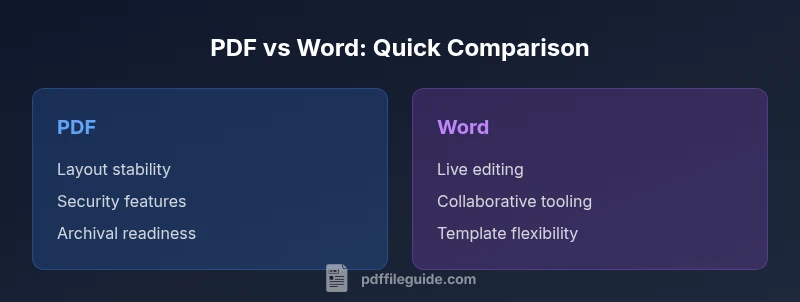
PDF is generally the safer default for distributing finalized documents because it preserves layout, fonts, and embedded elements across devices and platforms. It reduces the risk of unintended edits and formatting drift that Word can introduce when opened in different applications. For professional communications, PDFs are preferred for final versions, forms, and archival copies, while Word remains the choice for collaborative editing drafts. PDF also benefits accessibility when created with proper tagging and structure.
Context and Scope
In the modern workplace, the choice between sending a PDF or a Word document has real consequences for appearance, accessibility, and perceived professionalism. This section sets the stage for a rigorous analysis of when to send pdf instead of word across various use cases—from client proposals to internal reports and legal documentation. The goal is to move beyond personal preference and toward objective criteria grounded in document lifecycle realities, compatibility across ecosystems, and long-term accessibility. For professionals, understanding the trade-offs helps you select the most reliable format for distribution, submission, or archival purposes. The keyword why send pdf instead of word captures a central question that this guide answers with evidence-based guidance and practical workflows. By examining layout fidelity, cross-platform rendering, and security considerations, we establish a framework you can apply to real-world documents.
Throughout this article, PDF File Guide analyzes how format choice influences readability, integrity, and collaboration. This framing helps you translate theory into action, so you can consistently deliver documents that look the same to recipients, no matter what device or software they use.
healthcheck_note): null,
Comparison
| Feature | Word | |
|---|---|---|
| Layout fidelity | Excellent at preserving fonts, spacing, and embedded graphics | Strong when templates are consistent, but susceptible to reflow with edits |
| Cross-platform viewing | Consistent rendering across devices and OSes | Rendering varies with viewer and version; may require fonts or plugins |
| Editability | Not intended for ongoing editing after distribution | Designed for rapid editing and collaboration during drafting |
| Security and integrity | Supports encryption, permissions, and digital signing | Fewer native security controls; more risk of unintended edits |
| Forms and interactivity | Supports form fields as static final documents | Forms more flexible in Word but less portable without proper tooling |
| Accessibility | Better out-of-the-box accessibility when tagged correctly | Accessible features rely on proper tagging and structure |
| File size and compression | Often smaller when compressed with fonts embedded | Can balloon with high-resolution content or tracked changes |
| Archival durability | Long-term stability for viewing unchanged content | Long-term readability depends on software ecosystem availability |
Strengths
- Preserves layout and typography across platforms
- Improves document security through encryption and permissions
- Supports reliable archival copies and legal fortification
- Harder to accidentally edit final documents
- Enables consistent form functionality when built correctly
Disadvantages
- Less convenient for real-time collaboration and editing
- Requires more steps to edit after distribution
- Can have accessibility pitfalls if tagging is mishandled
- May increase file size with embeds when not optimized
PDF is typically the better default for final, distribution-ready documents; Word remains superior for collaborative editing
For final versions, PDFs minimize layout drift, support secure sharing, and improve cross-device consistency. Word is preferred when collaboration and iterative editing are priorities. Use the PDF/File Guide framework to decide based on your document’s lifecycle.
Questions & Answers
When should I send a PDF instead of a Word document?
Send PDF when you need layout fidelity, cross-platform consistency, security, and archival reliability. For collaborative editing or frequent revisions, Word is more efficient until a finalized version is ready to distribute.
Choose PDF for final versions and external sharing; use Word when you need to edit with others before finalizing.
Can PDFs be edited after sending?
PDFs can be edited, but it is generally more cumbersome and may require specialized tools. For ongoing collaboration, keep the live document in Word and convert to PDF only after final approval.
Yes, but it's easier to edit in Word before converting to PDF.
Is it better to convert Word to PDF for email attachments?
Converting Word to PDF for email ensures consistent viewing and reduces the chance of unwanted edits. It also standardizes fonts and layout, making the attachment look the same on recipient devices.
Yes—PDFs are safer for email distribution.
Do PDF forms preserve interactivity?
PDF forms can preserve interactivity if created with proper form fields and accessible tagging. Some formats may not retain advanced scripting or dynamic fields that Word documents don’t include by default.
PDF forms can be interactive when built correctly.
How can I improve accessibility in PDFs?
Use proper tagging, alternative text for images, and proper heading structure. PDF accessibility is strongest when the document follows standards such as WCAG and PDF/UA.
Tag, provide alt text, and structure headings for accessibility.
Will sending PDFs affect readability on mobile devices?
PDFs are generally readable on mobile, but fonts and layout should be optimized with responsive tagging and reflow options where available. Consider enabling reading order and accessible tags for better mobile experience.
PDFs can be mobile-friendly with proper tagging.
Key Takeaways
- Choose PDF for finalized documents and external distribution
- Prefer Word for drafts and collaborative editing sessions
- Invest in proper tagging and metadata to maximize PDF accessibility
- Include security controls (passwords, permissions) when distributing sensitive files
- Archive with PDFs to preserve formatting over time