World to Convert PDF: A Practical Conversion Guide
Learn practical methods to convert PDFs across formats—Word, Excel, images, and more—while preserving layout and accessibility. This guide covers desktop, online tools, OCR, and verification best practices from PDF File Guide.


Goal: convert PDFs efficiently across common formats such as Word, Excel, images, and editable forms. This quick guide outlines practical, step-by-step methods using desktop software, online converters, and built-in features, plus best practices for preserving layout, fonts, and accessibility. Whether you’re editing reports, invoices, or manuscripts, you’ll gain reliable workflows, quality checks, and clear decisions about when to choose each method.
Why world to convert pdf matters
We live in a document-driven world where teams need to reuse information across apps. The phrase world to convert pdf captures the demand to move content from static PDFs into editable formats. According to PDF File Guide, reliable conversion is foundational for collaboration, archival, and compliance. The right workflow reduces manual retyping, speeds approvals, and ensures that data, tables, and images remain legible after the transition. When you plan a conversion, define your target formats, required tolerances, and whether OCR is necessary for scanned pages. A thoughtful approach saves time and preserves data integrity across departments.
Popular conversion targets and when to use them
Common conversion targets include Microsoft Word for editing text, Excel for data in tables, and image formats for sharing when fidelity to the visual layout is critical. For long reports with mixed elements (text, tables, charts), Word often provides the best editability, while Excel shines for structured data. If collaboration is external or archiving is the primary goal, PDF or image formats can be appropriate for stable records. When you need to preserve visual fidelity or prepare content for web publication, consider HTML or image exports. Always test multiple targets to identify which preserves details like fonts and table structures most accurately.
Quality factors to watch during conversion
Key quality factors include font fidelity, layout stability, and image integrity. Fonts should render consistently; embedded fonts help, but some tools may substitute fonts, altering the look. Layout fidelity concerns margins, columns, and whitespace; complex multi-column pages can lose alignment during conversion. Images should remain clear and properly scaled, not pixelated. Color accuracy and readability also matter, especially for accessibility. When possible, run a side-by-side comparison between the source and output to catch subtle drift in spacing or line breaks.
Desktop vs online tools: making the choice
Desktop tools offer stronger privacy, offline processing, and often better handling of large files or sensitive data. Online converters can be faster for quick tasks or when you don’t have a full software suite installed. Consider file size limits, OCR capabilities, and the ability to batch-convert. For professionals handling confidential documents, prioritize offline workflows or trusted enterprise services. PDF File Guide emphasizes evaluating tool reliability, feature sets, and user reviews before committing to a single solution.
A robust workflow: from PDF to editable formats
A dependable workflow starts with planning, then selecting the right tool for the target format. Start by preparing your PDF (remove passwords, ensure legibility), then perform a test conversion with two methods if precision is critical. Compare outputs for text accuracy, table structure, and image quality. Make iterative adjustments (font embedding, layout tweaks, and re-running OCR if needed) until the result meets your standards. Document the chosen method for future reference and ensure the final files are stored with clear naming and versioning.
Special cases: scanned PDFs and forms
Scanned PDFs require OCR (optical character recognition) to become editable. The accuracy of OCR depends on the scan quality, language settings, and the tool’s OCR engine. For forms, active fields may be preserved if the right export option is used; otherwise, you may need to recreate or reflow form fields in the target app. When dealing with sensitive forms, ensure the OCR process respects data privacy and redact any unnecessary content before sharing.
Accessibility considerations in conversions
Accessible output means preserving or enhancing structure, headings, alternative text for images, and logical reading order. When converting, enable features that generate tagged PDFs or accessible Word/HTML equivalents. After conversion, verify screen-reader friendliness by navigating with a keyboard and using assistive tech to confirm the reading order and context remain intact. Document any accessibility trade-offs and plan corrective steps if needed.
How to verify results and fix issues
Verification should be systematic: check headings, lists, tables, and imagery, then test critical data like numbers and dates. Validate that hyperlinks and bookmarks transfer correctly and that the document remains searchable. If issues arise, adjust the source layout or tool settings, re-run conversions, and compare results until the output aligns with expectations. Keep a changelog to track improvements across attempts.
Tools and resources for conversion
A range of tools support PDF conversion, from full-featured editors to lightweight online services. Choose tools that offer OCR, batch processing, and reliable export formats. For ongoing work, invest time in setting up templates and automation scripts to streamline repetitive conversions. The PDF File Guide team recommends practicing with a sample set of documents to calibrate your chosen workflows before applying them to production content.
Tools & Materials
- PDF viewer/editor(e.g., Adobe Acrobat Pro, Foxit or similar software)
- Word processor(e.g., Microsoft Word, Google Docs)
- Spreadsheet editor(e.g., Microsoft Excel, Google Sheets)
- OCR-enabled conversion tool(Use when dealing with scanned PDFs)
- Quality-check checklist(A short list of validation steps for each format)
- Internet connection(Needed for online converters and cloud storage)
Steps
Estimated time: 60-120 minutes
- 1
Define your target format and quality goals
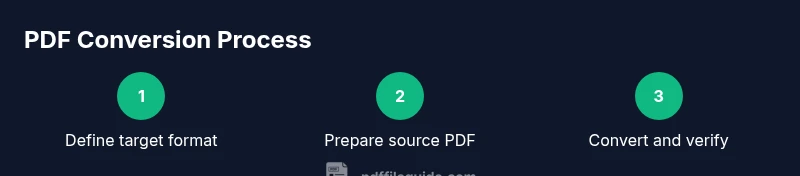
Determine the final format (Word, Excel, image, HTML) and the required fidelity level for text, tables, and visuals. This guides tool choice and OCR needs, preventing unnecessary steps later.
Tip: Document the expected deliverable and success criteria before starting. - 2
Prepare the source PDF for conversion
If the file is password-protected, unlock it or request access. Ensure pages with important data are legible, and note any color or high-contrast elements that may need adjustment after export.
Tip: Make a backup copy before making changes. - 3
Choose the right conversion method
Select a tool or service aligned with your target format. For complex layouts, run parallel tests with two methods to compare results and pick the best output.
Tip: Prefer offline tools for sensitive content and batch online tools for quick, non-confidential tasks. - 4
Convert and review the output
Run the conversion, then inspect text accuracy, table alignment, and image quality. Note any discrepancies and prepare to adjust settings or re-run the export.
Tip: Use side-by-side comparison to catch subtle changes. - 5
Address issues and adjust formatting
Tweak fonts, spacing, and table structures in the target app. Re-export if needed and validate again against the source.
Tip: Embedding fonts can improve consistency across devices. - 6
Secure, store, and document the finished files
Store outputs in a structured folder with versioning and clear naming conventions. Document the chosen workflow for future conversions.
Tip: Keep sensitive files on secure storage and limit sharing.
Questions & Answers
What is the best method to convert a PDF to editable formats?
The best method depends on the target format and document complexity. Start with a trusted desktop tool for accuracy, then validate results in the target app. If you need mass conversion, batch processing and OCR can save time, but always verify fidelity.
Use a trusted desktop tool first, then check the output for accuracy. For large jobs, batch processing helps, but always verify the results.
Can scanned PDFs be accurately converted to Word or Excel?
Scanned PDFs require OCR to become editable. The accuracy depends on scan quality, language, and the OCR engine. Expect minor errors and plan for manual corrections after conversion.
Yes, with OCR but expect some errors you’ll need to fix after the conversion.
How do I preserve fonts and layout during conversion?
Choose tools that support font embedding and layout retention. Verify font rendering and adjust margins, columns, and spacing post-conversion. For critical documents, perform a second pass with adjusted settings.
Embed fonts if possible and check layout; you may need to tweak margins after converting.
Is it safe to use online conversion tools for sensitive documents?
Online tools can be convenient but pose privacy risks. Avoid sharing confidential or regulated data. Prefer offline software or reputable, enterprise-grade services with strong data handling policies.
Online tools are convenient but can risk sensitive data; use offline options for confidential documents.
Which formats support formulas or tables best after conversion?
Word and Excel excel at handling editable content, formulas, and structured data. For tables, Excel preserves numeric data; Word can handle mixed content but may need formatting adjustments.
Excel is best for tables and formulas; Word works for mixed content with some formatting tweaks.
How do I convert a password-protected PDF?
You must unlock or remove the password with proper authorization before converting. If you cannot unlock it, you’ll need a source file without restrictions or obtain access rights.
Unlock the PDF with proper authorization, then convert. If you can't unlock, get access or a non-protected version.
What should I do if the output loses colors or images?
Check the export settings for color profiles and image compression. Re-export with higher quality settings or use a different tool to preserve visuals more accurately.
If colors or images degrade, adjust export quality or try another tool.
Watch Video
Key Takeaways
- Plan before you convert to set success criteria.
- Test multiple tools to choose the best fit for your content.
- Check fonts, tables, and images for fidelity after export.
- Document workflows and maintain secure storage for outputs.